
 A vibrant look reflecting strong connections from its farmer-owners to the global marketplace, along with enhanced functionality, are the hallmarks of the new website of CHS Inc., the nation’s leading farmer-owned cooperative and a global energy, grains and foods business. The new website also features mobile capability that allows users to navigate seamlessly from desktop to tablet to smart phone.
- Unirac, Inc., a Hilti Group Company and rovider of high quality, competitive solar photovoltaic (PV) mounting solutions, has been selected by Renewable Energy Systems Canada Inc., to provide two 10 megawatt (MW) Ground Mount Steel racking solutions for solar PV projects located in Ontario, Canada. The projects will be executed in two phases, which started in the fall of 2013, with final completion in 2014. The solar projects will provide clean energy to power the equivalent of 4,000 homes annually.
- Pennsylvania Governor Tom Corbett has awarded nearly $2 million in Alternative Fuel Incentive Grants (AFIG) to four successful applicants for their innovative alternative fuel technology projects. In addition to GE’s demonstrating of a dual fuel locomotive, the innovative projects include upgrading technology for recharging electric vehicles and hydrogen fueling stations, and design and testing of natural gas retrofit kits for gasoline direct injection engines. An estimated 15 new fueling stations and 30 existing stations will be supported by these vehicles.
- Dominion has placed in service a group of solar generation projects in Marion County, Ind., that will generate up to 28.6 megawatts of electricity. This is the third solar generation facility Dominion has placed in service this year.

Vivent Solar Sends Kids to Science Camp
Vivint Solar is sending kids to science camp. The solar company announced that it has matched the maximum fundraising efforts of $15,000 of the Windsor, California community to enable every sixth grader the opportunity to attend a three-day science camp in February.
 Due to budget cutbacks, the students were at risk of not being able to attend camp this next year. The Alliance Redwoods science camp, in Occidental, Calif., costs about $165 per student, and the community had only raised about half of the funds needed before Vivint Solar stepped in to pay the difference.
“We are proud to invest in the outdoor environmental education that science camp provides to young students,” said Greg Butterfield, CEO of Vivint Solar. “The long-term value of giving to the Windsor Middle School community during the holiday season is priceless to our team.”
The company found out about the shortfall from first-grade teacher Kelli Wong, a teacher at Healdsburg Elementary and Vivint Solar customer.
“I know that Vivint Solar is concerned about the environment, with their focus on the sun as a powerful and renewable resource,” said Wong, a parent of a sixth grader at Windsor Middle School. “I, and the entire community, was so excited when Vivint Solar responded so quickly to our need and invested in the science camp experience. The sixth-graders are beyond ecstatic about being able to go to camp together for a once-in-a-lifetime learning opportunity that is in line with the school’s emphasis on environmental stewardship.”
In addition to funding, Vivint Solar representatives will visit the camp when the students arrive to hand out t-shirts, water bottles and other necessities to ensure the campers are ready to learn and have fun.
DF Cast: EPA Proposal More Than Just Numbers
 We’ve heard a lot of the national numbers in the Environmental Protection Agency’s proposal to cut the amount of ethanol and biodiesel going into the country’s fuel supply… cellulosic biofuels at 17 million gallons, biomass-based diesel at 1.28 billion gallons, advanced biofuels at 2.20 billion gallons and renewable fuels at 15.21 billion. But outside of all these national numbers is the impact it will have on the small rural communities that have finally come out of economic depressions to host these biofuels operations, through direct jobs at the refineries and the boost to the farmers and their locally grown crops that serve as feedstocks for biodiesel and ethanol.
In this edition of the Domestic Fuel Cast, we speak with several people who are already seeing the impacts that just this proposal is presenting, including Iowa Governor Terry Branstad; Mark Beemer with Aventine REI; President and CEO of ethanol producer East Kansas Agri-Energy Jeff Oestmann; and Rick Schwarck, who serves as the president of Iowa Renewable Fuels Association and Absolute Energy, an ethanol producer on the Iowa-Minnesota border.
It’s a perspective of where the rubber meets the road, and you can hear more of it in the latest Domestic Fuel Cast: Domestic Fuel Cast - EPA Proposal More Than Just Numbers
Biodiesel Giant REG Buying Syntroleum
 Iowa-based Renewable Energy Group (REG) is planning on buying the assets of Oklahoma’s Syntroleum Corporation. REG announced it had agreed to acquire all of Syntroleum’s assets, including the company’s pioneering Fischer-Tropsch gas-to-liquids and renewable diesel fuel technologies and the company’s 50 percent share in Dynamic Fuels’ 75-million gallon renewable diesel production facility in Geismar, Louisiana. The deal is worth nearly 3.8 million shares of REG common stock (subject to reduction in the event that the aggregate market value of the REG common stock to be issued would exceed $49 million or if the cash transferred to REG is less than $3.2 million).
“Combining Syntroleum’s renewable and synthetic fuel technologies with REG’s expertise in biodiesel production, sales, marketing and logistics should be a positive outcome for investors in both companies,” said Renewable Energy Group, Inc. President and Chief Executive Officer Daniel J. Oh. “This will help us grow our advanced biofuel business, enhance our intellectual property portfolio, expand our geographic footprint and launch REG into new customer segments.”
“Today’s announcement marks the culmination of our comprehensive process to review Syntroleum’s strategic alternatives to enhance shareholder value,” said Syntroleum President and CEO, Gary Roth. “We are extremely pleased to have found a great partner in REG and to provide our stockholders with the opportunity to participate in a company with significant upside potential. We are confident that REG’s multi-feedstock business model and the combination of our strong management teams will drive increased value for Syntroleum’s stockholders and is the best path forward for Syntroleum.”
Syntroleum has been rumored to be on the sales block since this summer. With the buy, REG, already the Nation’s biggest biodiesel producer, expands its reach beyond its eight active biodiesel refineries in four states with a combined nameplate production capacity of 257 million gallons.
Obama’s Proposed Biodiesel Cuts Could Cost Dems
 Democrats looking to make gains on the Republican majority in the U.S. House and hold back any possible GOP takeover in the Senate in the 2014 elections could be hurt by the Obama Administration’s proposal to cut the amount of biodiesel in the Nation’s fuel supply. And that criticism is coming from one of the Democratic Party’s own. This opinion piece in Roll Call from former Mississippi Democratic congressman Ronnie Shows, says the proposal is likely to hurt fellow Democrats in some important states.
The biodiesel announcement was puzzling because the president has stated for years that advanced biofuels, such as biodiesel, are a critical component of this nation’s fuel supply. Throughout his presidency and even on the campaign trail, Obama has made his support of advanced biofuels a hallmark of his administration’s efforts to reduce our dependence on foreign sources of oil…
But despite the president’s recent support of biodiesel, as you read this, the EPA, which determines the number of gallons of biofuels federally required in the nation’s fuel supply, is soliciting comments on a proposal to reduce the amount of biodiesel sold every year in the United States by hundreds of millions of gallons.
Why the Obama administration is doing this to biodiesel is unclear, but I suspect the White House is planning to deny the Keystone XL pipeline — and offer Big Oil a consolation prize by cutting competition from renewable fuels, even advanced renewables such as biodiesel.
Shows goes on to say that the biodiesel proposal really hurts Democrats in key battleground states, such as North Carolina and Iowa. He concludes that the Administration’s lack of decisiveness on biodiesel could play into the hands of Republicans who accuse the White House of being “rudderless.”
ICM Signs Canadian Ethanol Plant
 Renewable energy technology company ICM of Colwich, Kansas has signed a Letter of Intent with IGPC Ethanol of Ontario, Canada to be the first Canadian adopter of ICM’s Generation 1.5™ technology.
Adoption of the technology will enable IGPC Ethanol to produce corn fiber cellulosic ethanol. “Through our previous collaboration with ICM, we believed it was important to continue down the path of obtaining their critical platform technologies that are necessary for making a sustained impact on agriculture and economic development within our region,” said IGPC Ethanol CEO Jim Grey.
ICM’s Generation 1.5™ Technology introduces a cellulosic ethanol production capability by adding ICM’s Fiber Separation Technology™ (FST™) building block onto IGPC Ethanol’s current ICM Selective Milling Technology ™ (SMT™) platform. Once the FST™ and SMT™ platforms are in place, the Generation 1.5™ technology can be added. Development of ICM’s Generation 1.5™ technology was funded, in part, by a U.S. Department of Energy BioEnergy Technology Office contract that ICM was awarded through the American Recovery and Reinvestment Act of 2009.
Legislation Would Extend Biofuels Tax Credits
 Legislation introduced last week in the House would extend expiring tax incentives important to the development of next generation biofuels.
Rep. Scott Peters (D-CA) introduced the “Second Generation Biofuels Extension Act of 2013” (H.R. 3758) which would extend for one year the Second Generation Biofuel Producer Credit and the Special Allowance for Second Generation Biofuel Plant Property. Four fellow Democrats are co-sponsors of the bill, which is strongly supported by the biofuels industry.
Renewable Fuels Association (RFA) president and CEO Bob Dinneen commended Peters for taking a stand and fighting for the future of next generation biofuels. “Rep. Peters clearly understands the need to continue this successful program,” said Dinneen. “Investors need certainty and extending the tax credits for second generation biofuels will boost investment and innovation in cellulosic and advanced biofuels.”
This week RFA sent a letter to the leadership of the House Ways and Means committee and the Senate Finance Committee to request that key expiring biofuel tax incentives be extended. In addition to the two credits in the Peters bill, that would also include the Alternative Fuel Vehicle Refueling Property Credit.
Soybean Board Offers Winter Biodiesel Storage Tips
 As the latest winter storm bears down on a large part of the country, the United Soybean Board is offering some cold weather tips for biodiesel. This post on Southeast Farm Press says the cold can cause problems for both biodiesel and No. 2 diesel, so there are some things you need to do in the way of tank maintenance.
Many farmers like to use biodiesel blends of 20 percent or greater during the summer months. While not impossible to use higher blends in the winter, it does require a high degree of fuel management and a vigilant tank-maintenance program.
It is highly recommended the average diesel consumer reduce their biodiesel blend to 5 percent during the winter months.
High water concentration in fuel can lead to water-logged fuel filters. When the temperature of the filter gets below 32 degrees, the water freezes and blocks the flow of fuel through the filter.
Paraffin is a naturally occurring component of diesel fuel. When the temperature of fuel is at or below its cloud point, paraffin material can collect on the bottom of the tank. Wax anti-settling agent (WASA) additives can be used to keep paraffins from collecting at the bottom of the tank where they can cause filter plugging.
USB also recommends that you:
• Check tanks for any water
• Install a dispenser filter to keep keep contaminants from reaching the vehicle tanks
• Use a new dispenser filter, 30 micron or higher to handle the increased viscosity of the fuel
• Check hoses, fill/vapor caps and gaskets for leaks.
• Transition to a lower-percentage biodiesel blend in winter months.
• Use an appropriate additive package and/or use No. 1 diesel to ensure operability.
• Fill your tank after harvest season. Fuel tanks should always be kept as full as possible to reduce fuel degradation from exposure to oxygen.
If you’re still having trouble, you can also call the Diesel Helpline at 800-929-3437.
Biomass-based Diesel Supply Curves Examined
 Rapid growth in the renewable diesel market has some big implications for biodiesel, especially considering biomass-based diesel supply curves. In the latest of some really well-thought out analyses, University of Illinois Ag Marketing expert Scott Irwin gets into the issue of supply responsiveness from biodiesel to the broader category of biomass-based diesel. He starts out explaining the difference between biodiesel, renewable diesel and biomass-based diesel:
Biodiesel is a transportation fuel made from animal fats and vegetable oils by a process known as “transesterification.” Renewable diesel is also a transportation fuel made primarily from animal fats and vegetable oils, but by entirely different production processes compared to biodiesel. One process is known as “hydrodeoxygenation,” whereby heat, pressure, and a catalyst are used to remove oxygen from the biomass feedstock. Biomass-based diesel is generally defined as any form of biodiesel or renewable diesel.
Setting up those definitions, Irwin explains how to estimate the supply curve for both biodiesel and total biomass-based diesel:
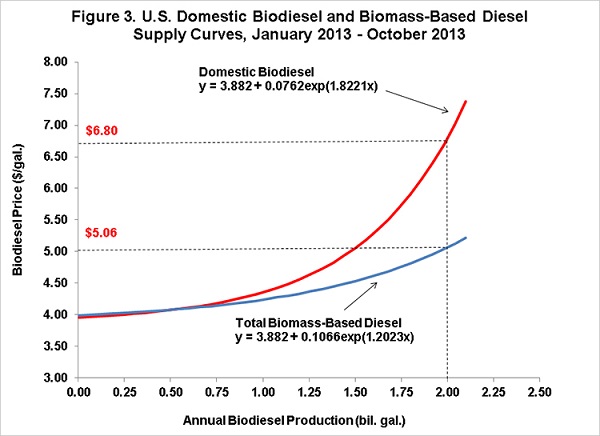
The estimated supply curves in Figure 3 are basically the same up to about one billion gallons of annual production but then diverge sharply for volumes above one billion gallons. For example, the estimates imply that a price of $6.80 per gallon is required in order for biodiesel production to reach 2 billion gallons, while a price of only $5.06 per gallon is required for total biomass-based diesel to reach 2 billion gallons. If costs and revenues per unit are approximately the same for biodiesel and renewable diesel, then one would expect the two supply curves to exhibit more of a parallel relationship because biodiesel is the largest component of total biomass-based diesel. In that case, the total biomass-based diesel supply curve would simply represent the horizontal summation at a given price of the biodiesel supply curve and the supply curves for the other three components of the total. The estimation results seem to imply that there are greater economies of scale to renewable diesel production. While this could be the case, an alternative explanation is that new renewable diesel production capacity came on line in 2013 and this skewed the results given the short sample period used to estimate the supply curves (10 months). Unfortunately, we may have to wait for another year in which the tax credit is set to expire in order to expand the sample in a meaningful way.
Irwin concludes that information shows that both domestic and foreign renewable diesel grew rapidly in the past year, and biomass-based diesel production was responsive to market prices, a fact that hasn’t grabbed a lot of attention. He goes on to say that since Renewable Fuel Standard compliance can be met with biodiesel or renewable diesel, this supply curve for total biomass-based diesel plays a key role in setting the market price of RINs.
Analyst Offers Sobering Ethanol Outlook
 AgResource Company president Dan Basse looked at the year in review for grain markets and gave his outlook for the future at the American Seed Trade Association (ASTA) CSS 2013 and Seed Expo last week in Chicago. That included a pretty sobering outlook for corn and ethanol.
First off, Basse said he expects North America to be “energy self-sufficient by 2020” but that is largely due to fracking to reach new deposits of crude oil and natural gas rather than biofuels. “Ethanol, which was deemed to be the savior from Mideast oil, is no longer going to have that spot at the table,” he said, adding that the industry has “reached its zenith.”
Thanks to flat-lining ethanol demand, Basse believes the good times may have come to an end for corn. “A year ago we had corn prices above $7 with flirtations to eight,” he said. “We’re now looking at Chicago markets with corn prices near four. We think the best we can do at least for the next 6-9 months is maybe getting back to something like four and a half.” Basse points out that the United States only needs to produce a corn crop of 13 billion bushels to meet demand. “That’s the big concern for the US farmer down the road,” he said.
Asked about the EPA proposal to lower the 2014 volume obligations for ethanol under the RFS, Basse said he believes the plan has a 70% chance of being approved. “If we don’t raise blend rates and get Big Oil and get Detroit behind us, there’s really no growth in biofuels,” he said. “I want everybody in agriculture to understand that the political wills are not there as they were a few years ago and unfortunately now with shale gas and the new blessings of a different kind of energy, we’re just talking to ourselves in terms of the marketing for biofuels going forward.”
Listen to my interview for the condensed version and his 30 minute presentation for more details:
Interview with Dan Basse, AgResource
ASTA CSS presentation by Dan Basse, AgResource