RFA E-15 Ad

Feds Continue Crackdown on Biodiesel RIN Fraud

John Davis

scalesofjustice1The federal government continues to go after the few bad actors who are trying to defraud the incentive system for biodiesel production. The Department of Justice announced the indictment of James Jariv, 63, of Las Vegas, and Nathan Stoliar, 64, of Australia that they netted more than $37 million in part from Renewable Identifcation Number (RIN) credits.

The indictment alleges that beginning around June of 2009, the two defendants, James Jariv and Nathan Stoliar, operated and controlled a company — City Farm Biofuel in Vancouver, British Columbia, Canada — that held itself out as a producer of biodiesel from “feedstocks” such as animal fat and vegetable oils. Jariv also operated and controlled a company based in Las Vegas, Nevada, called Global E Marketing. The government alleges that these defendants claimed to produce biodiesel at the City Farm facility, claimed to import and sell biodiesel to Global E Marketing, and then generated and sold RINs based upon this claimed production, sale and importation. In reality, little to no biodiesel produced at City Farm was ever imported and sold to Global E Marketing as claimed. The indictment alleges that the defendants’ scheme allowed them to generate approximately $7 million in RINs that were fraudulent, which were then sold to companies that needed to obtain them.Read More


Biodiesel, Government

Boeing Looks to Get Green Diesel Approval

John Davis

boeing1Aircraft manufacturing giant Boeing wants the government to approve its plan of using renewable or “green” diesel. This story from TriplePundit.com says the company is appealing to the U.S. Federal Aviation Administration (FAA) and other stakeholders to get permission to fly its planes on biodiesel’s close (but chemically different) cousin.

“Boeing wants to establish new pathways for sustainable jet fuel, and this green diesel initiative is a groundbreaking step in that long journey,” said Julie Felgar, managing director of Boeing Commercial Airplanes Environmental Strategy and Integration, in a statement. “To support our customers, industry and communities, Boeing will continue to look for opportunities to reduce aviation’s environmental footprint.”

“Green diesel approval would be a major breakthrough in the availability of competitively priced, sustainable aviation fuel,” said Dr. James Kinder, a Technical Fellow in Boeing Commercial Airplanes Propulsion Systems Division. “We are collaborating with our industry partners and the aviation community to move this innovative solution forward and reduce the industry’s reliance on fossil fuel.”

Estimates are that there’s about 600 million gallons of green diesel produced in the U.S., Europe, and Singapore, about 1 percent of jet fuel demand.

Boeing is part of the Sustainable Aviation Fuel Users Group (SAFUG), which looks to develop sustainable jet fuels. Back in 2011, Lufthansa became the first airline to test biofuels in regular flight operations.

aviation biofuels, Biodiesel, green diesel

Innovation Award to Chevy Cruze

Chuck Zimmerman

Innovation AwardThe first of this year’s Eye on Biodiesel Awards was presented this morning for Innovation. It was presented to General Motors and the B20-Approved Chevrolet Cruze.

General Motors continues to be a leading biodiesel supporter among OEM’s. This year the company took another step forward introducing the 2014 Chevrolet Cruze Clean Turbo Diesel – the first B20-approved light-duty passenger sedan. This new technology diesel engine powered by ultra-low sulfur biodiesel blends provides tailpipe emissions as clean as or cleaner than natural gas and gasoline, while providing superior fuel economy, horsepower and durability. The Chevy Cruze is the cleanest diesel passenger car model ever produced by General Motors and with the use of clean, renewable B20, it’s also now the greenest.

Accepting the award was Shailesh Lopes, Sr. Fuels Engineer, GM Powertrain, Fuels Group. Making comments was Chris Farmer, Manager of Aftersales, Chevrolet Southern California.

You can listen to comments from Chris here: Chris Farmer Remarks

2014 National Biodiesel Conference Photo Album

Audio, Biodiesel, National Biodiesel Conference

Winning Teamwork Needed by Biodiesel Industry

Chuck Zimmerman

Jim CraigThe current situation with the RFS has pitted the big petroleum industry against an industry that has made great strides in developing renewable and clean energy. Attendees at the National Biodiesel Conference today got some motivation and inspiration from Jim Craig, 1980 U.S. Hockey Team goalie on when they won gold at the Winter Olympics in what has been called the greatest sports moment in the 20th Century.

Jim encouraged all elements of the biodiesel industry to come together as a team. When comparing the industry to the petroleum industry in this fight he said to “Become the winning underdog.” I visited with him right after his speech.

You can listen to my interview with Jim here: Jim Craig Interview

You can listen to a brief excerpt of Jim’s remarks here: Jim Craig Remarks

2014 National Biodiesel Conference Photo Album

Audio, National Biodiesel Conference, NBB

Joe Jobe Exposes Renewable Energy Reality

Chuck Zimmerman

Joe Jobe NBBThis morning Joe Jobe, CEO, National Biodiesel Board, rallied his troops at the National Biodiesel Conference in San Diego. He told attendees that the petroleum industry is misleading Americans about fuel policy and called on President Barack Obama to stand firm behind his previous commitments to supporting alternative energy industries.

In his annual address at the Biodiesel Conference & Expo, Jobe shed light on current industry challenges and exposed cracks in how we think about energy.

He pointed out that biodiesel’s story is not unique, “Biodiesel’s story is an example of how effective government policy can be to jump start a fledgling industry. That is the same story of nearly every new industry that involves technological development. Strong government policy support along with a unique spirit of innovation, entrepreneurship, and risk-taking are the primary reasons that so many major modern industries had their start in America.”

You can listen to Joe’s speech here: Joe Jobe Speech

2014 National Biodiesel Conference Photo Album

advanced biofuels, Audio, Biodiesel, Biodiesel Conference, biofuels, National Biodiesel Conference, NBB

MIT Finds New Way to Get More Out of Solar

John Davis

MITsolar1Researchers at the Massachusetts Institute of Technology (MIT) have found a new way to get more out of harvesting solar energy. This article from the school says they’re using the sun to heat a high-temperature material whose infrared radiation would then be collected by a conventional photovoltaic cell.

In this case, adding the extra step improves performance, because it makes it possible to take advantage of wavelengths of light that ordinarily go to waste. The process is described in a paper published this week in the journal Nature Nanotechnology, written by graduate student Andrej Lenert, associate professor of mechanical engineering Evelyn Wang, physics professor Marin Soljačić, principal research scientist Ivan Celanović, and three others.

A conventional silicon-based solar cell “doesn’t take advantage of all the photons,” Wang explains. That’s because converting the energy of a photon into electricity requires that the photon’s energy level match that of a characteristic of the photovoltaic (PV) material called a bandgap. Silicon’s bandgap responds to many wavelengths of light, but misses many others.

To address that limitation, the team inserted a two-layer absorber-emitter device — made of novel materials including carbon nanotubes and photonic crystals — between the sunlight and the PV cell. This intermediate material collects energy from a broad spectrum of sunlight, heating up in the process. When it heats up, as with a piece of iron that glows red hot, it emits light of a particular wavelength, which in this case is tuned to match the bandgap of the PV cell mounted nearby…

The design of the two-layer absorber-emitter material is key to this improvement. Its outer layer, facing the sunlight, is an array of multiwalled carbon nanotubes, which very efficiently absorbs the light’s energy and turns it to heat. This layer is bonded tightly to a layer of a photonic crystal, which is precisely engineered so that when it is heated by the attached layer of nanotubes, it “glows” with light whose peak intensity is mostly above the bandgap of the adjacent PV, ensuring that most of the energy collected by the absorber is then turned into electricity.

The researchers go on to say this technique will make it easier to store solar energy.

Research, Solar, University

Biodiesel Part of Canada’s Canola Success Story

John Davis

canola3 Joel HornSome folks north of the border might call it the little yellow plant that could. But this article from the Toronto Globe and Mail says canola, one of the key feedstocks in Canada’s biodiesel industry, has really taken off from its humble beginnings in the 1970s when the plant was developed to produce a non-acidic, edible cooking oil from the non-edible rapeseed plant to become Canada’s most valuable farm export.

Exports of the small black canola seeds and the cooking oil and animal feed they yield have more than doubled in the past 10 years. And the group that represents growers and marketers of canola figures rising global demand will help it boost canola production by 40 per cent by 2025.

“The world is telling Canada’s canola industry to keep it coming,” said Terry Youzwa, a grain grower in Saskatchewan and chairman of the Canola Council of Canada, a group comprised of growers and the companies involved in the marketing and processing of the crop, including Cargill Ltd., Monsanto Canada and Richardson Oilseed Ltd.

Increasing the size of the canola crop will be no easy feat. The crop competes for field space with wheat, corn, soy and other grains that are rotated each season to let the soil recuperate. But Mr. Youzwa figures the larger crop can be achieved through better yields – squeezing out a lot more plants and seeds with just a small increase in acreage.

Canadian officials go on to say they are continuing to improve canola’s resistance to pest and droughts to make sure the world will continue to get the oil.

About 43,000 producers in Canada grow canola.

Biodiesel, International

Maine Wind Project Gains Key Approval

John Davis

aquaventasmaineAn update to a story we told you about last week… an offshore wind energy project in Maine has received a key approval from state regulators. This article from CompositesWorld.com says the Maine Public Utilities Commission gave the go-ahead for the Maine Aqua Ventus project, a pilot offshore wind farm project designed to prove the feasibility of floating offshore wind turbines.

The Maine Public Utilities Commission approved a term sheet for the 12-MW Maine Aqua Ventus project proposed by Maine Prime Technologies, a spin-off of the University of Maine (Orono, Maine, USA) and two general partners, engineering firm Cianbro Corp. (Pittsfield, Maine) and energy services firm Emera Inc. (Halifax, Nova Scotia, Canada).

Under the parameters of the term sheet, the project will produce about 43,000 MWh/year of energy at $0.23/kWh, with an annual increase of 2.5 percent per year for 20 years.

The approval by the commission now allows the Maine Aqua Ventus project to compete for $47 million in grant money from the U.S. Department of Energy.

Wind

Wisconsin Resarchers Find Better Biofuels Chemical

John Davis

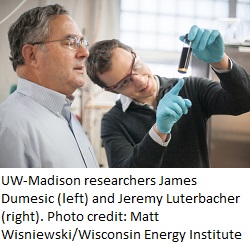
Dumesic-Luterbacher1Researchers at the University of Wisconsin-Madison have found a way to get more ethanol out of sugars used in the refining process. This university article says they’re using a plant-derived chemical, gamma valerolactone, or GVL.

“With the sugar platform, you have possibilities,” says Jeremy Luterbacher, a postdoctoral researcher and the paper’s lead author. “You’ve taken fewer forks down the conversion road, which leaves you with more end destinations, such as cellulosic ethanol and drop-in biofuels.”

Funded by the National Science Foundation and the U.S. Department of Energy’s Great Lakes Bioenergy Research Center (GLBRC), the research team has published its findings in the Jan. 17, 2014 issue of the journal Science, explaining how they use gamma valerolactone, or GVL, to deconstruct plants and produce sugars that can be chemically or biologically upgraded into biofuels. With support from the Wisconsin Alumni Research Foundation (WARF), the team will begin scaling up the process later this year.

Because GVL is created from the plant material, it’s both renewable and more affordable than conversion methods requiring expensive chemicals or enzymes. The process also converts 85 to 95 percent of the starting material to sugars that can be fed to yeast for fermentation into ethanol, or chemically upgraded furans to create drop-in biofuels.

The researchers are adding liquid carbon dioxide to the mix and could reduce the cost to produce ethanol by 10 percent.

biofuels, Ethanol, Ethanol News, Research, University

Bi-Partisan Group Protests EPA Biofuels Reductions

John Davis

bustosnoemA bi-partisan group of lawmakers is calling on the government to end its proposal to reduce the amount of ethanol and biodiesel that will be blended into the Nation’s fuel supply. Led by Democratic Congresswoman Cheri Bustos (IL-17) and Republican Congresswoman Kristi Noem (SD-AL), the group has sent a letter to the Environmental Protection Agency (EPA) over the agency’s proposal to reduce the renewable volume obligations (RVOs) under the Renewable Fuel Standard (RFS).

In a letter to EPA Administrator Gina McCarthy, the Members of Congress said that reducing the amount of renewable fuels in gasoline could hurt rural economies, jeopardize American jobs, raise prices at the pump and deter investment in biofuels and biofuel infrastructure. They asked that the EPA revise their proposal before the 60 day comment period ends on January 28th.

“We are writing to express our concern regarding the Environmental Protection Agency’s (EPA) proposed rule for the 2014 renewable volume obligations (RVOs) under the Renewable Fuel Standard (RFS) program,” the Congresswomen said in their letter. “The significant reduction in renewable volume obligations under this proposed rule could destabilize the renewable fuel industry and send the wrong message to investors. This risks jobs and threatens the development of advanced and cellulosic biofuels that bring higher-level ethanol and biodiesel blends to consumers.”

The effort is seen as part of a full-court press by biofuels advocates to reverse the proposal, which ends its comment period in about a week.

Biodiesel, EPA, Ethanol, Ethanol News, Government, Legislation, RFS