ACE Conference 2026

Rethinking Biofuel Yields

Joanna Schroeder

According to new research from Michigan State University (MSU), focusing solely on biomass yield comes at a high price. Looking at the big picture allows other biofuel crops, such as perennial grasses to score higher than corn, as viable alternatives for biofuel production. The research was published in the recent issue of Proceedings for the National Academy of Sciences.

GLBRC / KBS LTER cellulosic biofuels research experiment; Photo“We believe our findings have major implications for bioenergy research and policy,” said Doug Landis, MSU entomologist and one of the paper’s lead authors. “Biomass yield is obviously a key goal, but it appears to come at the expense of many other environmental benefits that society may desire from rural landscapes.”

Landis and a team of researchers from the Great Lakes Bioenergy Research Center compared three potential biofuel crops: corn, switchgrass, and mixes of native prairie grasses and flowering plants. They measured the diversity of plants, pest and beneficial insects, birds and microbes that consume methane, a greenhouse gas that contributes to climate change. Methane consumption, pest suppression, pollination and bird populations were higher in perennial grasslands.

In addition, the team found that the grass crops’ ability to harbor such increased biodiversity is strongly linked to the fields’ location relative to other habitats. For example, pest suppression, which is already higher in perennial grass crops, increased by an additional 30 percent when fields were located near other perennial grass habitats.

This suggests, says Landis, that in order to enhance pest suppression and other critical ecosystem services, coordinated land use should play a key role in agricultural policy and planning. “With supportive policies, we envision the ability to design agricultural landscapes to maximize multiple benefits.”

Landis points out that rising corn and other commodity prices tempt farmers to till and plant as much of their available land as possible. This includes farming marginal lands that produce lower yields as well as converting acreage set aside for the Conservation Reserve Program, grasslands and wetlands.

“Yes, corn prices are currently attractive to farmers, but with the exception of biomass yield, all other services were greater in the perennial grass crops,” Landis said. “If high commodity prices continue to drive conversion of these marginal lands to annual crop production, it will reduce the flexibility we have in the future to promote other critical services like pollination, pest suppression and reduction of greenhouse gasses.”

biofuels, biomass, Cellulosic, Research

Cold Weather, Logistics Problems Squeeze Propane

John Davis

As the Midwest is hit with yet another Arctic blast, experts at the Energy Information Administration (EIA) say the cold and logistics problems are making prices of propane spike. This story from the EIA says part of the problem includes no chance to recover inventories after this fall’s harvest.

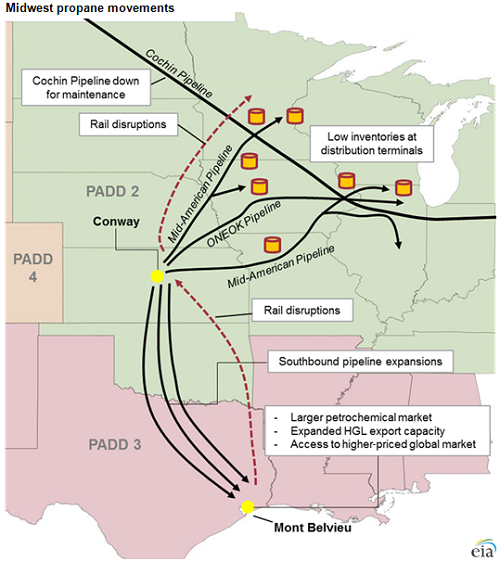
In the Midwest, propane is used for both drying agricultural crops and heating homes and businesses. For corn to be stored, it first needs to be dried, using large-scale heaters that often use propane for fuel. A late-2013 corn harvest, along with cold, wet weather, resulted in strong demand for propane at distribution terminals in the Upper Midwest. For the week ending November 1, 2013, Midwest propane inventories dropped more than 2 million barrels, the largest single-week stock draw in any November since 1993. This demand prompted a strong upward price response, and propane at Conway moved to a 3-cent-per-gallon (gal) premium over Mont Belvieu during the first week of November, the first such premium in almost three years.
eiapropane1
After the harvest, logistical problems prevented the region from fully replenishing inventories before the onset of winter. The Upper Midwest is supplied with propane by pipelines (Mid-American and ONEOK) flowing north from Conway (home to 30% of the nation’s propane storage), the Cochin Pipeline coming south from Canada, and from rail deliveries. The Cochin Pipeline, which delivers ethane and propane from Canada to the Upper Midwest, was out of service for maintenance from late November to December 20 and unavailable to deliver supplies. Rail transportation disruptions, both due to weather and other factors, curtailed deliveries from Mont Belvieu and Conway, as well as from Canada.

thuneThe pinch that Midwesterners, especially farmers, are feeling prompted Republican Senator John Thune of South Dakota, the Ranking Member of the Senate Commerce, Science, and Transportation Committee, to send a letter to the Federal Motor Carrier Safety Administration (FMCSA) asking for a lift on limits for drivers transporting propane in the Western region.

“Regional supply disruptions, high demand from a wet corn harvest, and the extreme cold temperatures this winter have strained propane and home heating oil supplies throughout the region,” said Thune. “The brutally cold temperatures in South Dakota, and across the region, this winter are a challenge for families and businesses, and a tight propane market only increases the dangerous conditions residents are facing. I will continue working with all relevant federal agencies to address this ongoing situation.”

FMCSA made similar declarations for propane distribution centers in the Southern, Eastern, and Midwestern areas the administration controls.

Propane

Minnesotans Encouraged to Think Biodiesel

John Davis

Minnesota soybean farmers are reminding their fellow Minnesotans just how much biodiesel has cleaned up the air they breathe. The Minnesota Soybean Research & Promotion Council (MSR&PC), better known as Minnesota Soybean, launched a campaign that clearly illustrates the advantages of soy-based biodiesel in improving air quality, including the following video airing local TV and cable stations, as well on the group’s social media channels:


“We want to open the consumer’s eyes to the reality of emissions from vehicles that run on petroleum. In fact, vehicle emissions are the largest source of air pollution in Minnesota,” states Bill Zurn, a Becker County farmer and Minnesota Soybean New Uses Action Team chair. “There is a positive message here in the use of alternative fuels.”

“Biodiesel is a cleaner-burning fuel that’s made in Minnesota,” says Bob Moffitt, communications director for the American Lung Association in Minnesota (ALAMN). “We recognize biodiesel as a Clean Air Choice® because of its ability to significantly reduce tailpipe emissions and help lessen our exposure to air pollutants. Not only does using biodiesel reduce particulate emissions, it also reduces greenhouse gas emissions.”

The group also points out that biodiesel in Minnesota alone provides more than 5,600 jobs, adds about $928 million to the economy, and increases demand by 13 percent for the state’s while also increasing in-state soybean processing capacity by 31 percent.

Minnesota Soybean is also offering a “North Shore Clean Air Adventure” to Duluth, rated by the American Lung Association as one of the top 25 cleanest U.S. cities. Winners get a three-night stay in the city and $500 spending money. The website www.biodiesel.mn has more information.

Biodiesel, Soybeans, Video

Austrian Trucking Company Buys Biodiesel Trucks

John Davis

13198-027An Austrian trucking company has bought a fleet of trucks able to use up to 100 percent biodiesel. This news release from truckmaker Scania says it has delivered 220 biodiesel-powered trucks to Austrian haulier Nothegger Transport.

“This is both an exciting and prestigious order,” says Christopher Podgorski, Senior Vice President Trucks at Scania. “Scania has invested more than any other manu­facturer in being able to offer both breadth and depth in its range of Euro 6 engines. This is clear evidence that we have correctly assessed customers’ needs.”
Nothegger has ordered the 2-axle tractors, intended primarily for long-haulage, as well as 3-axle rigid trucks. The company has also signed a Scania repair and main­tenance contract for all of the 220 vehicles ordered.

In Austria, there is a tax incentive to use biodiesel as well as lower prices at the filling stations. Despite the somewhat lower energy content in biodiesel and increased maintenance requirements, Nothegger expects to be able to cut its operating costs. At a total distance driven of 150,000 kilometres per year, the annual saving could be about EUR 4,000 per truck.

The announcement comes on the heel’s of Scania introducing its 13-litre 450 hp engine, which meets Euro 6 standard for biodiesel operation.Read More

Biodiesel, International

Mike Haas Receives Eye on Biodiesel Pioneer Award

Chuck Zimmerman

Mike HaasReceiving an Eye on Biodiesel Pioneer Award for lifetime achievement serving the biodiesel industry at the convention was Mike Haas, of USDA’s Agricultural Research Service.

Haas has been a Lead Scientist and Research Biochemist with the USDA’s Agricultural Research Service since 1981. He has been a huge supporter of the biodiesel industry and currently leads a project investigating the production and quality enhancement of biodiesel, and the chemical modification of lipids to produce bio-based petroleum replacements. Haas and the USDA have been a key supporter of the annual Biodiesel Technical Workshop and currently provides leadership for the NBB’s Next Generation Scientists for Biodiesel program.

You can listen to Mike’s remarks here: Mike Haas Remarks

2014 National Biodiesel Conference Photo Album

Audio, Biodiesel, National Biodiesel Conference, USDA

E15 Now Available in Ohio

Joanna Schroeder

Consumers in Ohio can now choose E15 at the pump. American Freedom Energy has become the first retailer in the state to offer the fuel blend to drivers with 2001 or newer vehicles. The station is located at S 430 St. Route 109, Liberty Center, Ohio 43532.

“Being a leader and not a follower, we believe in consumer choice,” said Glenn Badenhop, President and CEO of American Freedom Energy. “Offering higher ethanol blends like E15 fuel pumps Growth 003sets us apart from other stations, but also helps our local economies, helps the environment, and helps reduce our addiction to foreign oil. Alternative fuels are the future.”

Along with E15 for 2001 and newer vehicles American Freedom Energy will offer E85, E40, E30, and E20 for Flex Fuel vehicles (FFVs) at their Liberty Center station. In doing so, American Freedom Energy also joins more than 3,000 retailers throughout the nation who have the infrastructure available to provide motorists with a choice of various ethanol blends. There are currently 14 states that offer E15.

Growth Energy CEO Tom Buis added, “Seeing retail leaders like Freedom Energy, MAPCO Express, Murphy Oil and Minnoco offering E15 continues to validate that there is a viable market for the new fuel. When given the choice, consumers will seek the fuel that costs less, improves the performance of their vehicles and is better for our environment. The increase in E15 availability is quite impressive.”

biofuels, E15, Ethanol, Growth Energy

Len Hering Receives Eye on Biodiesel Award

Chuck Zimmerman

Len HeringLen Hering, a retired Rear Admiral from the U.S. Navy, gave an absolutely wonderful speech during the closing general session of the conference. You might want to share a link to it (listen below) with your friends and family and perhaps even the EPA! In addition he received an NBB Eye on Biodiesel Inspiration Award. Len is also the Executive Director of the California Center for Sustainable Energy.

Hering, is a prominent military and civilian sustainability leader instrumental in bringing B20 to naval bases. In his 32 years of Navy service he was known as a top expert in base operations and facility support with an emphasis on sustainability. His efforts included everything from renewable energy, including biodiesel, to responsible water use, photovoltaic technology, and conservation. Within three years, his team reduced energy consumption by nearly 42 percent, diverted 75 percent of Navy waste from landfills and reduced water consumption by more than one billion gallons, saving tens of millions of taxpayer dollars. President Bush awarded Hering a 2005 Presidential Award for Leadership in Federal Energy Management.

You can listen to Len’s remarks here: Len Hering Remarks

2014 National Biodiesel Conference Photo Album

Audio, Biodiesel, National Biodiesel Conference

Nebraska Corn Collects 5,000 RFS Comments

Cindy Zimmerman

ne-corn-newThe Nebraska Corn Board has received over 5,000 letters expressing opposition on the Environmental Protection Agency (EPA) proposal to lower 2014 volume requirements for biofuels under the Renewable Fuel Standard (RFS).

In early January, the Nebraska Corn Board sent out letters to Nebraska farmers alerting them of EPA’s actions and included a letter to EPA that farmers could sign. These letters were returned to the Corn Board and the Board will forward the entire stack of letters to EPA before the comment period deadline of January 28. To date, just over 5,000 letters have been returned, many with personal messages expressing the need to keep a strong renewable fuel industry and stating corn farmers can provide enough food, feed and fuel to help America be less dependent on imported oil.

“This is the greatest grassroots response in the history of the corn checkoff program since its implementation in 1978,” said Nebraska Corn Board Executive Director Don Hutchens.

The Board also distributed nearly 10,000 postcards throughout Nebraska where the recipient was asked to write a personal message and mail to EPA. They also offered the option of commenting online through a link on the Nebraska Corn Board website.

Nebraska Corn Board chairman and farmer Tim Scheer said the letters are being sent to EPA today. “Other states have mounted similar efforts to send letters to EPA,” said Scheer, noting that 4,000 letters are being sent in from Minnesota Corn and over 1,000 from Missouri Corn.

corn, Ethanol, Ethanol News, RFS

Why Mess with Success?

Joanna Schroeder

On the same day as the “Hearing in the Heartland” event took place in Des Moines, Iowa to gather comments to submit to the EPA regarding their 2014 proposed Renewable Fuel Standard (RFS) rules, Americans United for Change launched its next in a series of TV ads asking rural Americans to join the thousands of citizens around the country who have spoken out on the RFS.

The ad called “Why Mess With Success,” began airing yesterday in Washington DC, Cedar Rapids, IA, and the Quad Cities. The ad makes the closing argument that the RFS has been invaluable for rural economies the last decade, creating hundreds of thousands of jobs and billions in new wealth while saving consumers millions at the pump. Which is why it makes no sense to change course so drastically by gutting the RFS.

Brad Woodhouse, President, Americans United for Changes said of the ad campaign and the RFS, “It’s an open secret that Big Oil has spent millions of dollars trying to put out of business their 70 cent cheaper and cleaner renewable fuels competition. If Washington does what Big Oil wants and strips apart the Renewable Fuel Standard, it’ll be a case study in fixing what isn’t broke that would make the inventors of New Coke blush. While the U.S. economy has been on a wild ride the last decade, rural communities that seized opportunities in the renewable fuels industry have seen nothing but growth, new jobs, new wealth, and more reasons for their children to stay.”

“That’s why the choice before the EPA should be an easy one: either continue to go forward creating thousands of jobs that can’t be outsourced and revitalizing rural economies, or backward,” continued Woodhouse. “Either continue going forward weaning the nation off its addiction to overseas oil, or backwards. Continue making innovations in next generation renewable fuel sources that will build on its success of meeting 10 percent of the nation’s fuel needs, or discourage it. Continue going forward in cutting down carbon emissions harmful to the environment, or backwards and watch as already common oil-industry related disasters become even more routine. Continue giving consumers cheaper alternatives at the pump, or take them away.”

“At this 11th hour, it is critical that the millions of Americans who have benefited from the RFS — from farmers to businesses that serve ethanol industry workers, to consumers – to tell the EPA what’s at stake for them if Big Oil’s bottom line is put ahead of rural America. If you ask the taxpayers, Big Oil gets enough special treatment from Washington already – they don’t need another giveaway,” concluded Woodhouse.

Biodiesel, biofuels, EPA, Ethanol, RFS, Video

REG Biodiesel Conference Video Series

Chuck Zimmerman

REG Biodiesel TrendsThe Renewable Energy Group (REG) has produced a series of videos from the 2014 National Biodiesel Conference called Biodiesel Trends.

Biodiesel Trends is a video news series that will recap the conference. You can watch short video interviews with key presenters as they discuss industry trends and topics, meet some of the industry’s up-and-coming researchers, learn about federal and state policy updates; and take a virtual ride in the latest diesel-powered vehicles.

Here is one of them:

Biodiesel, National Biodiesel Conference, REG, Video