ACE Conference 2026

Young Scientist’s Share Passion for Biodiesel

Jamie Johansen

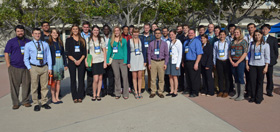
nbb-14-three-studentsStudents from across the country took advantage of this year’s National Biodiesel Conference and presented their research to gain feed back and awareness of the biodiesel industry. This opportunity also allowed them to network with fellow researchers and learn more about the biodiesel community.

Chuck met up with three of the young people and they shared what sparked their interest in biodiesel and what their research has consisted of. All three were really excited to see how respective the professionals they presented to were to their new ideas and research.

They also committed about the opportunity to met and ask questions from other fellow students who attended the event. Peer review is an essential part of these in-depth research studies.

You can listen to Chuck’s complete interview with these young scientists here: Interview with Student Scientists

2014 National Biodiesel Conference Photo Album

Biodiesel, Biodiesel Conference, Education, NBB, Research

Biodiesel’s Role in Bio-based Products

Jamie Johansen

soy-biobased-erkerDirector of bio-based products for the United Soybean Board (USB), Michael Erker, was one of the many attendees of the 2014 National Biodiesel Conference. He works with many bio-based products including biodiesel. He gives insights into what bio-based products that contain biodiesel include and shares how involved USB is in funding biodiesel research.

“When we talk about bio-based products made from soybean oil or meal, that includes biodiesel. Biodiesel soy methyl ester are a great solvents. You not only get biodiesel, you get many other products like hand cleaners, paint strippers or other personal care products.”

USB gets very involved with research projects and are major funders for biodiesel. You can bet that they have had their hand in about all research projects the National Biodiesel Board has conducted. Michael also shared their investment with Ford and research to bring soy tires to vehicles nationwide.

You can listen to Chuck’s complete interview with Michael here: Interview with Michael Erker

2014 National Biodiesel Conference Photo Album

Audio, Biodiesel, Biodiesel Conference, Soybeans, USB

Biodiesel Foundation’s Never Ending Support

Jamie Johansen

nbb-14-foundationIt is easy to say that many of the promotional opportunities we see from the biodiesel industry wouldn’t be possible without the Biodiesel Foundation. During the 2014 National Biodiesel Conference the foundation was hard at work to raise money in order to increase awareness.

Beth Calabotta, Vice President of the Biodiesel Foundation, shared with Chuck in an interview that their goal is to work to promote biodiesel education, infrastructure and awareness.

“We promoted a sustainability tour where we brought a lot of policy makers and their support staff out to see farms in Iowa and biodiesel plants. They really got a feel for what the renewable fuels industry is. We have co-hosted a tour of some environmental groups from California who had never been to a farm before and actually see how biodiesel is made. We have also been sponsoring some educational studies at Purdue University aimed at really understanding what this indirect land use change is and really improving the science.”

The Foundation has a very wide variety of people on it’s board, including producers, farmers and many others involved and passionate about the industry. Those interested in doing their part and contributing to the Biodiesel Foundation can do so at www.BiodieselFoundation.org.

You can listen to Chuck’s complete interview with Beth here: Interview with Beth Calabotta

2014 National Biodiesel Conference Photo Album

Audio, Biodiesel, Biodiesel Conference, NBB

Campaign Looks to Stop Grease for Biodiesel Thefts

John Davis

isenNot long ago, they couldn’t give the stuff away. Now, with the rise of biodiesel, inedible kitchen grease (IKG) has become a hot commodity … so hot it’s being stolen. This article from Biodiesel Magazine says a new campaign is underway to stop those thieves in their slippery tracks.

David Isen, asset protection manager for Imperial Western Products, spoke on an IKG theft panel at the California Biodiesel and Renewable Diesel Conference in San Diego last week. In a low market, Isen said 20 to 30 percent of IKG is lost to grease thieves.

Isen said there are two types of grease thieves in California: those licensed by the California Department of Food and Agriculture, which are opportunists and account for only 20 percent of stolen grease; and the unlicensed bootleggers, which account for the lion’s share of 80 percent of stolen product—where the real threat lies.

Not only do grease thieves steal IKG from containers owned by legitimate businesses, but Isen warned some go to extremes by highjacking whole containers and repainting them to try covering their tracks. They employ tactics to cut, damage or destroy containers, or even buy container keys from competitors, to illegally obtain product.

He offered tips to help identify habitual grease thieves in California. Watch for an expired or fake IKG sticker on their truck or no sticker at all. Their trucks will also often lack company signage and a California business license number. Grease thieves can also be spotted by their dirty and atypical collection vehicles, and may be lacking a TK or TL sticker indicating it’s a licensed truck or trailer. Isen also said to be wary of collectors operating between the hours of 2am and 6am.

New highway billboards in the “Stop Grease Theft Now” program will be going up soon, getting out the message of $500 rewards for information leading to the arrest of individuals responsible for stealing IKG. New bills in the California legislature are also looking to give law enforcement the tools it needs to stop this crime.


Biodiesel

Ontario Biodiesel Brewers Form Group

John Davis

ONTARIO BIODIESEL ASSOCIATION - Ontario Biodiesel ProducersA new group looks to promote biodiesel for refiners in Ontario, Canada. The Ontario Biodiesel Association (OBA) promises to work together to promote the production and use of the green fuel.

OBA members currently produce 100% of the grain-oil based biodiesel in Ontario which accounts for 75% of the total provincial production capacity of all biodiesel. OBA members have invested over $80 million in plant and equipment to produce biodiesel in the province. Besides environmental benefits, the biodiesel industry provides a direct and indirect positive economic impact on the province and its agricultural sector.

“OBA’s strength is the unity of biodiesel producers, supporting Provincial policy development, to improve Ontario’s air quality by promoting increased use of Biodiesel. The OBA is working with the Ontario government, feedstock suppliers and other key stakeholders to the industry to reach this goal.” Paul Grenier, Executive Director, Ontario Biodiesel Association.

OBA members include Methes Energies Canada Inc. located in Mississauga and Sombra (55 million liters/year), Great Lakes Biodiesel (GLB) in Welland (170 million liters/year), and Noroxel Energy Limited in Springfield, just outside of Alymer (5 million liters/year).

Biodiesel, International

Biofuel Groups React to SOTU

Cindy Zimmerman

Corn farmers and biofuels producers are questioning President Obama’s commitment to an “all of the above” energy strategy mentioned in the State of the Union address, considering the administration’s proposal to cut the Renewable Fuel Standard (RFS) this year. The address Tuesday evening came just hours before the comment period on the EPA proposal ended.

sotu-2014“It was great to hear President Obama talk about the importance of an ‘all-of-the-above’ energy policy,” commented National Corn Growers President Martin Barbre. “And you can’t have such a policy without biofuels. So, we call on his Administration to back away from its irresponsible proposal to reduce the Renewable Fuel Standard.”

Fuels America released a statement echoing a similar sentiment, adding that they hope EPA will listen to those who will be impacted by changes in the RFS. “We hope the agency considers the thousands of comments from farm families, small business owners, labor groups and environmental advocates. These are the real people who will lose their livelihoods and their faith in this Administration’s commitment to a clean energy future if the EPA proceeds down its current path.”

The president mentioned agriculture in the opening minute of his speech, with an image of a farmer in a corn field as an example of the “citizens, who make the state of our union strong.”

President Obama did make note of progress made in solar energy during his address and called for an end to tax breaks for the oil industry. “Every four minutes, another American home or business goes solar,” said the president. “Let’s continue that progress with a smarter tax policy that stops giving $4 billion a year to fossil fuel industries that don’t need it, so that we can invest more in fuels of the future that do.”

biofuels, corn, Ethanol, Ethanol News, Government, NCGA

Farm Polices Impact on Precision Ag

Jamie Johansen

nbb-14-kevin-rossMember of the National Corn Growers Association Board and director of Western Iowa Energy, LLC, Kevin Ross, chatted with Chuck after the opening session at the 2014 National Biodiesel Conference. They discuss farm policy and how precision agriculture technology has impacted his farming operation where he raises cattle and grows corn and soybeans.

Kevin shared that if we don’t move past what RFS has already provided then we become stuck and the innovation stops. He says everyone needs to do what they can to ensure the investments continue and technologies are utilized. He feels the government has given mixed signals and believes simple education on the issue could help.

“The Renewable Fuels Standard (RFS) itself is vitally important to my operation at home and to my neighbors. Not just from the farming side, but also from the livestock side. Especially, operations like mine in western Iowa where we can utilize the fats and add value back to the livestock. I am not sure how many people know that its even possible. Let alone be done on an industrial scale. Agriculture is about value-added. Creating markets in those new economies within a broader ag industry is what it is all about.”

Kevin goes on to discuss what types of precision agriculture they have taken advantage of on his operation.

“On our farm it has been a fast ramp up of precision technology. Just a couple years ago on our own farm we’ve gone to auto steer. I couldn’t plant straight rows if I tried. We also use single row shut-offs and it has been a huge plus for us. Overall newer equipment is more efficient with yield monitors and data that we collect. We are going into a new soil data collection phase on our farm which is an entirely new way of doing it then before. We have made major advancement in the recent years and profitability in ag and RFS have really had a huge role in making that possible.”

You can listen to Chuck’s complete interview with Kevin here: Interview with Kevin Ross

2014 National Biodiesel Conference Photo Album

Agribusiness, Audio, Biodiesel, Biodiesel Conference, corn, NBB, RFS, Soybeans

IRFA’s “Fuel the Future” Winners Announced

Joanna Schroeder

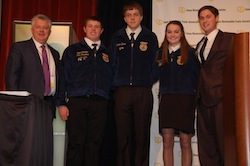
Jon Low 2014 IRFA Fuel the Future Grand Prize WinnerThe winners of the Iowa Renewable Fuels Association’s (IRFA) 4th Annual “Fuel the Future” Video Contest were announced today during the 8th Annual Iowa Renewable Fuels Summit. The first place award and $1,000 went to John Low of Marion, Iowa. An 11th grader from Linn-Mar High School won for his highly entertaining, creative and informative video, “E15: The Fuel of the Future”. Low beat out 26 other entries.

Second place, and winner of a $600 prize, was awarded to Tyler Yates and Dalton Hart of Muscatine, Iowa for their video entitled, “Saving the Planet with Ethanol.” Tyler and Dalton are juniors at Muscatine High School.

IRFA 2014 Fuel the Future Video 3rd Place WinnersThird place, and winner of a $400 prize, was awarded to Megan Anderson, Trenton Bacus and Tyler Blaudow of Bussey, Iowa for their “Paul Harvey spoof” entitled, “The Farmer Made Biodiesel.” Anderson is a senior, while Bacus and Blaudow are juniors at Twin Cedars High School.

“Every year I’m amazed at how creative and informative these student-produced videos are,” said IRFA Communications Director T.J. Page. “The IRFA congratulates all of the ‘Fuel the Future’ winners, as well as each of the Iowa high school students who took on the challenge of entering this year’s contest.”

IRFA’s “Fuel the Future” video contest challenges Iowa high school students to create the best video highlighting the importance and benefits of renewable fuels—such as ethanol and biodiesel—to local communities, Iowa and the nation. This year’s contest was sponsored by the law firm of Faegre Baker Daniels LLP.

View the 2014 Iowa Renewable Fuels Summit photo album.

Biodiesel, biofuels, E15, E85, Education, Ethanol, Iowa RFA, Video

IRFA Attendees Roar in Support of Biofuels

Joanna Schroeder

More than 600 people turned out for the 8th Annual Iowa Renewable Fuels Summit including hundreds of consumers from around Iowa who wanted to learn more about renewable fuels. Speaking with Monte Shaw, executive director of the Iowa Renewable Fuels Association (Iowa RFA), the largest state organization in the U.S. focused on biofuels, noted that there were some consumer driven panels on E15 and biodiesel. In addition, there was a panel featuring four cellulosic projects taking place in Iowa.

The morning focused on the legislative side of biofuels and Shaw noted that the conference landed on the last day of the EPA comment period for their 2014 proposed IRFA 2014 Summit Shawvolumes as part of the Renewable Fuel Standard (RFS). During the show more than 250 people submitted comments to the EPA.

“We’re really optimistic that its going to be very difficult for the EPA to be able to ignore the wealth of information as well as the grassroots support for not messing with the RFS,” said Shaw.

Iowa is number one in ethanol production with about 13.8 billion gallons and number one in biodiesel production with 230 billion gallons. “So we have more at stake than any other state,” said Shaw, “so we have taken the responsibility very seriously to lead the charge.” Shaw said there is bipartisan support around the country for the RFS and he is concerned that a loss of the program could lead to another farm crisis.

I asked Shaw why consumers should care if there is less renewable fuel in our gas. He explained that in Iowa alone, a consumer saves at least 23 cents a gallon for ten percent ethanol (E10). “If you take ethanol out of gas, it’s more expensive,” said Shaw. “It’s just that simply. Even Washington DC, whose not very good with numbers, even they should be able to do that math.”

Shaw also stressed that this fight is not over. Consumers should still call President Obama and tell him they want biofuels. And IRFA will continue the fight as well.

Listen to my full interview with Monte Shaw here: IRFA Attendees Roar in Support of Biofuels

View the 2014 Iowa Renewable Fuels Summit photo album.

Audio, Biodiesel, biofuels, Cellulosic, Ethanol, Iowa RFA, RFS

UK Government to Boost Community Energy

Joanna Schroeder

According to a survey conducted by the Department of Energy and Climate Change (DECC) located in the UK, more than 50 percent of people surveyed said that saving money on bills would be the major motivations for getting involved with community energy programs. The survey also found that approximately 3.5 million bill payers are ready to get together with other people in their local community to take more control of their energy. Four in 10 respondents said they were already interested in joining a community energy group or are already taking part in collective switching or collective purchasing programs.

DECC notes that local communities will now be able to take control of their energy bills and help to transform the energy system due to a proposal unveiled as part of Britain’s first Community Energy Strategy. The Government’s vision is that every community that wants to take forward an energy project should be able to do so. The Community Energy Strategy sets out how to remove barriers faced by communities that want to take action on energy to create opportunities for more people to get involved.

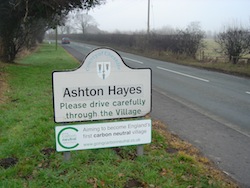
Energy and Climate Change Secretary Ed Davey said: “We’re at the turning point in developing true community energy. The cost of energy is now a major consideration for household budgets, and I want to encourage groups of people across the country to participate in a community energy movement and take real control of their energy bills. Community led actiosignlandscape1n, such as collective switching, gives people the power to bring down bills and encourage competition within the energy market.”

Under the plans Government will broaden the support available for community energy projects, whereby people come together to reduce their energy use or purchase and generate their own energy. Plans include:

  • £10m Urban Community Energy Fund to kick-start community energy generation projects in England;
  • £1m Big Energy Saving Network funding to support the work of volunteers helping vulnerable consumers to reduce their energy;
  • a community energy saving competition, offering £100,000 to communities to develop innovative approaches to saving energy and money;
  • and a “one-stop shop” information resource for people interested in developing community energy projects.

“The Community Energy Strategy marks a change in the way we approach powering our homes and businesses – bringing communities together and helping them save money – and make money too,” said Energy and Climate Change Minister, Greg Barker. “The Coalition is determined to unleash this potential, assist communities to achieve their ambitions and drive forward the decentralised energy revolution. We want to help more consumers of energy to become producers of energy and in doing so help to break the grip of the dominant big energy companies.”

In the future, the generation of electricity by communities themselves could put pressure on energy suppliers to drive down prices, creating warmer homes, cutting carbon emissions and diversifying the UK’s energy mix says DECC. Estimates suggest that energy generation programs involving local communities, such as installing solar panels on social housing buildings, could supply enough electricity for 1 million homes by 2020.

Clean Energy, Distribution, International, Solar