Is climate change impacting agriculture?

Jamie Johansen

New Holland ZimmPollOur latest ZimmPoll asked the question, “What is the MOST important part of sustainability?”

The environment is the number one thing on pollers mind when it comes to sustainability. The economy came in with a close second. Those resources and are utilized daily when it comes to agriculture. What are you doing to make them more sustainable?

Our poll results:

  • Environmental – 35%
  • Economic – 28%
  • Human resources -5%
  • Public policy – 5%
  • Inputs – 0%
  • Energy – 12%
  • Other – 15%

Our new ZimmPoll is now live and asks the question, “Is climate change impacting agriculture?”

The White House released a sweeping climate change assessment this week that has a large section on how agriculture is being impacted. What do you think about that?

ZimmPoll

GM Fuel Cell Vehicles Surpasses 3 Million Miles

Joanna Schroeder

General Motors’ fleet of fuel cell vehicles has surpassed the three million mile mark running on hydrogen-power. According to GM, some individual vehicles have accumulated more than 120,000 miles and by using hydrogen, the fleet has avoided 157,894 gallons of gasoline consumption. This specially equipped fleet of Chevrolet Equinox Fuel Cell vehicles are part of GM hydrogen-powered Chevrolet EquinoxGM’s 119-vehicle Project Driveway program, which launched in 2007. Since then, more than 5,000 drivers have provided feedback on the functionality and drivability of fuel cell technology.

“Hydrogen fuel cell technology is an important part of GM’s advanced propulsion portfolio and we continue to make substantial progress in furthering this technology,” said Charlie Freese, executive director of GM’s global fuel cell engineering activities. “These vehicles have operated through seven full winters and a wide range of environmental conditions, proving that fuel cells can meet the demands of real-world drivers.”

GM has announced several fuel cell-related collaborations over the past few years. In July, 2013, GM and Honda announced a long-term collaboration to co-develop next-generation fuel cell and hydrogen storage systems, aiming for potential commercialization in the 2020 time frame. In addition, GM and Honda are working together with stakeholders to further advance refueling infrastructure, which is critical for the long-term viability and consumer acceptance of fuel cell vehicles.

Also last year GM opened a new state-of-the-art Fuel Cell Development Laboratory at GM Powertrain World Headquarters in Pontiac, Mich. In September, 2013 GM and the U.S. Army Tank Automotive Research, Development & Engineering Center (TARDEC) jointly announced an expansion of their relationship for testing automotive fuel cell technology.

Alternative energy, Alternative Vehicles, automotive, Hydrogen

ANDRITZ to Market Tornado Pulper

Joanna Schroeder

ANDRITZ Inc. has signed an agreement with Bolton-Emerson Americas, LLC giving ANDRITZ exclusive rights to market and sell the Tornado Pulper for solid and liquid fuel applications, as well as biochemical processes. The Tornado Pulper is Bolton-Emerson’s unique technology ANDRITZ Tornado Pulper Installation with Vatfor preparing non-wood feedstocks (annual fibers, plants, and residues) so that they can be further treated with ANDRITZ technologies for conversion into renewable solid and liquid fuels or biochemicals.

Unlike traditional pulpers found in the pulp and paper industry, ANDRITZ explains that the Tornado Pulper has a side-mounted assembly with replaceable grinding segments to simultaneously wash and chop incoming raw materials and resize them into a uniform slurry. The Tornado Pulper has been proven on difficult-to-process materials such as kenaf, hemp, flax, sugarcane bagasse, cereal straw, and others. The Tornado Pulper can also resize woody materials such as forest waste, waste wood, bamboo, and giant reeds into uniform slurries.

ANDRITZ supplies advanced pre-treatment technologies for biofuel production. The company says these technologies are well-proven in other industrial processes and, through extensive R&D, have been modified by ANDRITZ to satisfy the requirements for biofuel and biochemical producers.

advanced biofuels, biochemicals, biomaterials

RFS at Odds with National Climate Assessment

Joanna Schroeder

In a letter to President Obama sent today, leaders of America’s renewable fuel industry are urging the Administration to rethink its proposal to weaken the bipartisan Renewable Fuel Standard – a proposal that is at odds with the National Climate Assessment the White House released earlier this week.

Carbon_dioxideThe letter is signed by Abengoa Bioenergy, the Advanced Ethanol Council, the Biotechnology Industry Organization, DuPont, DSM, Growth Energy, the National Corn Growers Association, Novozymes, the Renewable Fuels Association, and POET.

The companies and organizations write that the Administration’s proposal to reduce the amount of renewable fuel in gasoline and diesel would “make us more oil dependent, effectively gut the bipartisan Renewable Fuel Standard, strand billions of dollars in private investment, and send emissions of carbon dioxide and other pollutants sharply higher.”

The letter notes that the impact of the Administration’s proposal would increase carbon pollution by an estimated 28.2 million metric tons in 2014 alone – which is equivalent to building 7 new coal fired power plants or cancelling every wind farm project currently under construction in the United States.

“The question comes down to whether we want to rely more on foreign oil, or more on clean, renewable American made biofuels,” said the authors of the letter. “We urge you to reconsider the EPA proposal and the methodology for reducing the volumes — and allow the commonsense, bipartisan Renewable Fuel Standard to continue working as intended to create American jobs, promote American innovation, cut our reliance on foreign oil, and reduce harmful carbon pollution.”

The text of the letter follows.Read More

Climate Change, Environment, RFS

BioEnergy Bytes

Joanna Schroeder

  • BioEnergyBytesDFAbengoa has acquired 25% of the Beijing-based water company, GreenTech. The deal is currently under the standard review process by the Chinese Government and is expected to be approved in the second quarter of the year. GreenTech is a leader in the Chinese wastewater treatment and reuse market. Its current clients range from the municipal sector to the industrial sector, and the company has over 40 references in water treatment with a combined capacity of 2.1 million cubic meters (m3) per day.
  • SunEdison has announced it has completed construction of a 117 MW (megawatt) DC (direct current) portfolio of utility-scale photovoltaic (PV) solar power plants across the United Kingdom. The portfolio is comprised of eight separate solar power plants.
  • S&C Electric Company, a company focused on renewable energy integration, has announced the first real-world deployment of a new service offering to remotely monitor S&C’s Wind-Turbine Style Vista® Switchgear. This new service was pioneered on Vista switchgear at Infigen Energy’s 50-MW Kumeyaay Wind Farm, located 65 miles east of San Diego in Boulevard, Calif.
  • Solectria Renewables, LLC, has announced that its SMARTGRID 500 Inverters (SGI 500) have been purchased by NuGen Capital for five projects totaling over 13 MW in Massachusetts. All five systems in Massachusetts are ground-mounted. They are located in Swansea, Lunenburg, Whatley and Hadley. These projects generate net metering credits from the facilities and produce credits that will be made available to manufacturers and municipalities in the area via their utility provider.
Bioenergy Bytes

Prairie Horizon to Add Renewable Diesel Facility

Joanna Schroeder

Prairie Horizon Agri-Energy is one of only a handful of ethanol plants moving into the production of biodiesel. The biorefinery announced plans to form a partnership with WB Services to add a renewable diesel production facility into the existing ethanol plant.

“With this announcement, Prairie Horizon continues to meet its goal of providing leadership in the renewable fuels industry,” said Mike Erhart, CEO of Prairie Horizon Agri-Energy. “We are very excited and eager to partner with WB Services and get under construction and put this product in the marketplace.”

SONY DSCWB Services, LLC, will design, construct and operate the renewable diesel plant utilizing patented renewable diesel process technology. (Learn about WB Services in this audio interview with WB Services’ Bernie Hoffman).

According to Ron Beemiller, President and CEO of WB Services, “This plant will be the first of its kind—the first renewable diesel plant to fully integrate into an existing ethanol operation. This is a very exciting time for both Prairie Horizon Agri-Energy and WB Services, we look forward to working with PHAE’s exceptional leadership team on this project.”

Currently, Prairie Horizon Agri-Energy is a 40 million gallon per year nameplate ethanol plant, which began operations in 2006. With the completion of the facility, renewable diesel nameplate production will be 3 million gallons per year, and will also produce denaturant, fuel gas, and steam for use at the existing facility. Prairie Horizon Agri-Energy also has a significant investment in the renewable and biodiesel plants under construction by Green Energy Products in Sedgwick, Kansas. Design work has already begun, and construction is scheduled to begin in the middle of 2014.

advanced biofuels, Biodiesel, Ethanol, Renewable Energy

DOE Announces Offshore Wind Energy Projects

Joanna Schroeder

The U.S. Department of Energy has announced funding for three offshore wind demonstrations. The projects will receive up to $47 million each over the next four years to deploy innovative, grid- connected systems in federal and state waters by 2017. The projects are located off the coast of New Jersey, Virginia and Oregon.

twisted jacket formation for offshore wind energyFishermen’s Energy will install five 5-megawatt direct-drive wind turbines approximately three miles off the coast of Atlantic City, New Jersey. This project will utilize an U.S.-developed twisted jacket foundation that is simpler and less expensive to manufacture and install than traditional offshore wind foundations.

Dominion Virginia Power will install two 6-megawatt direct-drive wind turbines 26 miles off the coast of Virginia Beach, utilizing a U.S.-designed twisted jacket foundation. Dominion’s project will demonstrate installation, operation and maintenance methods for wind turbines located far from shore. Additionally, the Dominion project will install and test a hurricane-resilient design.

Principle Power will install five 6-megawatt direct-drive wind turbines approximately 18 miles off the coast of Coos Bay, Oregon. The U.S.-developed WindFloat semi-submersible floating foundation will be installed in water more than 1,000 feet deep, demonstrating a solution for deep water wind turbine projects and lowering costs by simplifying installation and eliminating the need for highly specialized ships.

The Energy Department’s efforts to advance innovative offshore wind technologies support the Obama Administration’s comprehensive National Offshore Wind Strategy to develop a sustainable, world-class offshore wind industry. As part of that strategy, the Energy Department continues to work with partners across the government, including the Department of the Interior, to conduct resource assessments, streamline siting and permitting, and overcome technical and market challenges to installation, operations, and grid connection.

Government, offshore wind, Renewable Energy

Research Finds Real-Time Biodiesel Analysis

John Davis

Biodico logoNew research shows a way to conduct quality analysis in real-time. Biodico’s VP of Research and Development, Trey Teall, presented the results of a five-year research project at the recent American Oil Chemists’ Society (AOCS) Annual Meeting & Expo in San Antonio, Texas that focused on the use of Fourier Transform Near-infrared Spectroscopy (FT-NIRS) to provide real-time in-situ analysis of the biodiesel production process as an alternative to conventional ASTM biodiesel methodology.

TreyteallASTM 6751 protocols require the use of techniques that are relatively time-consuming and provide data about the state of the biodiesel reaction kinetics after the fact. For example, the use of gas chromatography to determine mono, di and tri glycerides, and free glycerin will take a trained technician over 45 minutes. It requires that a sample be drawn, reacted (silylated) and run through the GC; and the results indicate what the reaction state was instead of what it is in real time. In contrast, Teall’s research has shown that the use of FT-NIRS can be conducted with sensors imbedded into various production process streams and provide highly accurate near-instantaneous data about the state of the reaction. It can also detect low level contaminants to ensure that finished biodiesel meets the requirements of ASTM D 6751 for finished biodiesel.

The research is continuing and is funded by grants from the California Energy Commission and is in collaboration with the Naval Facilities Engineering and Expeditionary Warfare Center, California Polytechnic University at San Luis Obispo, University of California Santa Barbara, and Marquette University.

Biodiesel

Biodiesel By-Product Innovation Award Announced

John Davis

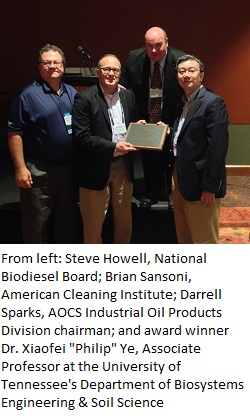
Glycerine Innovation Award2Research that looks to overcome roadblocks to innovative uses for the biodiesel by-product, glycerin, has been honored. The National Biodiesel Board and the American Cleaning Institute presented their 2014 Glycerine Innovation Award at the American Oil Chemists’ Society’s annual meeting.

The 2014 honoree is Dr. Xiaofei “Philip” Ye, Associate Professor at the University of Tennessee’s Department of Biosystems Engineering & Soil Science. The ACI/NBB Glycerine Innovation Award recognizes outstanding achievement for research into new applications for glycerine, with particular emphasis on commercial viability.

Dr. Ye undertook his research in response to the rapid growth of the biodiesel industry worldwide resulting in the production of large amounts of glycerine, creating an urgent need to quickly and effectively convert crude glycerine into value-added chemical products.

While three major commodity chemicals can be derived from glycerine – acrylic acid, lactic acid, and propylene glycol, which serve as building blocks for environmentally friendly plastics and polymers, there have been “bottleneck problems” hindering the industrial production of these chemicals from glycerine. Dr. Ye’s research focuses on innovative technology development to overcome these problems, while his modeling showed economic promise for the commercial production of value-added chemicals from glycerine.

Biodiesel, NBB

New Record Distillers Grains Exports

Cindy Zimmerman

Distillers grains exports set a new monthly record in March, while U.S. ethanol exports rebounded from the previous month, according to the latest numbers.

distillers-grainsThe Renewable Fuels Association (RFA) reports that March exports of U.S. distillers grains, which is the animal feed co-product from dry mill ethanol plants, were a record 1.16 million metric tons. March shipments were up 28% from February and topped the one million mark for just the fourth time in history. China accounted for half of the export shipments, with Mexico and South Korea taking the second and third place slots. Year-to-date, distillers grains exports as of March totaled 2.97 million metric tons, a 65% increase over the same period a year ago, putting the U.S. on pace to export a record 11.9 million metric tons this year.

At the same time, total U.S. ethanol exports, including both denatured and undenatured, were 84.0 million gallons in March, up 25% over February and just slightly below the January total of 86.2 million gallons. Canada and Brazil were top destinations in March, with both the Philippines and Nigeria re-entering the market. Meanwhile, U.S. ethanol imports totaled just 5.3 million gallons in March, making the United States a net exporter by a wide margin for the seventh straight month.

Distillers Grains, Ethanol, Ethanol News, Exports, RFA