After years of hearing about the future of ethanol and Project LIBERTY, the first commercial cellulosic ethanol plant located in Emmetsburg, Iowa using corn stover and corn cobs is officially open for business and in production. The POET-DSM Advanced Biofuels project is a joint venture between POET and Royal DSM.
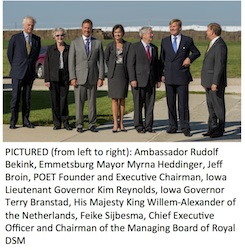 Project LIBERTY, was formally opened in the presence of His Majesty Willem-Alexander, King of the Netherlands, U.S. Secretary of Agriculture Tom Vilsack, Deputy Under Secretary Michael Knotek of the Department of Energy, Governor Terry Branstad and Lieutenant Governor Kim Reynolds of Iowa, other dignitaries and thousands of guests.
“Some have called cellulosic ethanol a ‘fantasy fuel,’ but today it becomes a reality,” said Jeff Broin, POET Founder and Executive Chairman. “With access now to new sources for energy, Project LIBERTY can be the first step in transforming our economy, our environment and our national security.”
The cellulosic ethanol facility converts baled corn cobs, leaves, husk and stalk into renewable fuel. The plant has now officially started up, processing its first batch of biomass into cellulosic ethanol and is moving forward toward continuous operation. At full capacity, it will convert 770 tons of biomass per day to produce ethanol at a rate of 20 million gallons per year, later ramping up to 25 million gallons per year.
Agriculture Secretary Tom Vilsack said during the event, “The Project LIBERTY opening demonstrates that America is ready for advanced renewable energy production. USDA invested to help bring this facility online because it is boosting America’s energy independence, cutting carbon pollution, and holds great promise for our domestic agriculture and energy industries. This facility has already created local jobs and opportunities for farmers, and it will continue to spur local investment and open the door for new technology and job growth across rural America. I congratulate the POET-DSM Advanced Biofuels team on their grand opening and for all they have done and the opportunities they will continue to create for farmers and rural communities.”
Read More


 r refrigeration, lighting, Internet and improving hydroelectric power. Adjunct Professor of Mechanical Engineering Michael Cornachione is assisting the students with their projects.