RFA: API Understates Benefits of RFS

Joanna Schroeder

Is the American Petroleum Institute (API) changing its RFS tune? In a recent interview with POLITICO Pro Energy’s Morning Energy, API President and CEO Jack Gerard said his organization was pivoting its strategy toward reforming the Renewable Fuel Standard (RFS) rather than continuing to call for an outright repeal. A change of tune for sure but whether it’s on key remains to be seen.
dontmesswithRFS_logoRenewable Fuels Association President and CEO Bob Dinneen responded to Gerard’s comments. “API claims they are winning and that the RFS no longer holds the political currency it once did. So why are they then changing course? The reason for the change in approach is that API’s narrative on the RFS is a fiction and Jack Gerard knows it. API can’t continue to support repeal of the RFS because Americans want fuel choice, they want to reduce our dependence on petroleum, they want to address global climate change, they want the evolution of our transportation fuel system to continue. They want the RFS. API knows repeal of the RFS will never happen so they need to change course. That’s not winning. That’s recognizing that you have lost.

“But their ‘reform’ will be equally bankrupt. They will attempt to eviscerate a program they despise because it has robbed them of their monopoly and name it reform. Eliminating the corn ethanol part of the RFS, for example, would render the RFS a toothless tiger. More than 90 percent of the RFS is currently met by corn ethanol, so they would get their monopoly back. That would just tighten oil supplies and raise consumer gasoline costs. More importantly, without corn ethanol, the foundation for next-generation biofuels would be eliminated and the tremendous progress we have made toward cleaner, lower carbon fuels would be lost. That’s not reform. That’s capitulation to an overly entitled oil industry that simply does not share America’s desire to see cost-competitive low-carbon fuels in the marketplace.

“It galls Jack Gerard and the API that support for ethanol and the RFS remains strong among consumers and the Congress despite all the money they have thrown at creating their false narrative. Their acknowledgement today that they need to change course is a white flag. They’ve given up. But beware their next move. It too will not be in the best interests of consumers or American energy and environmental policy.”

biofuels, Ethanol, RFA, RFS

Mid American Agri Products Adds Cellunator

Joanna Schroeder

Mid American Agri Products/Wheatland (MAAPW) has gone online with Cellunator from Edeniq at its ethanol and biodiesel facility located in North Platte, Nebraska. According to Edeniq, the technology will increase the plant’s 44 million gallons per year (MGPY) of ethanol production by pretreating the corn slurry to liberate additional starch. The MAAPW facility also produces three MGPY of biodiesel. The resulting cellulosic ethanol gallons will quality for D3 RINS under the Renewable Fuel Standard (RFS).

Edeniq-Logo“We selected Edeniq’s Cellunator technology because of its proven track record at accessing residual starch and its ability to also pretreat corn kernel fiber to enable production of cellulosic ethanol at our plant,” said Robert Lundeen, CEO of MAAPW.

In addition to installing Cellunators, MAAPW has an option to license the Pathway Technology. Edeniq’s Pathway Technology integrates Edeniq’s Cellunator equipment with cellulase enzymes to convert corn kernel fiber to cellulosic ethanol. The company says its Pathway Technology utilizes existing fermentation and distillation equipment to produce up to 2.5 percent cellulosic ethanol and a 7 percent increase in overall ethanol yield.

“We are excited that Mid American Agri Products/Wheatland has partnered with us to increase their ethanol yield,” said Brian Thome, President and CEO of Edeniq. “We look forward to continuing to work hand in hand with their team to maximize their return on investment with our technology.”

advanced biofuels, Cellulosic, corn, Ethanol

Growth, RFA Urge U.S. to Action Against China

Joanna Schroeder

Back on January 12, 2016, the Ministry of Commerce of the People’s Republic of China (MOFCOM) filed antidumping and countervailing duty cases against the U.S. distiller’s dried grains industry (DDG). This was not the first time the MOFCOM has filed antidumping charges against the U.S.; however, all earlier cases were dropped.

Photo Credit: Renewable Fuels Association (RFA)

Photo Credit: Renewable Fuels Association (RFA)

Yesterday the ethanol industry including Growth Energy and the Renewable Fuels Association (RFA), called upon the U.S. government to take action against China on the current DDGs antidumping case. The groups sent a letter to President Obama calling for action through the Office of the U.S. Trade Representative, Department of Commerce and Department of Agriculture “to challenge both the process and preliminary determinations made by China’s investigating authority through comments to MOFCOM and through the World Trade Organization.”

The letter stated, “The uncertainty and market risk resulting from China’s actions has already triggered substantial financial losses for U.S. distiller’s grains producers. Distiller’s grains prices have plunged more than 25 percent since last summer, while prices for corn and other feedstuffs have been stable or even increased slightly. At a time when both U.S. ethanol producers and farmers are facing serious economic challenges, it is estimated that China’s actions have already resulted in distillers grains losing $30-35/ton in value. This is equivalent to an annualized aggregate loss of $1.2 to $1.6 billion to U.S. ethanol producers, many of whom are small businesses in rural America. Losses would mount further, potentially to $50-60/ton or more, if the anti-dumping and countervailing duty actions ultimately result in a total collapse of distillers grains exports to China, meaning a loss to the U.S. economy of more than $2 billion.”

The letter concluded by asking President Obama to “work closely with the U.S. distiller’s grains industry to mount an aggressive defense of our access to the Chinese livestock feed market throughout China’s antidumping and countervailing duty investigations.”

Distillers Grains, Ethanol, Exports, Growth Energy, RFA

Become a Next Generation Biodiesel Leader

Joanna Schroeder

Jesse Meyer, center, with former co-chairs Dan Browne and James Anderson

Jesse Meyer, center, with former co-chairs Dan Browne and James Anderson

The National Biodiesel Board (NBB) is calling for the next crop of biodiesel leaders to join the Next Generation Scientists for Biodiesel program. NGSB is seeking additional co-chairs to help take this student professional organization to the next level. Working with NBB staff, the volunteer co-chairs help establish direction, assist with planning educational content, recruitment efforts and producing webinars and other events. The co-chairs also review and rank scholarship applications to the National Biodiesel Conference & Expo, and attend the event.

“The co-chair position has provided me with a unique opportunity to interface with the commercial biodiesel community,” said Jesse Mayer, a biochemistry student at the University of Nevada – Reno who attended this year’s conference. “You will network with top scientists and energy thought leaders while shaping our generation’s contributions to the bioenergy field. This opportunity is much more than a resume builder.”

To apply: You must be a college/university student in a scientific field of study, and have joined NGSB. Send an E-mail to NGSB@biodiesel.org with:

  • Your resume and contact information (include expected graduation date. We will prioritize applicants who can serve for two years or more.)
  • A 500 word summary of your experience with biodiesel, commitment to biodiesel, and why you want to be a co-chair.
  • A biodiesel-related photograph of yourself (optional).
  • Deadline to apply is April 1, 2016.

Want to get a feel of what participating in NGSB is like? Click here to read a few stories from student biodiesel leaders that came out of this year’s annual conference in Tampa, Fl.

advanced biofuels, Biodiesel, Education, NBB

Veteran Reporter Rachel Gantz Joins RFA Team

Joanna Schroeder

rfalogo1Oil Price Information Service (OPIS) Journalist Rachel Gantz is joining the Renewable Fuels Association (RFA) team on March 7, 2016. She will serve as RFA’s new communications director and spokesperson and in her role will communicate the organization’s key messages to reporters as well as assist in growing RFA’s media footprint.

“I am excited to join the RFA staff and look forward to working with the media to promote the ethanol industry’s benefits,” said Gantz. “I have written about biofuels for more than 15 years and worked alongside many in the industry. I look forward to continuing that relationship in a different capacity.”

Gantz spent nearly 17 years as a reporter with OPIS where she was a senior reporter covering the biofuels industry. She also worked at Hart Energy Publishing’s Oxy Fuel News and Argus’ Air Daily, covering the biofuels and air emissions industries.

“We are thrilled to have Rachel joining the RFA team,” said RFA President and CEO Bob Dinneen. “She is well versed in the ethanol industry’s legislative and regulatory issues, marketplace priorities and personalities. She’ll be able to hit the ground running. I look forward to Rachel taking the RFA’s press and social media efforts to new heights.”

Ethanol, RFA

Berkeley Lab’s Enzyme Reduces Plant Lignin

Joanna Schroeder

One of the barriers to efficient second generation biofuels is creating a better way to break down the lignin in plants that is then converted to the sugars that create the building blocks of biobased products such as cellulosic ethanol, biomaterials and biochemicals. But this hurdle may be getting lower with research out of Lawrence Berkeley National Laboratory. Scientists have demonstrated an enzyme that can be tweaked to reduce lignin in plants.

This illustration shows the molecular structure of HCT that was derived at Berkeley Lab’s Advanced Light Source. The purple and green areas are two domains of the enzyme, and the multi-colored structures between the two domains are two molecules (p-coumaryl-shikimate and HS-CoA) in the binding site. New research shows this binding site is indiscriminate with the acceptor molecules it recruits, including molecules that inhibit lignin production. (Credit: Berkeley Lab)

This illustration shows the molecular structure of HCT that was derived at Berkeley Lab’s Advanced Light Source. The purple and green areas are two domains of the enzyme, and the multi-colored structures between the two domains are two molecules (p-coumaryl-shikimate and HS-CoA) in the binding site. New research shows this binding site is indiscriminate with the acceptor molecules it recruits, including molecules that inhibit lignin production. (Credit: Berkeley Lab)

Lignin is essential to plant health. It resides in a plant’s cell walls and surrounds and traps the sugars inside. In order to extract the sugars, the lignin must first be broken down through chemical pretreament. Thus, the less lignin there is, the less expensive the pretreatment step becomes.

The research was published in Plant & Cell Physiology and focuses on an enzyme called HCT that plays a key role in synthesizing lignin in plants and has been found to be indiscriminate with what molecules it binds with. With this discovery, the researchers introduced another molecule to the enzyme that occupies the binding site usually occupied by the lignin-producing molecule. This swap inhibits the enzyme’s ability to support lignin production. Initial tests showed a decrease in lignin content by 30 percent while increasing sugar production, without weakening the plant.

“Our goal is to tune the process so that lignin is reduced in a plant where we want it reduced, such as in tissues that produce thick cell walls, and when we want it reduced, such as later in a plant’s development,” said Dominique Loque, a plant biologist with the Joint BioEnergy Institute (JBEI), a DOE Bioenergy Research Center led by Berkeley Lab, which pursues breakthroughs in the production of cellulosic biofuels. “This would result in robust bioenergy crops with more sugar and less lignin, and dramatically cheaper pretreatment costs.”

Next the researchers want to learn how to adjust the temporal and spatial specificity of the enzyme’s lignin-reduction abilities in plants. They also want to further study the Advanced Light Source-derived enzyme structures to see if HCT can be modified to be even more attractive to the new molecules.

advanced biofuels, Cellulosic, enzymes, Ethanol, Research

US Grains Releases New Portal, App

Joanna Schroeder

The U.S. Grains Council (USGC) has released a grains conversion calculator app and a U.S. grains-in-all-forms exports portal to help members of the global grain trade access critical information more easily. The U.S. grains-in-all-forms exports portal is an online calculator that converts volumes of exported U.S. commodities including ethanol and dried distillers grains (DDGs) into corn equivalents. This offers a different and holistic view of the amount of feed grains produced by U.S. farmers that are consumed by overseas customers.

screen568x568“We are excited to expand our digital presence to include these products that will be helpful for both domestic and international stakeholders,” said USGC Chairman Alan Tiemann, who farms in Nebraska. “The grains conversion app and the grains-in-all-forms portal are cutting-edge resources that contain information, trends and statistics that will help the global grain trade work and grow.”

The Council’s grains conversion app converts English units to metric units and vice versa for grains and related measures. The app is available to download for free in the appropriate app stores for Apple, Android and Windows platforms. It also includes an option to switch between multiple languages including English, Arabic, Japanese, Mandarin, Spanish, French and Korean.

corn, Distillers Grains, Ethanol, Exports, USGC

Poll Show Iowans Support RFS

Joanna Schroeder

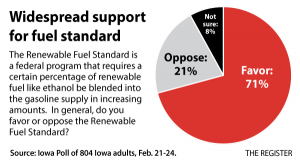
According to a new poll from the Des Moines Register, 71 percent of Iowans favor the Renewable Fuel Standard (RFS), 21 percent oppose it and eight percent are unsure. The issue was a hot button for candidates leading up to the Iowa Caucus where Sen. Ted Cruz received the state’s nomination, despite voters being unsure as to what his stance on the RFS and ethanol really was and RFS supporter groups spending millions running pro-RFS and anti-Cruz ads throughout the state.

The poll also found that 66 percent of Republicans, 76 percent of Democrats and 71 percent of independents favor the RFS. Tea party supporters also support the legislation with 64 percent in favor.

The most recent poll showed a five SnjNqf3percent growth in support among Republicans to 66 percent, while support among Democrats stayed consistent.

“Iowans know ethanol and the RFS are allowing America’s farmers and innovators to produce clean, secure, renewable fuel right here at home that reduces toxic emissions and is better for the air we all breathe. The immense benefits and potential of biofuels, like ethanol, plays a critical role in America’s energy policy and in developing a 21st century fuel for 21st century vehicles,” said Tom Buis, co-chair of Growth Energy in response to the poll.

He added, “Contrary to the oil industry spin, this poll reinforces the fact that the issue gained ground with Iowans during the 2016 caucuses and now they support it in even greater numbers than before. The relevancy of the issue is why an overwhelming 83 percent of Iowans caucused for pro-RFS candidates in 2016, higher percentage than in 2012.”

The poll was conducted by Selzer & Co., which surveyed 804 Iowa adults from Feb. 21-24. The poll has a margin of error of plus or minus 3.5 percentage points.

biofuels, Ethanol, Growth Energy, RFS

New Report: On-Farm Biodiesel Production in Vermont

Joanna Schroeder

All you need to know about biodiesel in Vermont is now in a new report,  “On-Farm Biodiesel Production in Vermont: Legal and Regulatory Overview.” The report was conducted by the Institute for Energy and the Environment (IEE) at Vermont Law School and reviews all Vermont state and federal regulations related to on-farm biodiesel production. The goal of the report is to inform farmers about the potential laws and regulations surrounding on-farm biodiesel production.

On Farm Biodiesel Production in Vermont“As statewide partners begin to find new ways to achieve the goals of Vermont’s Comprehensive Energy Plan, which identified biodiesel as a fuel that will help Vermont meet the 10-percent renewable transportation goal for 2025, the On-Farm Biodiesel Production in Vermont report provides a timely review of the regulations that pertain to homegrown biodiesel production,” said Ellen Kahler, executive director of the Vermont Sustainable Jobs Fund who commissioned the report.

According to the report’s findings, “while several of the federal regulations are only triggered by high levels of production, there are a number of state laws and regulations that may be triggered by small-scale biodiesel production, such as state air emission provisions that establish lower thresholds when compared to the federal Clean Air Act (CAA). In addition, it is critical to understand the role biodiesel production plays in the definition of ‘farm’ and ‘farming activities’ for the purpose of states laws, such as Act 250 and the Current Use Program.”

IEE researchers applied the legal review to three potential scenarios in the report that concludes with a list of “do’s and don’ts” for farmers to use as a legal checklist as they move forward with producing biofuel in on-farm operations.

VLS Professor Kevin B. Jones, deputy director of the Institute for Energy and the Environment, added, “Our institute’s research should help Vermont farmers understand the regulatory hurdles to producing biodiesel on the farm and help them convert a locally grown resource into economic and environmental benefits for Vermont.”

advanced biofuels, Biodiesel

Sumitomo Invests in Cosan Biomassa

Joanna Schroeder

Sumitomo Corporation has signed a contract to acquire up to 20 percent of Cosan Biomassa, a producer of sugarcane pellets for power generation. With an eye on Asia’s need to reduce fossil fuel use and meet goals as set forth in the Climate Treaty last December, the partnership between Sumitomo and Cosan will focus on increasing exports to Japan and Europe as well as increase domestic sales.

bagasse-pelletsAccording to a press statement, the state of Sao Paulo has the collective production potential of 45 million tons/year of sugarcane pellets. The venture has set forth a goal to produce 2 million tons by 2025 and as much as 8 million tons/year in the future. Cosan Biomassa has developed a fuel pellet made from sugarcane residues such as bagasse from the sugar mill and straw left over in the sugarcane field, and built a large-scale production plant with an annual capacity 175,000 tons that went into commercial production in December 2015.

“Brazil is already among the largest producers and exporters of agricultural commodities in the world. Pelletized biomass is a new commodity being created to serve the low carbon economy,” said Mark Lyra, Cosan Biomassa CEO. “By making use of sugarcane residues and benefiting from the economic and environmental advantages that the shift to rail logistics brings to the game, Brazil is positioned to become the Saudi Arabia of renewable energy.”

Sumitomo Corporation has targeted biomass energy as a promising source of renewable energy, and began importing biomass fuel for power generation to Japan in 2008.

“By the year 2030, we foresee that Japan will consume as much as 10 million+ tons of pelletized biomass, the majority of which would come from overseas. Renewable energy including biomass will play a prominent role in our power generation sector by that time,” said Yoshinobu Kusano, general manager, Biomass Business, Sumitomo Corporation. “We believe a relevant portion of this demand will be met by agricultural waste, particularly sugarcane biomass pellets produced in Brazil. Sugarcane’s productivity and abundant availability tied to the fact that we are using its residual byproduct as a raw material gives us a unique sustainability condition when compared to other biomass sources in the world.”

bioenergy, biomass, Brazil