ACE Conference 2026

Doggett Interim CEO for NCGA as Novak Joins CropLife America

Jon Doggett has been named interim CEO for the National Corn Growers Association (NCGA) starting August 1, taking over for Chris Novak, who becomes president and CEO of CropLife America (CLA) in August.

Novak will become just the fifth staff leader of CLA in its 85-year history on August 20. He replaces Jay Vroom, who has been CEO since 1989 and announced his plans to retire last year. Novak has served as NCGA CEO since October 2014, after six years as CEO of the National Pork Board.

Doggett has been with NCGA since 2002 and has served as Executive Vice President since 2014. Prior to that, he served as Vice President, Public Policy, and continues to manage the organization’s 11-person Washington office and lead its public policy efforts.

Raised on his family’s Montana ranch, Doggett has substantial knowledge of production agriculture and more than 30 years of agricultural policy experience. Before joining NCGA, Doggett served 11 years at the American Farm Bureau Federation, where he was the Bureau’s lead lobbyist on a number of public policy issues, including ethanol, climate change, land use, conservation, and endangered species. Doggett also worked for the National Cattleman’s Beef Association/Public Lands Council and served as senior legislative assistant for former Montana Congressman Ron Marlenee.

An announcement regarding the formal search process for a permanent CEO will be made at a later date.

Ag group, AgWired Animal, AgWired Energy, AgWired Precision, corn

House Subcommittee Hearing on Advanced Biofuels

Cindy Zimmerman

The House Energy and Commerce Subcommittee on Environment held its fourth hearing this year aimed at addressing issues related to fuels and vehicles, this time focusing on advanced biofuels under the Renewable Fuel Standard (RFS).

Among those who testified at the hearing on Friday were Advanced Biofuels Association president Mike McAdams, National Association of Truck Stop Operators representative Robin Puthusseril, Renewable Energy Group (REG) CEO Randy Howard on behalf of the National Biodiesel Board (NBB), and Advanced Biofuels Business Council Executive Director Brooke Coleman. Click on names for links to written testimony.

Listen to opening comments from subcommittee chairman Rep. John Shimkus (R-IL) and statements from these four witnesses. Advanced biofuels hearing 6-22-18

advanced biofuels, Audio, Biodiesel, biofuels, Cellulosic, Ethanol, Ethanol News, NBB, RFS

Lamberty Focused on E10 in Mexico and E15 in US

Cindy Zimmerman

Right after the Fuel Ethanol Workshop (FEW) wrapped up in Omaha this month, word came that a Mexican federal court overturned an injunction blocking ethanol blends from climbing to 10 percent from 5.8 percent, allowing most of the country to move forward with E10 blends.

That was very good news as American Coalition for Ethanol senior vice president Ron Lamberty returned to Mexico last week for the third time this year to speak at a meeting of Mexican petroleum equipment installers and retailers in León about equipment compatibility and other practical considerations when implementing and selling up to E10 blends for the first time.

“Like we’ve seen as ethanol expanded in the U.S., ethanol’s competitors in Mexico have created roadblocks to higher ethanol use,” Lamberty said. “One of those roadblocks was removed when a Mexican court overturned the injunction.” That injunction was put in place a year ago and ethanol opponents are expected to continue litigating the expansion of ethanol in the country.

Lamberty joined the U.S. Grains Council for two other technical workshops this year in Monterrey and Tijuana. “Now that E10 is a real possibility in most of Mexico, and “the math” of adding ethanol is so attractive, I explained to these station owners how they can differentiate themselves from competitors and still make better margins,” Lamberty added.

Back here in the states, Lamberty continues to help retailers with the ins and outs of offering E15, which has its own roadblocks in the way. At FEW, Chuck Zimmerman talked with Lamberty about the ever changing policy landscape for getting a Reid Vapor Pressure waiver to allow E15 to be sold during the summer months.

Interview with Ron Lamberty, ACE

2018 Fuel Ethanol Workshop Photos

Fuel Ethanol Conference content sponsored by

Coverage of the Fuel Ethanol Conference is sponsored by Syngenta Enogen

ACE, Audio, E15, Ethanol, Ethanol News, Exports, FEW

Enogen-Enhanced Cellerate Technology Advancing Biofuels

Cindy Zimmerman

The Advanced Biofuels Conference ran in conjunction with the 2018 Fuel Ethanol Conference last week in Omaha and several sessions were sponsored by Cellerate® process technology, enhanced by Syngenta Enogen corn.

Miloud Araba, Technical Services for Enogen, participated in two panels to discuss how Enogen and Cellerate are helping move advanced biofuels forward. “Cellerate allows producers to get more ethanol, maybe more cellulosic ethanol as well, and also improves yield by converting fiber and getting more oil,” said Araba. “More importantly, it adds value to the feed part by concentrating the protein and improving digestibility.”

Cellerate and Enogen corn can help deliver notable benefits to ethanol plants beyond what can be achieved through either technology alone – including increased throughput and yield and a notable reduction in natural gas, electricity and water usage.

Araba also discussed how farmers growing Enogen corn are producing enzymes for ethanol plants, which saves plants from having to add them in the process. “An enzyme could come from anywhere, here we’re doing it in the corn itself, and it’s produced locally,” he explained.

Learn more in this interview: Interview with Miloud Araba, Enogen

2018 Fuel Ethanol Workshop Photos

Fuel Ethanol Conference content sponsored by

Coverage of the Fuel Ethanol Conference is sponsored by Syngenta Enogen

advanced biofuels, Audio, Cellulosic, corn, Enogen, enzymes, Ethanol, Ethanol News, Syngenta

White House Reorganization Plans Would Change USDA

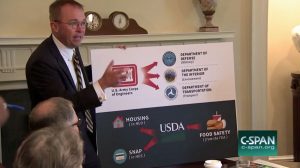
During an open media cabinet meeting Thursday, which was mostly dominated by President Trump commenting on the immigration issue, Office of Management and Budget (OMB) director Mick Mulvaney gave an entertaining summary of the administration’s plans to reorganize the government.

“It’s been almost a hundred years since anybody really reorganized the government,” said Mulvaney, before providing a couple of examples of why it needs to be reorganized. “Because of the Byzantine nature of the way we regulate in this country…if you make a cheese pizza, that is governed by the Food and Drug Administration, if you put pepperoni it, that’s governed by USDA. If you have a chicken, it’s governed by the USDA. If that chicken lays an egg, it’s governed by the FDA, but if you break the egg and make it into an omelet, that is now covered again by USDA.”

“This is stupid,” Mulvaney said simply.

Under the plan, food safety regulations would move from FDA to USDA, while rural housing would move from USDA to Housing and Urban Development (HUD) and non-commodity nutrition assistance programs would move to the Department of Health and Human Services’ (HHS), which would be renamed the Department of Health and Public Welfare (DHP).

Click here to view the administration plan and listen here to Mulvaney explain some of it at the Cabinet meeting. OMB Director Mick Mulvaney outlines reorganization plan

AgWired AgNewsWire, AgWired Energy, Audio, Government, USDA

EPA Decision Boosts Isobutanol

Cindy Zimmerman

In news that was somewhat overshadowed during his Midwest tour last week, EPA Administrator Scott Pruitt announced the registration of isobutanol as a fuel additive for blending into gasoline at levels up to 16 volume percent from the previous 12.5 percent blend level.

Pruitt issued a letter of notification on June 12 to Butamax Advanced Biofuels LLC registering isobutanol “after all applicable Clean Air Act requirements were met and after careful review of the numerous comments received.” Isobutanol or biobutanol is considered to be a second generation biofuel that can be made from biomass.

Butamax is a joint venture between BP and DuPont that was locked in a legal battle over the technology with Gevo Inc. for many years until the two companies came to an agreement in August 2015. Shares of Gevo skyrocketed over 300 percent this week on news of the EPA decision.

Ethanol, Ethanol News, isobutanol

ACE Awards 2018 Scholarships

Cindy Zimmerman

(L to R) Keithen Drury, Emma Baker, Brett Galles

The American Coalition for Ethanol (ACE) has announced the winners of its 2018 scholarship program recipients. Keithen Drury, Brett Galles, and Emma Baker will each receive a $1,000 scholarship to help further their collegiate education.

Keithen Drury from Blue Hill, Nebraska, is pursuing a degree in Mechanical Engineering at Dordt College in Sioux Center, Iowa. Keithen is the son of Terry and Penny Drury. His father Terry is employed at ACE ethanol producer member Chief Ethanol Fuels in Hastings, Nebraska.

Brett Galles of Remsen, Iowa, will be attending Iowa State University in Ames where he plans to study Industrial Engineering. Brett is the son of Bart and Kelly Galles. His father Bart is employed with ACE ethanol producer member Little Sioux Corn Processors in Marcus, Iowa.

Emma Baker is from Lena, Illinois, and will be pursuing nursing at Highland Community College in Freeport. Emma is the daughter of Ray and Amy Baker. Her father Ray works for ACE ethanol producer member Adkins Energy in Lena, Illinois.

The ACE Scholarship Program was initiated in 2004, and ACE has awarded $53,000 since then. Scholarships are made available to employees and dependents of employees and shareholders of ACE Ethanol Producer, Voting and Associate member companies and organizations in good standing.

ACE, Education, Ethanol, Ethanol News

House Democrats Demand Answers from EPA

Cindy Zimmerman

Democratic members of the House Energy and Commerce Committee and the House Committee on Agriculture led by Reps. Dave Loebsack (D-IA) and Cheri Bustos (D-IL) are demanding that EPA Administrator Scott Pruitt provide additional information regarding his agency’s “failed implementation of the Renewable Fuel Standard (RFS).”

A letter signed by a dozen Democrats presents a series of questions seeking information about “the mismanagement of a program that provided waivers to some of our nation’s largest, most profitable refiners, but were intended to help support small refiners with demonstrated economic hardship and were in danger of going bankrupt.”

The lawmakers also want information about the EPA’s retroactive awarding of Renewable Identification Numbers (RINS), which they have repeatedly requested and which the EPA has refused to answer.

“We appreciate the effort of these members to bring attention to EPA’s woeful disregard of the statute and its indiscriminate granting of hardship waivers,” said Renewable Fuels Association president and CEO Bob Dinneen. “The Agency’s lack of transparency in this process prompted RFA to file a Freedom of Information Act (FOIA) request, which has been met with complete silence. We have also filed suit in the 10th circuit challenging specific waivers and in the DC Circuit contesting EPA’s failure to reallocate gallons.”

Read the letter.

EPA, Ethanol, Ethanol News, Government, RFA, RFS

Growth Energy Touts Prime the Pump Success

Cindy Zimmerman

More than 2,800 retail sites will offer E15 by 2021, generating approximately 350 million new ethanol gallons annually, according to a new report by Growth Energy on the success of E15 and the accomplishments of Prime the Pump, a nonprofit organization dedicated to helping build the infrastructure and distribution of higher biofuel blends.

“Thanks to the hard work and generosity of participants in the Prime the Pump program, American consumers can purchase E15 at more than 1,400 locations across 30 states,” said Growth Energy CEO Emily Skor.

The initiative has succeeded in doubling the number of E15 stations four years in a row to the current 1400, and added three major new retailers to the program in 2017, including a partnership with Kwik Trip which successfully rolled out E15 at 300 sites in just four months.

However, Skor notes that this great momentum is at risk without Reid Vapor Pressure (RVP) relief for year round sales of E15. “It’s a major obstruction for those going the extra mile to expand into new markets and grow our industry,” said Skor. “Retailers in many markets simply can’t or won’t retool their labels and fuel offerings each summer, which means that E15 is off the menu all year and what’s at stake is 7 billion new gallons of ethanol demand.”

Click here to read the Prime the Pump one pager.

E15, Ethanol, Growth Energy, Retailers

DuPont Launches New Products for Fuel Ethanol Market

DuPont Industrial Biosciences used the Fuel Ethanol Workshop to showcase three new products geared toward the fuel ethanol market.

All three products are part of the XCELIS platform, which also includes an online partner community for the industry called Grain Changers. Each of these products is already available, according to Judy Underwood, global marketing leader for biorefinery business with Dupont Industrial Biosciences.

Underwood said DuPont™ SYNERXIA® THRIVE GX is a next generation yeast product for the fuel alcohol industry. A second product, DuPont™ DISTILLASE® DXT, is an advanced glucoamylase blend, designed to help customers extract even more value from liquefied grains through a combination of advanced glucoamylases, trehalase and cold cook alpha amylase.

“Starch gets trapped by the corn fiber, and the fiber presents itself as a really strong matrix,” said Underwood. “So this is a way to loosen up that fiber and let some of that starch out so that the alpha amylase in liquefaction can tackle it and solubulize it, leading to higher yields. Really good for producers that have an issue with residual starch.”

The third product, DuPont™ OPTIMASH® AX, is designed to help customers extract even more value out of nonstarch carbohydrates. It relaxes fibers to release inaccessible starch; increases ethanol yields up to one percent and is complementary to alpha amylase performance.

Underwood said launching three products this year is exciting, but the company is far from finished with innovation in this area.

“We want the audience to know that we are not done and we are still really very invested in this market. We are very invested in research and development to bring even new solutions to the market over the next months and years that will help them become more efficient and drive towards whatever goals they’re pursuing,” said Underwood.

Listen to Chuck’s interview with Judy here: Interview with Judy Underwood, Xcelis

2018 Fuel Ethanol Workshop Photo Album

AgWired Energy, Audio, Dupont, Ethanol