Ethanol Export Mission to Indonesia and Vietnam

Cindy Zimmerman

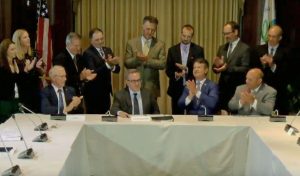
The U.S. Grains Council (USGC) and ethanol industry partners joined the recent USDA Agricultural Trade Mission to Indonesia in July, led by USDA Undersecretary for Trade and Foreign Agricultural Affairs Ted McKinney.

Indonesia currently imports half of its gasoline demand, and the government has set a goal for renewables to represent 23 percent of the country’s energy mix by 2025 and to reduce greenhouse gas (GHG) emissions by 29 percent by 2030. Importing high octane ethanol could help Indonesia achieve that by reducing the use of aromatics. Instead, the Indonesian government has instituted import restrictions and high tariff rates for ethanol and ethanol products inconsistent with those for gasoline or aromatics, so the Council delegation met with Indonesian ministry officials to highlight the benefits of increased ethanol use in terms of air quality and GHG emission reductions.

The delegation also visited Vietnam, which started offering E5 this year with a goal to move to E10 by 2020, as total gasoline consumption rates are expected to grow by nearly 10 percent annually. The Council delegation met with Vietnamese energy ministry officials, ethanol producers and oil industry members to learn more and offer their support for the country’s trade-friendly policies.

The Vietnamese ethanol industry expects to source some of the ethanol needed to fulfill these mandates domestically from local cassava producers. But, the government and industry are open to importing ethanol should domestic production fall short of feedstock needed to fulfill the mandate, as ethanol plants come back online or feedstock prices fluctuate.


Ethanol, Ethanol News, Exports, USGC

NBB Files Brief Challenging 2018 RFS Rule

Cindy Zimmerman

The National Biodiesel Board has filed the opening brief in a lawsuit objecting to the methodology EPA used for establishing the 2018 Renewable Fuel Standards (RFS).

NBB has three specific disputes with EPA’s final RFS rule for 2018, arguing:
– EPA must account for all small refinery exemptions in the annual percentage standard;
– The agency acted arbitrarily when it set the 2018 advanced biofuel volume below what it found to be “reasonably attainable;” and
– The agency set the 2019 biomass-based diesel volume based on impermissible considerations.

NBB’s brief is the first the courts will consider in arguing that EPA must account for all small refinery “hardship” exemptions – including retroactively granted exemptions – when it sets the annual RFS volumes and Renewable Volume Obligations (RVOs).

NBB’s brief states, “EPA unlawfully has failed to account for all small-refinery exemptions it awards, violating its duty to promulgate percentage standards that ‘ensure’ all aggregate volumes are met. Unaccounted for small-refinery exemptions reduce aggregate volumes, and EPA’s approach creates a new, de facto waiver authority contrary to Congress’s design. Despite knowing those consequences, EPA declines to adjust percentage standards to account for that shortfall, either before it is likely to happen or after it actually does.”

EPA has disclosed that it recently retroactively granted 48 small refinery hardship exemptions, reducing the 2016 and 2017 RVOs by a combined 2.25 billion RINs. In the brief, NBB notes that the exemptions reduced the 2016 RVOs by 4.3 percent and the 2017 RVOs by 7.5 percent. Separately, NBB estimates the 2016 and 2017 exemptions reduced demand for biodiesel by more than 300 million gallons. Every 100 million gallons of increased biodiesel production supports some 3,200 jobs. The small refinery hardship exemptions could put hundreds of new jobs at risk.
Read more from NBB

Biodiesel, biofuels, EPA, Ethanol, NBB

ACE Plans Retailer Panel Encore

Cindy Zimmerman

A flex fuel retailer panel will be part of the general session lineup again this year at the American Coalition for Ethanol (ACE) 31st annual conference, August 15-17 in Minneapolis, Minnesota.

ACE Senior Vice President Ron Lamberty will moderate a discussion between returning panelist Bob O’Connor, owner of Wisconsin-based JETZ Convenience Centers, and first-time panelist Glenn Badenhop, owner of Ohio-based American Freedom Energy, both who have made the switch to higher ethanol blends. Last year, it was Charlie Bosselman, owner of Nebraska-based Bosselman Enterprises and Pump & Pantry c-stores, who was on the panel with O’Connor.

With the prospect for year-round access to E15 as ripe as ever, the ACE conference provides these retailers with a timely platform — in the middle of the summertime ban on E15 — to share successes and challenges in E15 and flex fuel retailing, what they’ve seen so far, and how they view the future of biofuels. The panel is entitled “E15 and Flex Fuel: How’s that working out for you?” and will take place at 8:30 a.m. Central on Friday, August 17.
Click here to learn more about the ACE conference.

ACE, ACE Ethanol Conference, Ethanol, Retailers

RFA Hires Chief Economist

Cindy Zimmerman

The Renewable Fuels Association (RFA) has announced that Scott Richman will join the organization next month as chief economist to lead the development and execution of a wide range of research and analysis initiatives.

Most recently, Richman served as senior vice president and co-head of North America Consulting for Informa Agribusiness Consulting, a global firm specializing in research and intelligence on agricultural commodities, biofuels, food production, seed and crop protection, fertilizers, animal health and policy and regulation. Richman developed two successful practice areas at Informa—ethanol and agricultural biotechnology—and co-managed a 15-person North American team.

While at Informa, Richman conducted multiple studies and analyses for RFA, as well as individual clients involved in ethanol production and marketing, private equity firms and other bioenergy investors, the U.S. Department of Agriculture, and organizations like the National Corn Growers Association, U.S. Grains Council, and Growth Energy.

Ethanol, Ethanol News, RFA

RFA Hosting Ethanol Safety Seminars in VA

Cindy Zimmerman

The Renewable Fuels Association (RFA) and several organizations are hosting ethanol safety seminars in Virginia this week.

The ethanol safety seminars, in partnership with TRANSCAER, International Association of Fire Chiefs, and Pipeline and Hazardous Materials Safety Administration, will be held all day today, tomorrow and Wednesday in Chesapeake at the Chesapeake Public Safety Operations Building.

The ethanol safety seminar focuses on numerous important areas of ethanol safety including an introduction to ethanol and ethanol-blended fuels, chemical and physical characteristics of ethanol and hydrocarbon fuels, transportation and transfer, storage and dispensing locations, firefighting foam principles, general health and safety considerations and storage and pre-planning considerations.

The seminar is funded through an Assistance for Local Emergency Response Training (ALERT) grant, awarded by the Pipeline and Hazardous Materials Safety Administration and in partnership with the International Association of Fire Chiefs.

Click here for more information.

Ethanol, Ethanol News, RFA, safety

ACE Addresses Ethanol Questions in 4th Mexican City

Cindy Zimmerman

American Coalition for Ethanol (ACE) Senior Vice President Ron Lamberty traveled to Chihuahua this week for the fourth of six technical ethanol workshops the U.S. Grains Council is holding for Mexican petroleum equipment installers and retailers.

“My presentations to these groups are primarily math and history,” Lamberty added. “We “do the math” of splash-blending less expensive ethanol with gasoline, and I explain the history of getting ethanol from the middle of the U.S. to the rest of the country, via rail and splash blenders. We expect a few of the people at these events will get the idea they could be one of the wholesalers who takes ethanol all over Mexico.”

Lamberty says Chihuahua is about 250 miles from El Paso, Texas, which is closer than the Mexican refineries and prices favor U.S. ethanol.

Last month, Lamberty spoke at a workshop in León and earlier this year, he spoke at two other workshops in Monterrey and Tijuana. Last year, he traveled to Guadalajara, Mexico, to meet with members of Association Mexicana De Empresarios Gasolineros (AMEGAS), Mexico’s largest group of gasoline station owners. Lamberty will participate in two more USGC technical workshops in Mexico yet this year, with a trip to Xalapa planned to take place next month and a meeting in Mexico City in September.

ACE, Ethanol, Exports

Trump in Iowa Reaffirms Support for Ethanol

Cindy Zimmerman

As President Trump was starting a roundtable on workforce development in Iowa Thursday, his very first words were about ethanol.

“I’m very close, I have to tell you, to pulling off something that you’ve been looking forward to for many years and that’s the 12 month E15 waiver,”said Trump. “It’s a very complex process.”

E15 comments from Trump in Iowa

Growth Energy CEO Emily Skor said they were happy to hear those words. “Increased access to US markets will provide America’s farmers with some financial confidence, and we hope that President Trump will direct the EPA to act quickly to provide year-round RVP relief.”

Renewable Fuels Association president and CEO Bob Dinneen said he was encouraged because, unlike his comments about E15 in April, President Trump did not mention also helping out refiners. “Refiners are doing quite fine today, seeing record profits and unprecedented exports. Farmers are not,” said Dinneen. “Farmers need relief now in the form of increased market opportunities. E15 year-round would do that.”

American Coalition for Ethanol CEO Brian Jennings added that “actions speak louder than words. There’s a clear recognition of refinery wins in the form of so-called hardship waivers and collapsing RIN prices have caused real damage in rural America — it is time to carry out the repeated pledge to allow E15 to be sold year-round outside of a deal that would serve as another win for refiners.”

ACE, Audio, E15, Ethanol, Ethanol News, Growth Energy, RFA

#SubEnvironment Holds Hearing on RINs

Cindy Zimmerman

The House Energy & Commerce Subcommittee on Environment took a deep dive into the complex world of Renewable Identification Numbers (RINs) during a hearing on Wednesday.

The committee, chaired by Rep. John Shimkus (R-IL), heard from a panel of independent witnesses to provide background on RINs and how the market for them works. The panel included:

Brent Yacobucci – Energy and Minerals Manager, Congressional Research Service
Sandra Dunphy – Director, Energy Compliance Services, Weaver and Tidwell, LLP
Paul Niznik – Senior Consultant, Argus Media Incorporated
Dr. Gabriel E. Lade – Assistant Professor of Economics, Iowa State University
Corey Lavinsky – Director of Global Biofuels, S&P Global Platts Analytics

Listen to the opening statements of the hearing and some questioning here:
RINs hearing Rep. Shimkus and members' statements
RINs hearing witness testimony and first questions

The Renewable Fuels Association (RFA) sent a letter today to the subcommittee leadership urging them to let RINs “do the job they were intended to do by stimulating increased ethanol production and blending.”

“RIN credits are the engine that drives the RFS. Not only are RINs used to demonstrate compliance with annual RFS blending obligations, but they also serve as a critical economic incentive to expand the production and use of renewable fuels,” RFA explained to the lawmakers. “Studies show that higher RIN prices facilitate deeper discounting of ethanol-blended fuels (such as E15 and E85) relative to gasoline, and that wider discounts lead to greater consumption of these blends. In turn, greater demand for E15 and E85 stimulates increased production of ethanol, which leads to increased RIN generation and larger supplies,” the letter noted.

Click to read the letter.

Audio, Biodiesel, biofuels, Ethanol, Ethanol News, RFS, RINS

EPA Approves Sorghum Oil as Biofuels Pathway

Cindy Zimmerman

Environmental Protection Agency Administrator Andrew Wheeler yesterday announced the approval of sorghum oil as an eligible feedstock under the Renewable Fuel Standard during a signing event at EPA headquarters in Washington, D.C., with sorghum farmers and other stakeholders.

In December 2017, the EPA released a notice of proposed rulemaking (NPRM) concerning renewable fuels produced from sorghum oil under the RFS program followed by a 30-day comment period. EPA’s analysis showed biodiesel produced from sorghum oil has greenhouse gas (GHG) emissions savings of 82 percent. This will give ethanol plants extracting oil from sorghum access to sell into the biodiesel market.

In addition to the nine ethanol producers already extracting oil from sorghum, several other facilities will now be able to purchase and use sorghum.

Among those present for the signing who made comments were Sen. Deb Fischer (R-NE), National Sorghum Producers CEO Tim Lust, American Farm Bureau Federation president Zippy Duvall, and sorghum farmers Dan Atkisson of Kansas, Bobby Nedbalek of Texas, and Kody Carson of Texas.

Sorghum farmers comment on biofuels pathway

Sen. Fischer comments on biofuels pathway

NSP CEO Tim Lust comments on biofuels pathway

AFBF president Zippy Duvall comments on biofuels pathway
AFBF, Audio, biofuels, EPA, Ethanol, Ethanol News, sorghum

USDA Announces Trade Disruption Relief for Farmers

The U.S. Department of Agriculture (USDA) will take several actions to assist farmers negatively impacted by recent trade actions.

President Trump directed Secretary Perdue to craft a short-term relief strategy to protect agricultural producers while the Administration works on free, fair, and reciprocal trade deals to open more markets in the long run to help American farmers compete globally. Specifically, USDA will authorize up to $12 billion in programs, which is in line with the estimated $11 billion impact of the unjustified retaliatory tariffs on U.S. agricultural goods. These programs will assist agricultural producers to meet the costs of disrupted markets.

Secretary Perdue held a press conference with USDA Chief Economist Robert Johansson to announce the aid.

USDA announces trade disruption relief for farmers

Ethanol group leaders thanked the president for the aid, but noted that approving year-round access to 15% ethanol (E15) would be more helpful to farmers in the long run.

“We hope as the administration explores trade mitigation options, they will also recognize the benefit of providing RVP relief,” said Renewable Fuels Association (RFA) president and CEO Bob Dinneen. This would increase demand for higher level ethanol blends, stimulating more growth in rural America, and helping to counteract the prohibitive tariff and non-tariff trade barriers that China and other countries have placed on American agricultural products.

Growth Energy CEO Emily Skor said, “Once again, this administration has missed an opportunity to provide long-term relief to farmers by increasing domestic demand through RVP relief. Allowing year-round sales of higher blend fuels such as E15 is one way to address sales lost because of new tariffs and provide increased certainty for farmers and producers. We will continue encouraging the President and his administration to uphold his promise of supporting farmers and rural Americans by following through on allowing the year-round sale of higher blend fuels.”

AgWired Animal, AgWired Energy, AgWired Precision, Audio, E15, Ethanol, Ethanol News, Growth Energy, RFA, Trade, USDA