Corn Growers Dispute Land Use Petition Claims

Cindy Zimmerman

Environmental groups filed a petition with EPA this week claiming that “millions of acres of wildlife habitat” have been converted to corn and soybean crops to produce biofuels under the Renewable Fuel Standard, based on a June report to Congress, which offered no specific conclusions about land use change related to biofuels production.

The petition claims that previously uncultivated land is being used to grow biofuels feedstocks, even though the amount of land used for corn and soybean production has declined since the RFS was instituted.

“The acreage data is very clear: farmers are planting fewer acres to corn today than we did when the Renewable Fuel Standard (RFS) was expanded,” said National Corn Growers Association (NCGA) president Lynn Chrisp. “And it’s not just corn acres that have fallen. The area planted to principal crops is shrinking nationwide. The reality of what is happening on today’s farms is not accurately portrayed in the petition.”

NCGA notes that farmers planted fewer acres to corn in 2018 (89.1 million) than they did when the RFS was expanded in 2007 (93.5 million). During that same time, ethanol production expanded from 6.5 billion gallons to 15.8 billion gallons. Overall, the area planted to principal crops in the U.S. has fallen from 328.6 million acres in 2000 to 322 million acres in 2018, according to the U.S. Department of Agriculture data.

Meanwhile, the average corn yield has increased by more than 25 bushels per acre since 2007 and doing so with fewer resources and improved farming practices. Farmers have doubled yields while the cutting use of primary nutrients per bushel in half between 1980 and 2014.

Chrisp says they welcome new dialog with environmental organizations. “Environmental groups recognized the emissions reductions and health benefits of biofuels when they backed the RFS. This energy and environmental policy has been a success, delivering GHG reductions, improving air quality, saving consumers money at the pump and reducing our dependence on oil,” said Chrisp.


corn, EPA, Ethanol, Ethanol News, NCGA

Woolley Fuel Marks 10 Years of Biodiesel Service

Cindy Zimmerman

Woolley Fuel of New Jersey is celebrating its 10th year as a distribution location providing high quality biodiesel to consumers across the Garden State.

Woolley Fuel was started in 1924 by two brothers Herbert and Norman W. Woolley Sr. Their desire was to start a coal company similar to their father’s and found potential in Maplewood, New Jersey. The brothers built an energy company that is now approaching its 95th year and is still evolving. Norman Woolley, Jr. created a whole new market when he made his company the first in the state to offer biodiesel to the public. Woolley Fuel started with just B5 blends, and now due to demand, they are selling B30 to customers.

“It is hard to believe that 10 years has passed since the opening of the first public biodiesel fueling station in New Jersey. Kudos, thanks, and credit go to Norm and his colleagues for their forward thinking and entrepreneurial spirit in being the first to bring this environmentally friendly fuel to the public,” said Brian Palmer, New Jersey Soybean Board Chairman.

Woolley Fuel prides itself in offering biodiesel that is a clean burning alternative fuel, produced from domestic, renewable resources. Biofuel from Woolley is accessible throughout much of New Jersey including Essex, Morris, Somerset, Hunterdon, and Union Counties. Along with biodiesel, Woolley is also a major player in the Bioheat® sector providing heating oil to northeastern New Jersey residents.

Biodiesel, biofuels, Bioheat

NEC to Feature Showtime’s The Circus Hosts

Cindy Zimmerman

The popular political commentary luncheon at the 2019 National Ethanol Conference will feature the co-hosts of Showtime’s popular political documentary series The Circus.

The Renewable Fuels Association (RFA) has announced that John Heilemann and Mark McKinnon will speak together at the 24th annual National Ethanol Conference, Feb. 11-13, 2019, in Orlando.

Heilemann and McKinnon will be the featured luncheon speakers on Tuesday, Feb. 12 for a lively discussion on the 2018 mid-term elections, the 2020 presidential race, and many other political topics. Both are well-known political commentators who collaborated to create and host The Circus, which premiered in 2016 and focused on the 2016 U.S. presidential election, January to November. In 2017 the series centered on President Trump’s first 100 days and this year the third season has been following the mid-term elections.

“The Circus has been called the ‘wildest political show on earth,’ and its fast-paced, behind-the-scenes approach has quickly earned the show a loyal and growing audience,” said RFA president and CEO Geoff Cooper. “We’re certain this will be one of the most entertaining and provocative luncheons we’ve had in the NEC’s 23-year history.”

Registration and more information is available online at NationalEthanolConference.com.

Ethanol, Ethanol News, National Ethanol Conference, RFA

RFA Pushes Back on API E15 Push Poll

Cindy Zimmerman

The Renewable Fuels Association (RFA) is pushing back on a poll released yesterday by the American Petroleum Institute (API) that claims most Americans are concerned about approving E15 to be sold year round.

“API’s newest poll is so manipulative it can’t even be called a ‘push poll.’ It’s more like a ‘shove poll’ that bullies respondents into answering the questions exactly the way API wants them answered. These results are meaningless and do nothing to objectively represent consumer opinion on E15,” said RFA President and CEO Geoff Cooper.

API’s poll claims to show that 69-83 percent of voters have concerns about E15, but questions asked in the poll clearly lead the respondents by making statements that are either totally false or misleading at best. For example, API says “83 percent of voters are concerned that consumers could shoulder higher pump prices if service stations are forced to invest in new infrastructure to accommodate certain types of fuels.” Here is how the question was worded (emphasis added):

There are some people who think the government should force service stations to carry higher levels of ethanol such as E15. According to a study by the Petroleum Equipment Institute, service stations might have to buy new storage tanks and pumps and make other investments in their properties to carry E15. These increased expenses could increase the cost of gasoline. How concerned are you that government mandates that force service stations to carry certain types of fuel could end up costing consumers more when they fill up?”

The question is based on a totally false premise. The federal government is not considering any mandate that would force stations to sell or consumers to buy any kind of fuel.

Cooper adds that since E15 was approved as a motor fuel in 2011, there have been no reported cases of consumer misfueling or engine damage related to the fuel blend. “While API continues to spread false and misleading information about E15, American drivers deserve to know the truth—E15 is a cleaner, lower priced, higher octane fuel that will soon be available year-round and nationwide,” said Cooper.

E15, Ethanol, Ethanol News, RFA

Novozymes Bioenergy Sales Up

Cindy Zimmerman

Novozymes is reporting a five percent sales growth in the third quarter of 2018, including a 14% increase in the bioenergy sector of the company.

Novozymes reports that the strong growth momentum within enzymes for conventional biofuels in the first half of this year continued in the third quarter. Novozymes’ newly launched yeast product, Innova® Drive, posted good growth in the third quarter, and Latin America continued to perform well, supported by new starch-based ethanol production capacity coming online.

“Nine months into the year, I’m very pleased that Bioenergy continues to deliver strong; organic growth was up 14% and third-quarter growth was a touch better at 15%,” said Tina Sejersgård Fanø, Executive Vice President, Agriculture and Bioenergy. “We are happy to see that E15 in the U.S. now appears more likely to be implemented by the Environmental Protection Agency; there are still some legislative hurdles to be overcome, but longer term this is a good supportive measure for the U.S. ethanol industry, for Novozymes, and for the environment.”

Similar to the first half of 2018, U.S. and global ethanol production grew by an estimated 2% in the third quarter while trends with elevated inventories and tight margins for ethanol producers remain the same.

enzymes, Ethanol, Ethanol News, Novozymes

POET Moving Forward with New Indiana Biorefinery

Cindy Zimmerman

President Donald Trump’s decision to move forward with allowing year round sales of E15 is already spurring investment.

POET has announced it is moving forward with full construction of a new 80 million-gallon-per-year biofuel facility in Shelbyville, Indiana, with an expected completion date for the nearly $160 million facility of spring 2020.

“This is the right project in the right location at the right time,” POET CEO Jeff Broin said. “Farmers desperately need the income boost from this new market for grain, and Pres. Trump’s recent announcement of year-round E15 sales has the biofuels industry poised for new growth and prosperity. Shelbyville is leading the way for future production to meet new E15 demand. We’re excited to partner yet again with Indiana to create a cleaner, healthier environment for our children and grandchildren.”

POET Biorefining – Shelbyville will be the 28th starch biofuel plant in POET’s network, and the fifth in Indiana. It will add 45 full time jobs and $110 million in annual corn purchases for farmers in the area, primarily within a 30-mile radius. POET plans to start hiring for full-time positions in spring 2019.

E15, Ethanol, POET

NFU Radio Ad Urges E15 Action

Cindy Zimmerman

The National Farmers Union (NFU) has launched a national radio ad campaign urging President Donald Trump to “keep his promises to family farmers by immediately implementing year-round E-15 and reversing the losses caused by the misappropriation of small refinery exemptions.”

“Farmers are still at a net loss from Trump’s actions on biofuels,” the ad says, due to the EPA’s allocation of waivers exempting large oil refiners from complying with the Renewable Fuel Standard (RFS). This decision has “destroyed 2 billion gallons of ethanol demand,” a volume that far exceeds any increased use of E15 expected over the next five years.

To make amends for the profound damage done to the biofuel industry, NFU is calling on President Trump to “do right by his promise to support American farmers” and “move quickly on E15 and support net increases in biofuels use – not cuts.”

Listen to the ad here:

NFU E15 Radio Ad
Audio, E15, Ethanol, Ethanol News, NFU

Ethanol Stakeholders Comment on High Octane Fuel

Cindy Zimmerman

Ethanol stakeholder groups submitted comments Friday to the Environmental Protection Agency (EPA) and National Highway Transportation Safety Administration (NHTSA) on the proposed SAFE Vehicles Rule, emphasizing the benefits for fuel economy and emissions reductions from the use of high-octane fuels, which can be attained with higher blends of ethanol.

“Ethanol delivers the highest octane at the lowest cost, allowing automakers to benefit by continuing to develop high-compression engine technologies and other product offerings to achieve efficiency improvements and reduced emissions,” said the American Coalition for Ethanol (ACE), which provided recommendations for removing regulatory barriers restricting market access to high octane midlevel ethanol blends in its comments.

Comments from the National Corn Growers Association urged regulators to consider fuels and vehicles as a system of high-octane fuel used with optimized engines. NCGA also believes high-octane, low-carbon fuel can help support harmonization between federal and state standards.

“The science behind the benefits of midlevel ethanol-blended fuels like E25 and E30 is well documented by national laboratories, automobile manufactures, and scientific institutions,” said Growth Energy Vice President of Regulatory Affairs Chris Bliley. “Stable policies and access to market drivers will enable our industry to provide low-carbon, more affordable, high-performing, sustainable vehicle fuel solutions.”

The Renewable Fuels Association (RFA) is recommending that EPA and NHTSA should require the gradual phase-out of today’s regular grade gasoline and replace it with a fuel-neutral higher-octane standard. “The auto industry and petroleum refiners already support the idea of legislation to raise gasoline octane to 95 RON. But no legislation is necessary to enable more efficient vehicles: Congress has already provided EPA with authority to control octane levels under section 211(c) of the Clean Air Act,” RFA explained.

ACE, corn, Ethanol, Ethanol News, Growth Energy, Octane, RFA

Ethanol Report from Export Exchange 2018

Cindy Zimmerman

There was a special focus on the ethanol co-product distillers dried grains with solubles (DDGS) at the fifth biennial Export Exchange held this past week in Minneapolis.

The U.S. Grains Council (USGC) began organizing this event in 2010 with the help of the Renewable Fuels Association (RFA) to bring together international buyers and domestic sellers of U.S. feedgrains and ethanol co-products.

In this edition of the Ethanol Report, we hear from USGC CEO Tom Sleight, RFA chief economist Scott Richman and RFA Regulatory Affairs Vice President Kelly Davis about the importance of DDGS to ethanol producers and the U.S. feedgrains export market.

Ethanol Report from Export Exchange 2018

Subscribe to the podcast via RSS
Subscribe via iTunes

Ethanol, Ethanol News, Ethanol Report, Events, Export Exchange, Exports, RFA, USGC

Concerns Raised About E15 Rulemaking Delay

Cindy Zimmerman

Ethanol interests have been raising concerns this week about the Environmental Protection Agency delaying the start of the rulemaking process for year-round E15 until February 2019, which would make the timeline for getting it approved before next summer very tight.

“EPA ought to speed it up, or otherwise it’s going to look like the president wasn’t serious about his announcement,” said Sen. Chuck Grassley (R-IA) this week. “We don’t need this sort of bureaucratic red tape with something that’s been discussed in Washington for years.”

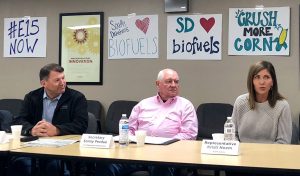
The issue was brought up during a roundtable discussion Thursday with Agriculture Secretary Sonny Perdue, Sen. Mike Rounds and Rep. Kristi Noem at POET Biorefining in Chancellor, South Dakota. “EPA bureaucrats already appear to be slow-walking the rule, which raises doubts it can be done by June 1,” said American Coalition for Ethanol (ACE) CEO Brian Jennings, who attended that roundtable. “We cannot accept EPA slow-walking the process after the President made such a big splash announcing it for rural America, particularly our farmers who are hurting from low corn prices.”

Secretary Perdue is optimistic it will happen. “Federal regulations take more time than certainly I would like, but we believe the E15 rule will be in place prior to next year’s driving season,” he told reporters in Illinois this week – USDA radio news story 10-25-18

Renewable Fuels Association president and CEO Geoff Cooper says they would very much like to see a proposal out sooner than February, but the administration has assured them it can be done before next summer. “We’re certainly hopeful that’s the case but it’s going to take the pedal to the metal to make that happen,” said Cooper during a conference call with reporters Thursday. He confirmed that some retailers may be hesitant about making the commitment to E15 now based on promises for next year, while a couple have already jumped on board since the president made the announcement earlier this month.

RFA CEO Geoff Cooper comments on E15 rulemaking timeline
ACE, Audio, corn, Ethanol, Ethanol News, POET, USDA