American Lung Assn. of WI Sponsors E85 Snowmobile Challenge Team

uw_snowmobile_teamThe American Lung Association of Wisconsin will be sponsoring the UW-Platteville Society of Automotive Engineering (SAE) Clean Snowmobile Challenge team in a project designed to inspire students and showcase innovative, cleaner energy technologies. As part of SAE’s Clean Snowmobile Challenge, the group modified a stock snowmobile to operate on E85.

Since its inception 10 years ago, the “challenge” of each competition has been for students to modify a stock snowmobile to meet a series of requirements, including air pollution levels. Last year, snowmobiles were required to run on ethanol. This year, snowmobiles must run not just on pure ethanol, but on any blend up to 85 percent, making these true flex-fuel vehicles.

The Environmental Protection Agency (EPA) has managed snowmobile air quality regulations since 2006, according to lead event organizer Jay Meldrum. According to Meldrum, the EPA has established regulations that significantly reduce acceptable levels of hydrocarbons, carbon and oxides of nitrogen in snowmobile exhaust. “Our teams are proving at each competition that we can beat the emissions and noise standards with practical solutions,” says Meldrum.

The team has been on the move, promoting their unique machine across the state. The UW-Platteville snowmobile served as the pace sled of the AMSOil World Championship Snowmobile Derby in Eagle River in January, and was displayed at the 2009 Corn/Soy Expo in Wisconsin Dells. This year’s competition will be held March 16-21 at Michigan Tech University.

E85, Ethanol

Stimulus Includes Billions for Renewables

Cindy Zimmerman

Obama stimulus signRenewable energy and biofuels are among the big winners in the $787 billion economic stimulus package signed by President Barack Obama today.

“Because we know we can’t power America’s future on energy that’s controlled by foreign dictators, we are taking big steps down the road to energy independence, laying the groundwork for new green energy economies that can create countless well-paying jobs,” said President Obama during the signing ceremony. “It’s an investment that will double the amount of renewable energy produced over the next three years. Think about that — double the amount of renewable energy in three years.”

Provisions that will benefit the domestic energy industry include $16.8 billion for the Energy Efficiency and Renewable Energy Program. That funding specifies $800 million for projects related to biomass and $400 million for geothermal activities and projects, as well as $300 million for the Alternative Fueled Vehicles Pilot Grant Program.

AFBF StallmanThe American Farm Bureau Federation is among many organizations praising the stimulus package.

AFBF president Bob Stallman says the renewable energy provisions in the package will help the agriculture industry and all Americans through the economic recovery period.

“The tax incentives for renewable energy, particularly for new renewable fuels, will help build an industry that will provide farmers and ranchers with income and the rural economy with jobs, while contributing to a cleaner environment and reducing dependence on imported oil,” said Stallman in a statement today.

Energy, Ethanol, Farming, Government, News

Musical Activist to Headline World Biofuels Meeting

Cindy Zimmerman

Activist and musician Bob Geldof has been announced as the keynote speaker at World Biofuels Markets 2009 (WBM09) to be held March 16-19 in Brussels, Belgium.

Geldof, an Irish musician who launched his activist career by organizing Live Aid in 1985, will discuss how he believes biofuels can help developing countries become more energy independent without impacting food production. He and along with other speakers will discuss the sustainable bio future and how this could help eradicate poverty, particularly across the African continent.
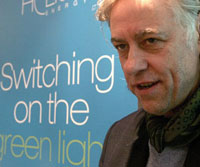
In an interview with WBM, Geldof explained how he sees biofuels helping Africa. “Import substitution. More money in the economy. More jobs. Domestic fuel at the local level,” he says. “Africa has always used “bio-fuel” as a primary source – wood, dung, residue etc. They can build responsibly on this tradition.”

The WBM09 website states: Biofuels has come under a concerted media campaign alleging that they are all unsustainable and have adverse impacts. Some biofuels can be harmful to the environment but most biofuels provide a positive energy balance, can play an increasing role in reducing transport emissions, can be developed from feedstocks without impacting food production, can be grown on land without impacting delicate ecosystems or water use, can help alleviate poverty in developing countries.

conferences, Energy, Ethanol, International

California Wind Farm Wins Approval

John Davis

accionaA wind energy project in Southern California soon could be lighting up 50,000 homes. The Acciona Wind Energy USA wind farm will be Santa Barbara County’s first renewable wind-energy project after the county Board of Supervisors gave unanimous approval to the project.

This story from the Lompoc (CA) Record
says it will be built southwest of the Pacific Ocean-side town of Lompoc:

A maximum of 65 wind turbine generators, which will reach 397 feet-high and are to be 15 feet in diameter, were approved, along with meteorological towers, operational facilities and a PG&E power line running from the project to Lompoc.

Construction could begin at the end of this year, and clean energy production could start by 2010, according to the developer.

Acciona is based in Spain, and you might remember from my post last August 11, 2008 that the company built a wind farm in the Dakotas that will provide power for 60,000 homes in that area.

Wind

Scholarships for Biodiesel Essays

John Davis

cleanairchoicelogoWriting about a green fuel could earn you some green for school! The American Lung Association’s Minnesota and South Dakota field offices, in conjunction with their respective states’ soybean promotion councils, are offering scholarships to students who write essays on biodiesel.

In each state, the competitions are open to high school seniors with plans to attend postsecondary education.

mnsdsoybeanIn Minnesota, winners will receive $1,000, while second place gets a $500 scholarship. South Dakota winners get $500, and second place receives $250.
For both states all essays and application materials must be submitted by 4:30pm on April 30, 2009.

General information is available on the ALA’s Upper Midwest Web site, www.cleanairchoice.org. Specifics for Minnesota are here… South Dakota here.

Good luck to all!

Biodiesel

Support for Increasing Ethanol Blend Levels

Cindy Zimmerman

Increasing the approved level for ethanol that can be blended into gasoline is the number one priority for the ethanol industry this year, and recently support for that goal has been indicated by two major players in Congress and the administration.

BingamanSenator Jeff Bingaman (D-NM), chairman of the Senate Energy and Natural Resources Committee, said in a recent New York Times interview that he thought government regulations that limit ethanol content to 10 percent should be reconsidered.

“I believe we could go to E-12, or E-14 or E-16 without causing any great problems with vehicle operation,” he said.

Bingaman said the EPA and the Energy Department are currently conducting tests on higher blends and results could be available within a year or so.

VilsackMeanwhile, Secretary of Agriculture Tom Vilsack recently said in an interview with Bloomberg that USDA and EPA are in discussions about raising the ethanol blend level, but they have no specific numbers yet. “I do think it’s important for us to look for strategies to make sure the infrastructure of the ethanol industry is preserved, because it is a key component to this new energy future the president’s laid out,” said Vilsack.

Increasing the blend level is seen as the only way to reach the Renewable Fuels Standard, which requires 11.1 billion gallons of renewable fuels, including ethanol, to be used this year. Vilsack says they should not have to change the RFS. “We’ve laid the markers down there and I think we have to work hard to meet it,” he said.

blends, Ethanol, Government

Galva Holstein Adds Third E85 Fueling Station

holsteine85Galva Holstein Ag, LLC has opened their third E85 fueling location in Iowa. The site is located at 211 North Main Street (Highway 59) in Holstein. Other fuels offered include E10, E30 biodiesel and regular unleaded gasoline.

“Honestly, it took us a little longer than we had hoped to get this station up and running this winter,” commented Gary Brosamle, Energy Department Manager at Galva Holstein Ag, LLC. “But we are delighted that the site is now operational and excited to offer E85, E30 and higher biodiesel blends to our customers. The Renewable Energy Center is open 24 hours a day and accepts most credit cards including Galva Holstein Ag’s local card and CENEX credit cards.”

A grand opening is scheduled for May 5 and the date is symbolic. Galva Holstein opened their very first E85 station on May 5, 2005 at 1583 Market Ave. in Galva.

“Three stations in four years is something we are very proud of,” noted Anne Johnson of Galva Holstein.

Miscellaneous

Book Review – Hot, Flat, and Crowded

Joanna Schroeder

hot_flat_and_crowded1The other week I was meeting with Suzanne Shelton, President and CEO of the Shelton Group (you should check out their Energy Pulse research) and we were ruminating over how difficult it is to get through a Thomas Friedman book. I’ve been trying to finish Hot, Flat, and Crowded for several months and I’m proud to say, I’m finished! The effort was well worth it because Friedman has some great stuff in the book.

There is too much good info so I’m going to pick a few things that I think are insightful…for starters, “The Laws of Petropolitics.” The first law, “as the price of oil goes up, the pace of freedom goes down; and as the price of oil goes down, the pace of freedom goes up.”  The second law, “Today, you cannot be either an effective foreign policy realist or an effective democracy-promoting idealist without also being an effective energy saving environmentalist. 

In essence, we need to address our energy policy in conjunction with our environmental policy. The first step is to reduce our fossil fuel use – the greatest contributor to global climate change. Sorry, people, it looks like we’re ALL going green.Read More

book reviews, Miscellaneous

Miners to Learn How to Use Biodiesel

John Davis

regbiodiesel1Renewable Energy Group, the leading biodiesel producer and marketer in the country, is helping miners learn how to use biodiesel in their underground operations.
REG will hold a webinar titled, “Biodiesel Utilization in Underground Mines: Successfully Meeting MSHA DPM Requirements” March 5, 2009 from 11 a.m. to 12 p.m. CST.

REG has been successfully supplying biodiesel to the underground mining industry since 2005. Many REG mining customers made the switch from #2ULSD to 100 percent biodiesel in all of their underground equipment in part because biodiesel creates less diesel particulate matter than conventional diesel.

“Biodiesel is one of the tools available to the underground mining industry that has proven effective in reducing DPM emissions,” according to a Biodiesel Magazine interview with Bill Pomroy, a spokesman for the Mine Safety and Health Administration. “Inspectors have seen DPM levels drop from 300-800 micrograms per cubic meter of air to 50-200 micrograms. The only change that was made was to switch from straight diesel to B100.”

Jon Scharingson, director of marketing at REG will be hosting the educational forum. In the Webinar, Scharingson will focus on how underground mining operations can significantly reduce DPM emissions and integrate B100 into existing infrastructure/engines. Those in the underground mining industry interested in taking advantage of the benefits biodiesel has to provide can also learn how to partner with the biodiesel experts at REG.

There’s no cost for the event, but they do ask you register ahead of time. Here’s the Webinar mining link. Or, you can call Alicia Clancy at 515-239-8118 to sign up.

Biodiesel

Two Steps to Turn Biomass into Biofuel

Cindy Zimmerman

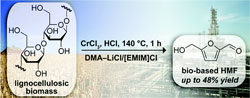
Researchers at the University of Wisconsin-Madison have reportedly developed a two-step method to convert the cellulose in raw biomass into biofuel.

The process, published in a recent Journal of the American Chemical Society issue, uses untreated, inedible biomass as the starting material.

According to a story from the University of Wisconsin, the first step in the process is the conversion of cellulose into the “platform” chemical 5-hydroxymethylfurfural (HMF), from which a variety of valuable commodity chemicals can be made. “Other groups have demonstrated some of the individual steps involved in converting biomass to HMF, starting with glucose or fructose,” says Ronald Raines, a professor with appointments in the Department of Biochemistry and the Department of Chemistry. “What we did was show how to do the whole process in one step, starting with biomass itself.”

In the second step, Raines says they converted HMF into the promising biofuel 2,5-dimethylfuran (DMF). Taken together, the overall yield for this two-step biomass-to-biofuel process was 9 percent, meaning that 9 percent of the cellulose in their corn stover samples was ultimately converted into biofuel. Raines says DMF has the same energy content as gasoline, doesn’t mix with water and is compatible with the existing liquid transportation fuel infrastructure, having already been used as a gasoline additive.

biomass, Cellulosic, Research