ACE Conference 2026

Biofuels Council Founder Appointed to Advisory Board

Cindy Zimmerman

The Latin American biofuels development firm of Santiago & Sinclair has appointed Sean O’Hanlon, founder and executive director of the American Biofuels Council (ABC), to their advisory board. The firm is comprised of experts who assist organizations looking to enter the biofuels sector in Latin America.

O'Hanlon“As the founder of one of the most influential biofuels associations in America, Sean O’Hanlon will bring an invaluable level of expertise to our clients through his position on our advisory board,” said Carlos St. James, Managing Director. “His knowledge base about biofuels is as broad as it is deep and he has spent a good portion of his career developing coalitions. These skills will be essential to the success of Latin America’s biofuels industry. It’s a strategic competitive advantage to have him on board.”

With the enormous agricultural opportunities in Latin America, the region will play an important part in developing energy sources that will ultimately impact the world. Cross country collaboration will be critical in helping the world reduce its reliance on petroleum in part through the development of clean, renewable, forms of energy, especially biofuels.

Biodiesel, Energy, Ethanol, International, News

Energy Department and OriginOil Team Up for Algae Biodiesel

John Davis

origindoeA company working to make algae biodiesel comercially mainstream has teamed up with the U.S. government to come closer to that goal.

Biodiesel Magazine reports OriginOil Inc. inked an agreement with the U.S. DOE’s Idaho National Laboratory to validate and commercialize the Los Angeles-based company’s algae-to-oil technology into the mainstream market:

The multi-phase research program will focus on commercial scaling of OriginOil’s technology in the production of algae-based fuels by utilizing state-of-the-art equipment, capabilities, scientists and engineers of the Idaho National Laboratory. The initial phase will focus on the collaborative development of an energy balance model for photobioreactor-based algae systems. The company expects to use this model in the optimization of its algae-to-oil technology as early as the first quarter of this year. Subsequent phases will center on validation of OriginOil’s processes and piloting specific commercial applications.

“Our primary challenge is cost-effective and scalable industrial processes and our partnership with OriginOil will help us find solutions to this challenge in the promising area of algae-to-oil technology,” said Thomas Ulrich, advisory scientist for Idaho National Laboratory’s Biofuels and Renewable Energy Department.

In operation since 1949, Idaho National Laboratory is a science-based, applied engineering national laboratory dedicated to supporting the DOE’s energy research and national defense efforts. “Partnerships with innovators like OriginOil will accelerate our pursuit of national energy independence initiatives,” Ulrich said.

The magazine had reported late last year that OriginOil has been able to automate its algae cultivation and oil extraction system so it can grow algae to produce oil for biodiesel production.

algae, Biodiesel

Atlanta Recycles Grease Into Biodiesel

John Davis

zerowastezoneatlantaAtlanta, Georgia is the latest city to set up a program to turn waste restaurant grease into biodiesel as part of the city’s “Atlanta Recycles” program… an effort with the U.S. Environmental Protection Agency to create the Southeast United State’s first waste-free zone.

This EPA press release explains the biofuel phase of the program is part of a larger composting plan:

Zero Waste Zones are designed to reduce the environmental impact of waste in homes, workplaces and in the community. Phase One of the Zero Waste Zone will focus on downtown Atlanta’s convention district and participating foodservice operations. More than 10 participants, including the Georgia World Congress Center, the Hyatt Regency and Ruth’s Chris Steakhouse have already pledged to recycle, reuse spent grease for the local production of biofuel and compost or donate food residuals to drastically decrease the amount of waste going to landfills.

No word on how much biodiesel could be produced, but for every gallon of grease you keep out of the sewers or landfills is one you can burn cleanly. Makes sense to me.

Biodiesel

Shorter Name But Same Message for Biodiesel Flick

John Davis

fuel-posterLast year at about this time, you might remember we were talking to movie maker Josh Tickell about his biodiesel documentary, “Fields of Fuel.” In fact, Cindy interviewed Tickell right after he showed his award-winning film at 2008’s National Biodiesel Conference & Expo in Orlando, Florida.

Now, the winner of the 2008 Sundance Film Festival Audience Award for Best Documentary has shortened the title to simply “Fuel,” and the movie is making its debut to a limited number of theaters. The BIOConversion Blog’s C. Scott Miller sent us this review on the film:

“Fuel” is the end product of an eleven year odyssey by Director Josh Tickell in his sunflower festooned, diesel Winnebago called Veggie Van. The traveling show that accompanies the movie release promises to capture attention and stimulate grassroots demand to replace fossil thinking, process, and fuels with renewable energy. “Fuel” could become the communications vehicle that educates the public at large of the liabilities associated with fossil fuels and the benefits of home grown alternatives.

The current film is 111 minutes long and full of geology, biology, physics, politics, and history – most of it personal. It is first and foremost the perspective of a 34 year who grew up not knowing any better. He didn’t know that he couldn’t use the balance of his college student loans to buy a diesel vehicle. He didn’t know whether there would be a low-budget, sustainable way to convert restaurant grease and vegetables into fuel to power his transport. He couldn’t have imagined that he would spend the next eleven years RVing America. To what end? To what purpose? Quite frankly, when you’re 22, who cares.

All he knew was that he wanted to find out if there was a clean alternative to the paradigm that has resulted in the environmental and health disaster of the bayous of his family’s native Louisiana. This region, once home to Cajun culture and bayou ecology, is now dominated by the brown fields of the petro-industry with air, land, and water quality contamination that more than likely will never return to normal. In a stark section of the film about hurricane Katrina, Josh shows an on-land oil spill the size of the Exxon Valdez that was left in the hurricane’s wake – yet never reported in the mainstream media. Why not? Clearly, the petro industry is a “sacred cow” in the state.

“Fuel” is now playing on a few screens across the country. You can visit the movie’s Web site for showtimes and locations and more information.


Biodiesel

More Sorghum Projected for Ethanol Use

Cindy Zimmerman

USDA’s World Agricultural Supply Demand report for February projects more sorghum to be used for ethanol.

SorghumAccording to the report, sorghum food, seed, and industrial use is projected 40 million bushels higher based on indications of increased sorghum use by ethanol plants in the Southern and Central Plains.

The report also noted that ethanol blender and producer margins have recently improved and weekly production of gasoline blends with ethanol has risen. The projected season-average farm price range for corn is narrowed 10 cents on each end to $3.65 to $4.15 per bushel.

Globally, USDA reports coarse grain supplies for 2008/09 are lowered 0.9 million tons this month with reductions in corn production for South America and India and world corn production for 2008/09 is lowered by 4.6 million tons.

corn, Ethanol, News, sorghum

NEVC Applauds Inclusion of Tax Credit Improvement in Stimulus Package

nevcThe economic stimulus package, signed by President Obama, includes an increase in the federal income tax credit for alternative fuel infrastructure. The National Ethanol Vehicle Coalition (NEVC) played a lead role in the inclusion of this incentive and is confident this will lead to a more prominent position of high blends of ethanol in the marketplace.

The American Recovery and Reinvestment Act, or H.R. 1, increases the existing Federal alternative fuel infrastructure tax credit of $30,000 or 30 percent of the incremental cost, to $50,000 or 50 percent of the incremental cost. The NEVC began encouraging the inclusion of this additional tax incentive in November of 2008 by forwarding a letter to the Speaker of the House with nearly ninety industry leader signatures. The original infrastructure development provision was part of the 2005 Energy Policy Act.

More than seven million E85 compatible or flexible fuel vehicles (FFVs) are currently driving on American roads. To date, only 1,958 E85 stations exist to fuel these FFVs. Furthermore, Chrysler, Ford Motor Company and General Motors all have promised to increase their flexible fuel model year availability in a few short years. The additional tax credit will assist those struggling fuel retailers to include this clean burning, alternative fuel to their stations.

According to Bernie Punt, chairman of the NEVC and general manager of Siouxland Energy and Livestock Coop., the increased federal income tax credit should be instrumental in the establishment of new fueling systems across the nation. Punt stated, “The NEVC has been focusing on the lack of E85 fueling infrastructure for the past several years. We lead the effort to establish the tax credit in 2005 and to increase the credit in the stimulus bill. The lack of fueling infrastructure remains the major impediment to using high-level blends of ethanol.”

Also included in the recently signed Stimulus Bill is a grant program providing $300 million to the Department of Energy’s Clean Cities program to implement section 721 of the Energy Policy Act of 2005. The NEVC will be closely monitoring the planned distribution of these funds to encourage DOE to allocate significant portions of the monies to advance E85 fueling systems and educational/marketing efforts.

E85, Equipment, Ethanol, Facilities, Government, National Ethanol Vehicle Coalition, News

BP and Verenium Form Cellulosic Ethanol Venture

Cindy Zimmerman

VereniumBPBP and Verenium Corporation have taken another step in a partnership announced last year by forming a joint venture to develop and commercialize cellulosic ethanol from non-food feedstocks. Both companies have agreed to commit $45 million in funding and assets to the company.

The collaboration will be focused on the development of a commercial-scale cellulosic ethanol facility in Highlands County, Florida and expects to break ground on that site in 2010. The estimated construction cost for this 36 million gallon-per-year facility is between $250 and $300 million. Production from this plant is expected to begin in 2012. With plans to add additional capacity, the joint venture company also intends to develop a second site in the Gulf Coast region.

The joint venture company will initially be based in Cambridge, Massachusetts, will be comprised of a team from both BP and Verenium and will be governed by a board with equal representation from both parent companies.

Cellulosic, Ethanol

Record Distillers Grains Exports

Cindy Zimmerman

Exports of the primary by-product of ethanol production are continuing to skyrocket.

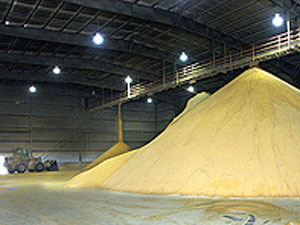
According to USDA’s Foreign Agriculture Service, exports of distillers grains from the United States nearly doubled last year, up more than 90% from 2007 to total 4.51 million metric tons. Distillers grains are an ethanol co-product used as livestock feed.

About one-third of every bushel of corn used to produce ethanol becomes distillers grains, which Renewable Fuels Association Vice President of Research and Analysis Geoff Cooper says have become a very valuable co-product for ethanol producers. “This increasing production and use of distillers grains is providing livestock feeders across the globe with a high protein source of feed that can partially displace the need for whole corn and soybean meal in feed rations,” said Cooper. “As a result, distillers grains are an important and often overlooked component of both the fictitious debate about food versus fuel and the ongoing discourse surrounding the science of land use change.”

The largest markets for exports of distillers grains from the United States in 2008 were Mexico, Canada and Turkey.

Distillers Grains, Ethanol, RFA, USDA

REG Opens Houston Biodiesel Truck Loading Facility

John Davis

regbiodiesel2Less than six months after opening a biodiesel plant in petroleum country, Iowa-based Renewable Energy Group has opened its Houston biodiesel facility for 24-hour a day pickup for trucks… the first of its kind in the Houston area.

This story from the Houston Business Journal has details:

“The current market conditions in Texas make biodiesel a tremendous choice for truck stops and petroleum distributors throughout the Gulf Coast,” REG Vice President of sales and marketing Gary Haer said.

The Seabrook production facility is capable of producing 35 million gallons a year of B99 or B100 biodiesel, and proximity to diesel terminals allows in-truck splash blending.

Purchasers will receive Renewable Identification Numbers currently worth 20 cents a gallon, and will be exempt from Texas’ 20-cents-per-gallon state excise tax.

Biodiesel

Oklahoma Moves Forward on Alt Fuel Bills

John Davis

A pair of bills that will give Oklahomans who choose alternative energy to heat and cool their homes and run their vehicles a break on their taxes continue their way through the state’s legislature.

chris_bengeThis story from The Daily Oklahoman
says House Speaker Chris Benge’s bills are designed to lessen the dependence on foreign oil and could be applied nationally:

House Bill 1948 would provide a 5 percent tax credit for residents and businesses who would buy a geothermal heat pump system. House Bill 1949 is intended to double the number of publicly available compressed natural gas fueling stations and give Oklahomans tax credits to help them make a transition to alternative fuel vehicles.

Benge, R-Tulsa, said other energy-related measures to be taken up this session deal with solar, nuclear and wind power.

It’s estimated HB 1948 would cost the state about $850,000 a year while no estimate has determined yet how much HB 1949 would cost, Benge said.

Benge authored HB 1949 last summer when gasoline prices were about $4 a gallon in the state. Gasoline prices have dropped more than half since then, but Benge said it’s still important for Oklahoma to push an energy plan.

“Once the economy picks back up, we’re expecting the gasoline prices to go up again because that demand’s going to be there,” he said.

Government, Legislation, Miscellaneous