

The California Air Resources Board (CARB) is set to vote on the Low Carbon Fuels Standard (LCFS) on April 23-24, 2009. This first of its kind bill was designed to reduce the carbon intensity of all transportation fuels in California 10 percent by 2020. Many states, as well as the federal government, are watching the outcome very closely as they consider adopting similar bills.
 In preparation for the ruling, the ethanol industry has been working with CARB to document ethanol as a proven low carbon fuel. Today, the Brazilian Sugarcane Industry Association (UNICA) sent out a statement declaring that sugarcane ethanol’s carbon intensity is even lower than currently calculated by CARB.
“Sugarcane ethanol has a verifiable reduction in greenhouse gases of 90% compared to gasoline. Sugarcane ethanol will easily meet the LCFS, not just in 2020 but today,” said Marcos Jank, UNICA’s President & CEO. UNICA sent out a public statement following the submission of a 25-page letter to the California regulator.
Within this standard, gasoline will be eligible as a “low carbon fuel” if it reduces its current carbon output from 95 grams of carbon dioxide per megajoule (gCO2/MJ) to 86 gCO2/MJ by 2020. Since all biofuels have a lower carbon intensity, they will be a large factor in the reduction of fuel-based carbon.

UNICA's President and CEO Marcos Jank
Although UNICA’s letter is specific to sugarcane ethanol produced in Brazil, the American ethanol industry has also submitted documentation about the uncertainty of indirect land use and repeatedly called for more research before finalizing the LCFS.
 As we head into the weekend, some of you may be planning a trip to an auto mile to buy a new car. When you drive away in your new vehicle, you’ll be helping the world get one car closer to the two billion mark. Today there are one billion cars on the road and within the next 20 years, there will be two billion cars on the road. And this is the premise of this week’s book,
  A lawsuit filed by
  The Environmental Protection Agency
 Bob Stallman, President of the
  It was the scene of the “day that would live in infamy.” Now, visitors to the USS Arizona Memorial in Pearl Harbor, Hawaii will be able to pay homage to the more than 1,000 heroes honored with a renewable energy source: biodiesel.
 A 25-member panel of researchers that advises the President and Congress on science and engineering issues is calling for more development of sustainable and clean energy sources to transition the country away from fossil fuels.
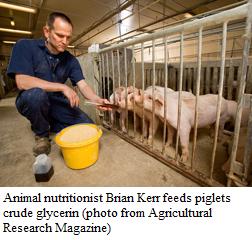 Kerr led studies that examined how crude glycerin feed supplements affected swine energy use. In five different experiments, he supplemented the diets of starter pigs and finisher pigs with different levels of crude glycerin…
 According to a POET press release, POET Biorefining in Bingham Lake, Minnesota, has used a new technology wich will eliminate water discharge providing a more efficient way to produce ethanol.
 The 35 million gallon per year facility currently uses less water than average plants. Bingham Lake facility used 3.42 gallons of water to produce one gallon of ethanol. With zero-liquid discharge, that is cut by 23 percent, to an estimated 2.64 gallons of water per gallon of ethanol.
 A landfill in Dallas, Texas will soon be the source of renewable biomethane that will be burned to create electricity.
 “This gas sale agreement validates selling renewable biomethane as a valuable, low-carbon fuel. It provides Clean Energy with a sound, long-term revenue stream and also supports expansion of the plant’s production capacity for additional gas sales, including potential use as vehicle fuel,” said Andrew J. Littlefair, Clean Energy president and chief executive officer “Many of our largest customers are showing interest in biomethane for their fleet vehicles as it is one of the best alternative fuels to meet new Low Carbon Fuel Standards coming in California and other states.”