

 A six-foot tall box behind a restaurant in Massachusetts is a solution to two problems: what to do with leftover cooking oil and how to power the fryers that produce all that grease in the first place.
This article from Popular Science says the Vegawatt Power System that turns used cooking oil into an energy source for Finz restaurant in Dedham, Massachusetts has been picked as one of the magazine’s Invention Awards:
Engineer James Peret’s Vegawatt is the first all-in-one device that processes grease to continuously provide a building with electricity and hot water, heralding a significant change in alternative-fuel applications. “It’s a brilliant idea,” says Josh Tickell, author of Biodiesel America. “A waste stream to an energy source, with no intermediary.”
 Last December, after a year of 80-hour weeks on the development, Peret, 33, installed the first Vegawatt at Finz, a joint that offers loads of fried seafood. With patents still pending, he’s reluctant to give specifics on its inner workings, but it begins with staff members pouring in 10 to 12 gallons of used deep-fryer oil each day. Before going into the Vegawatt’s generator, the bread-crumb-filled muck is deposited into a reservoir and undergoes a multi-stage cleaning, treatment and filtration process. At this stage, the oil is prepared for combustion with a method Peret devised that draws heat from the exhaust system. After that, the processed grease moves into a tank that feeds the modified 15-horsepower diesel generator. Heat from the Vegawatt’s engine coolant is used to warm the water in the building’s pipes, further reducing the restaurant’s energy needs.
The Vegawatt goes through about 80 gallons of grease a week and puts out five kilowatts of energy an hour. That could save restaurants $1,000 a month in energy costs. You can find out more by going to the Vegawatt Web site.
 Instead of bringing an apple for teacher, students in Montgomery, Alabama schools will be encouraged to bring in used cooking oil that the city’s public schools will turn into biodiesel to run their school buses.
 New York City is going to get a little cleaner thanks to a clean-running garbage truck.
 Gov. Chris Gregoire said her staff has meetings scheduled with department heads in June to talk about how to incorporate more biofuel usage. “I don’t want to lose the momentum that we’ve built up,” said Gregoire in The Herald of Everett. “We’re going to get there but it’s going to take more time than what was originally projected.”
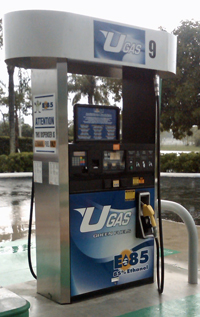 RFA Director of Market Development Robert White says this is a milestone in E85 history. “Being in the Miami metro area promoting E85 shows that this is not a Midwest niche fuel any longer,” White said. “This is a product that can be distributed and sold anywhere in the country and we are able to take E85 where the people and the flex-fuel vehicles are.”
 President Barack Obama
  Meanwhile, during his visit to Nellis Air Force Base in Nevada yesterday, Obama talked up the promise of clean energy for creating green jobs in America.
 President Obama was talking about the power of the sun today at the nation’s largest solar array.
 Our friends at the National Algae Association’s Mid-South Chapter has snagged some impressive speakers for their upcoming workshop, “Algae: The Race for New Oil,” on June 12, in Orlando, Florida. Among those speaking will be Ronald Pate of Sandia National Laboratories, who will talk about the U.S. Department of Energy’s take on the OBP’s Recovery Act Funding Opportunities:
 Filling up with 85 percent ethanol paid off in a big way for an Indiana couple who hit the Hoosier Lotto jackpot this month.
 A spectacular fire over the weekend at the Minnesota Soybean Processors (MnSP) biodiesel plant in Brewster, Minnesota (no, that’s not a picture of the fire on the left… that’s from a NBB training video) has prompted the National Biodiesel Board to offer those in the industry and local fire officials of some tips on how to handle the rare fires at biodiesel production facilities.