Representatives from ethanol organizations and companies testified before the House Agriculture Committee this morning on proposed low carbon fuel standards.
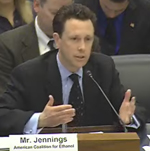 The heads of three ethanol trade associations all presented basically the same message when it comes to using indirect land use changes (ILUC) to evaluate the greenhouse gas emissions of renewable fuels – it is unproven theory that should not be used.
“The architect of the ILUC theory is Mr. Tim Searchinger,” said American Coalition for Ethanol executive director Brian Jennings. “Mr. Searchinger is not a scientist or an economist. He is an attorney, who for most of his career worked at the environmental organization Environmental Defense, consistently attacking American farmers and ranchers and the public policies that ensure our stable supply of food, fiber and fuel.”
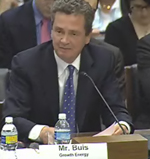 Tom Buis, CEO of Growth Energy, said they would support ILUC if it were done correctly. “First, it should apply equally to all transportation fuels. Second, it should be based on universally accepted science and economic modeling. Third, the international land use requirement should be eliminated,” Buis said. “The low carbon fuel standard proposals at the state and federal level that we have reviewed do not meet these two requirements. Oddly, science and parity have not been part of the equation – which makes us seriously question the motivation.”
 Renewable Fuels Association president and CEO Bob Dinneen says the modeling being used to determine indirect land use is simply not good science. “The tremendous uncertainty and inherent lack of transparency associated with analysis of international indirect land use changes makes it extremely difficult for regulators to legitimately use these results to assign penalties for international indirect effects to the carbon score of various biofuels,” Dinneen said. “Models should be seen as learning tools, not truth machines.”
Dinneen also said they believe the EPA’s lifecycle greenhouse gas analysis of ethanol is not what Congress intended in the 2007 Energy Independence and Security Act (EISA) which specifically limited such consideration of indirect emissions to those “related to the full fuel lifecycle, including all stages of fuel and feedstock production and distribution” – not food production.
 Testimony also centered on the impact ILUC calculations could have on the future development of advance biofuels. “In my view, there are not, and will not be, any “significant” indirect impacts from advanced biofuels production – the literal test required by the terms of EISA,” said Verenium president and CEO Carlos Riva. “Because there is zero commercial-scale production of such fuels today, and there are only trivial quantities of advanced biofuels production in prospect in the immediate 3-5 year time horizon. We have the time to get this right, and we must get it right.” He encouraged the panel to recommend modifications to EPA’s proposed rule.


 Getting ready to take off on your summer vacation? Planning to drive 100… 200… 1,000 miles from home? How about 60,000 miles? That’s been Brian Brawdy’s 11-month long road trip fueled with biodiesel, solar and wind power… plus he captures rainwater when he can to drink.
 Brawdy has been using a Ford F-350 diesel pickup truck with a camper in the bed during his cross-country adventure he has dubbed “Conservation through Exploration.” In this latest edition of the Domestic Fuel Cast, he tells me that the solar panels and wind turbine have allowed him to get truly off the grid and see some places that most people can’t even get to.
 There are many opportunities and challenges facing the renewable energy industry. To achieve long-term success, one of the greatest hurdles the industry must overcome is garnering consumer support and product adoption. This has been tough for the corn-ethanol industry in part, due to media hostility and biased reporting.
 Duke Energy
 On June 15, Sunoco Inc. is scheduled to be the owner of a former Miller brewery near Syracuse, NY. Northeast Biofuels L.P. filed bankruptcy in January this year and is now being purchased by Sunoco for $8.5 million.
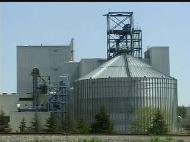 Sunoco spokesman Thomas Golembeski said that this aquisition would supply 25 percent of the ethanol Sunoco needs to blend into gasoline to meet renewable-fuels standards. He noted that Sunoco was attracted to the Northeast Biofuels plant in Volney, NY because it was close to Sunoco’s main operations in the Northeast. Golembeski also said the company hoped to save some money in the shipment of ethanol from the Midwest, where most of the nation’s ethanol is made and where corn production is concentrated.
 Get your reservation in for the next free Farm Foundation Forum, as the topic of discussion will turn to the subject of greenhouse gases and the options for agriculture.
 Canadian waste-to-biofuels technology company Enerkem has received North America’s first unconditional commercial permit to produce advanced biofuels, in particular, ethanol, from sorted municipal solid waste.
 Look out corn and sugar, an untapped source for ethanol could be on its way — watermelon. According to the USDA, Agricultural Research Service (ARS) in Oklahoma has been testing ways to make the simple sugars found in watermelons into ethanol, and the USDA is now reporting some success on that front.
  The National Watermelon Association began working with the USDA in 2006 to see if the 700-800 million pounds of blemished melons (and late-season melons that are not worth it for big farms to harvest) could find another life as ethanol instead of being plowed back into the ground.
  Algae is being seen as the next great feedstock for biodiesel… if the industry can grow the algae and extract the oil in a commercially-viable way. To that end, our friends from the