

Ford Motor Company has been making news recently with its announcement that using ethanol in its “Eco-Boost” engines can increase fuel economy. The system which is known as Direct Injection Octane Boost, has the potential to increase fuel economy between five to 10 percent. The improved fuel economy is realized by injecting a quick burst of ethanol into the combustion chamber prior to a regular injection of unleaded gasoline. Ford is already working on its second generation Eco-Boost V6 engines.
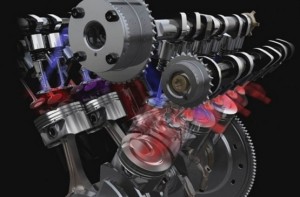
It appears that the technology will debut in the U.S. market in the Lincoln MKS. This technology is one of a kind and Ford has filed documents with the Department of Energy confirming that their “Bobcat” V8 engines will be brought to market in the F-truck series range.
The technology was developed in conjunction with Ethanol Boosting Systems and capitalizes on ethanol’s higher octane rating to improve power and fuel economy. This is similar to a driver of a flex-fuel vehicle who is burning E85 getting a power boost when stepping on the accelerating.
The system uses to separate tanks, one for ethanol and one for gasoline but according to company sources the ethanol tank will only require periodic filling due to the small amount of ethanol used.
While better fuel economy is always a benefit, especially with the volatility of gas prices, there is a drawback–the car sporting the Eco-Boost technology still uses gas as its primary fuel.
 After becoming one of the top three wheat exporters in 2008, Russia is now determined to play a pivotal role in the flow of worldwide agriculture markets. Russian Federation’s President Dmitry Medvedev has proposed closer coordination between global grain exporters and said, “excessive protectionism had encouraged speculation in global grain markets,” during the
 While I’ve always admired U.S. Marines for their ability to go anywhere, anytime, under any conditions – and kick some serious butt!!! – you have to admire the way they are also looking out for the environment.
 The stock in a company that seemed to be wiped out by Hurricane Ike last year has taken a dramatic jump. While Texas-based renewable energy company Greenhunter Energy Inc won’t say anything about Tuesday’s 62 percent surge in price,
 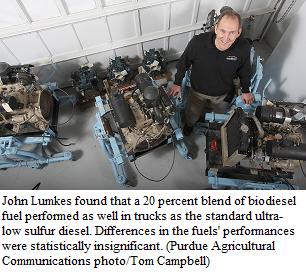 “In terms of performance, reliability and maintenance costs, it was basically a wash,” said John Lumkes, the assistant professor of agricultural and biological engineering who led the study. “The only differences are environmental and economic.”
 The
The  One of the issues with burning higher blends of biodiesel in newer diesel engines that use post-injection for controlling emissions is significant engine wear with methyl ester dilution in the engine oil crankcase.
 “Further developing the biofuels industry helps create jobs and stimulates rural economies, an important part of getting our economy back on track,”