

 The National Renewable Energy Laboaratory (NREL), a laboratory for the Department of Energy, is testing higher blends of ethenol to be used in vehicles. Researchers are trying to find out, because these new ethanol blends could play a significant role as America tries to wean itself off petroleum based fuels.
The Energy Independence and Security Act of 2007 (PDF 821 KB) (EISA) is one force behind the quest for higher ethanol blends. The 2007 law requires that the U.S. use 36 billion gallons of renewable fuels by 2022. But, a leaner benchmark is just around the corner, with 15 billion gallons required by 2012.
“We’re pushed right now to find ways to get more ethanol into the fuel stream,” said Keith Knoll, senior project leader for NREL’s Fuels Performance Group.
Currently, ethanol is the most widely used and readily available renewable fuel. As a result, it is a likely candidate to make up a significant chunk of the 36 billion gallons required under EISA. Ethanol as a motor fuel is commonly found in E85, a fuel intended for use only in Flexible Fuel Vehicles (FFVs). Ethanol also is widely used as a 10 percent blend in standard gasoline (E10) to reduce carbon monoxide emissions and smog. But, increasing ethanol from the current 10 percent blend to a proposed blend of E15 or even E20, brings up a whole host of questions and issues.
For instance, E20 is currently not allowed for use in conventional automobiles under the Environmental Protection Agency’s (EPA) Clean Air Act. This is where research from NREL and Oak Ridge National Laboratory (ORNL) will play a pivotal role in understanding how blends like E15 and E20 affect vehicles currently in the market. The research is examining whether using higher ethanol blends will have an adverse impact on tailpipe emissions, exhaust temperatures, catalytic converters and engine performance and durability.
 They say that fiction is truth sprinkled with a few well placed lies. In this week’s book, “Black Monday,” by
  Although UNICA supports the idea in some aspects, they also note that various aspects need further analysis. One such area of concern involves the challenges in defining the concept of food security, due to the crop’s dual functions as to provide both food and energy. The proposal, as currently written, could lead to restrictions in growing sugarcane that would, according to UNICA, “have the reverse effect in terms of food security, by restricting the production of additional sugar.” Brazil supplies 60 percent of the world’s sugar needs after supplying its own.
 Mark your calendar for October 1st and 2nd for the third annual Alternative Energy Symposium held at the campus of Chicago State University.
 A car that is part Prius Hybrid, part algae-biodiesel burner, has completed a 3,750-mile trip from San Francisco to New York City… the first cross-country trip running on a blend of algae-based gasoline in an unmodified engine.
 The trip was sponsored by the Veggie Van Organization, the group founded by movie producer and biodiesel advocate Josh Tickell that is dedicated to moving the country away from petroleum. The trip was also to celebrate the nationwide opening of Tickell’s film FUEL, which aims to inspire green energy solution thinking, such as the Algaeus.
 Since May, eight sweet sorghum varieties have been growing on a Wicomico County farm for evaluation as potential stock for ethanol production on the Delmarva peninsula. Dr. Samuel Geleta of Salisbury Univerisity’s Biological Sciences Department says about half of the varieties have already been harvested, with the rest to be finished by mid-October. Some of the plants grew to a height of 12 feet. He said sweet sorghum is attractive because it is drought resistant, fast-growing and has low nutrient and fertilization requirements. “Sweet sorghum can be grown on marginal land with less fertilizer and water as compared to corn,” Geleta said. “Since sweet sorghum juice contains simple sugar, producing ethanol from it simply requires extracting the juice and fermenting.”
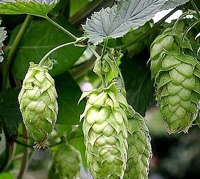 Any good beer drinker knows that hops are primarily used to make beer and the vast majority of hops grown world wide are used by breweries. The top hops producing country is Germany, followed by the United States. Hops are used extensively in brewing today mainly because they balance the sweetness of the malt with bitterness, contributing a variety of desirable flavors and aromas, but also because they have an antibiotic effect that favors the activity of brewer’s yeast over less desirable microorganisms.
  “If EPA insists on counting the angels on the head of a pin, it needs to do so on every pin and that includes the indirect impacts of petroleum production and use,” said Renewable Fuels Association Bob Dinneen. “All energy choices come with trade-offs. By focusing solely on the impacts of biofuels, EPA has created shell game only petroleum can win. EPA must revisit its proposed rule, make its methodologies and calculations transparent, and redraft a program that is fair and workable for all parties. EPA’s current version fails on all counts.”
 BP expects biofuels to displace 25 percent of fuel in the U.S. in the next two decades, the head of BP’s alternative energy unit said.
  Members of the