

A new report from the Environmental Law Institute (ELI) finds that federal subsidies for fossil fuels are twice that of renewables.
 According to a summary on the ELI report store website:
The largest U.S subsidies to fossil fuels are attributed to tax breaks that aid foreign oil production, according to research released by ELI. The study, which reviewed fossil fuel and energy subsidies for Fiscal Years 2002-2008, reveals that the lion’s share of energy subsidies supported energy sources that emit high levels of greenhouse gases. Fossil fuels benefited from approximately $72 billion over the seven-year period, while subsidies for renewable fuels totaled only $29 billion.
The report found that about $16.8 billion in subsidies went to corn-based ethanol over the seven year time frame with most of that coming from the blenders tax credit.
ELI Senior Attorney John Pendergrass says the report indicates a lack of support for more environmentally friendly energy sources. “The combination of subsidies—or ‘perverse incentives’— to develop fossil fuel energy sources, and a lack of sufficient incentives to develop renewable energy and promote energy efficiency, distorts energy policy in ways that have helped cause, and continue to exacerbate, our climate change problem,” Pendergrass said in a press release. “With climate change and energy legislation pending on Capitol Hill, our research suggests that more attention needs to be given to the existing perverse incentives for ‘dirty’ fuels in the U.S. Tax Code.”
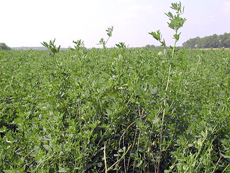 The lowly alfalfa crop could play a role in the future of cellulosic ethanol.
  Pioneer Director of Alfalfa Research Dave Miller says they believe cellulosic ethanol will need multiple feedstocks and alfalfa is a good fit for a number of reasons. “It’s great for crop rotation, its environmental benefits in terms of lack of soil erosion because it’s deep rooted and a perennial are well known, and it fixes nitrogen.”
 Clear your calendar for a
  Algae is all the rage as the next great feedstock for biodiesel… although the longtime champion for the green fuel, soybeans, might not be ready to give up its crown to the green pond scum.
 One the one hand, you have guys like Riggs Eckelberry, the CEO of
  Leonard Kosar, CEO of
  One of the most oil-rich countries in the world will be making ethanol from excess dates. Iraqi government has approved a plan to produce the clean burning alernative in attempt to boost their economy.
  Prior to the US-led invasion of Iraq, the country produced more than 900,000 ton of dates per year. The country only used about 150,000 ton so the remaining was exported. However, since 2003 the market for Iraqi dates has dried up to the point where only about 350,000 ton of them are produced annually.
 The Sundance award winning documentary,
  Snapping a photo of his daughter stopping to smell the flowers paid off for Rich Johnson of Omaha, Nebraska who has been named the winner of the
  As the winner, Johnson received a $1,000 fueling card, presented by RFA Director of Market Development Robert White. “Educating consumers is all about engaging them where they live and in ways that motivate them to act,” said White. “Based on this contest alone, tens of thousands of Americans were exposed to ethanol-related information, many for the first time.” White says Heather Litton of Westerville, Ohio, won the Most Voted Award and $100 in fuel for her photo entitled “Ethan.”
 In what’s being characterized as an “historic national program” that would dramatically reduce greenhouse gas emissions and improve fuel economy for new cars and trucks sold in the United States… vehicles that can run on B20, a 20 percent blend of biodiesel… will be considered flexible fuel vehicles.
 A couple of years ago, I told you about how the Utah Department of Transportation was planting safflower, camelina, canola and perennial flax in a safety strip along Interstate 15 and then crushing the seeds to make biodiesel (see
  General Wesley Clark, Co-Chairman of
  General Clark rose to the rank of four-star general after nearly 40 years of service in the U.S. Army. He has lead Growth Energy since February 2009, working to increase American energy independence by expanding the use of environmentally-friendly ethanol.