

 Chicago-based Zenergy International has bought the Greenlight Biofuels biodiesel plant near Lubbock, Texas.
This Zenergy press release says the deal should be finalized in the next few weeks:
Greenlight Biofuels Ltd. has developed a robust, proprietary, and proven technology capable of processing a variety of feedstock. In alignment with the corporate strategy, having technology that can use flexible feedstock is particularly advantageous, as upon market pricing fluctuation the feedstock sources can be changed in accordance with where the best value lies.
Zenergy International has recently embarked on a biodiesel facility acquisition strategy. With Greenlight Biofuels, Ltd. the company has invested in an operation capable of producing five million gallons per year, with 40 acres of land, providing considerable room for expansion.
The release goes on to say the Greenlight Biofuels plant is on a transport corridor, close to a number of transport fueling depots, that should help it provide significant local revenues.
 A new solid catalyst could save some green fuel makers some green in their wallets.
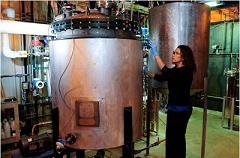 Catilin is commercializing the research done in developing the new catalyst at Iowa State University in Ames and the U.S. DOE’s Ames Laboratory. The T300 heterogeneous catalyst is nontoxic and can be a direct replacement for conventional catalysts used in biodiesel production. The drop-in solid catalyst operates at industry standard pressures and temperatures and is removed with filtration. As a result, current producers can retrofit their plants in a matter of days at very low cost. Another key advantage is that the glycerin coproduct has purity greater than 98 percent and qualifies as technical grade, which significantly enhances its overall value.
 One of the stars on hand to address the crowd at
  “It’s what we do. We sell blenders to everyone,” said Scott Negley, director of alternative energy products at
  The cars are the result of the work Roush has been doing with propane in gasoline
 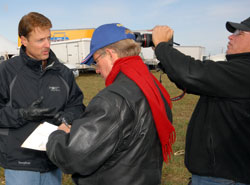 POET CEO Jeff Broin, seen here being interviewed in the field this morning, is glad for sunshine. At last year’s Project LIBERTY Field Day we had a wet one.
 An Iowa State University researcher has been named “Innovator of the Year” for his work on biofuels.
 The Kerry-Boxer climate bill is set for markup tomorrow (Tuesday, Nov. 3) in the U.S. Senate Environment and Public Works Committee… whether or not any Republicans decide to come along.
 Now here is an energy resource that we don’t hear or talk enough about: geothermal. Engineered Geothermal Systems (EGS) projects produce electricity using heat extracted through engineered fluid flow paths in hot rock. Geothermal energy has the ability to produce electricity 24 hours a day.