

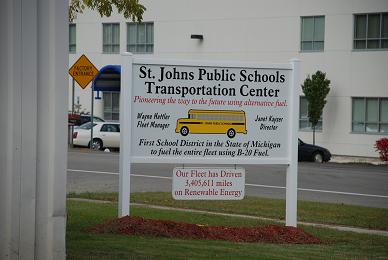
 A school bus in Michigan has just hit 300,000 miles, and the bulk of those miles have come while running on biodiesel.
This National Biodiesel Board press release tells the tale of Bus #14 of the St. Johns, Michigan Public School system, which started burning a 20 percent blend five years ago:
“Since switching to biodiesel, it is much cleaner and smells much better,” the 20-year veteran of the St. Johns, Mich. Public Schools said. “When fueling, you don’t have the smell on your hands all day. Your clothes don’t smell like diesel all day. It is a much better work environment and much healthier for the kids and the community.”
The school district’s switch to B20 in 2002 came from the persistence of Wayne Hettler, Garage Foreman & Head Mechanic for St. Johns. His foresight has led to a reported track record of bus longevity and reduced service needs, saving the school district money.
Last week, “bus #14” rolled over 300,000 miles – a milestone Hettler attributes to B20 and believes no other Michigan school bus used on a daily route has achieved.
In October, 2002, bus #14 had 119,621 miles on the odometer. That was the first day of the rest of its life on B20. Since then, the maintenance on this engine has been very low with the only unscheduled maintenance being a $160 lift pump and a $90 injector, according to Hettler.
St. Johns officials add that due to the extra lubricity biodiesel brings to the table, the school district has been able to extend the mileage between oil changes from about every 6,000 miles to 12,000-18,000 miles, saving the district money on oil and filters. The district figures it has driven 3 million miles on B20.
The program hit a bit of a snag when rising biodiesel costs forced school officials to cut to B5, but they hope that they’ll be able to go back to B20 soon.
 Coming to Omaha, Nebraska on November 10-12, the Operators’ School is designed to educate ethanol producers on the ins and outs of alcohol production, the latest troubleshooting techniques and technology used in the industry. The three day conference will be held at Scott Conference Center at 6450 Pine Street.
  According to the
  The second award included the Clean Fuels Foundation and the
  President Clinton was the keynote speaker during the closing session at the
  What do salt and oil have in common? In its time, the world was overdependent on the strategic commodity (oil today and salt more than 100 years ago). Our country (nor the world) is “salt dependent” but the world is oil dependent, but not in the way that most people define oil dependence. “That is what energy independence means: that it no longer matters who holds the reserves, that oil becomes much less relevant to global affairs, that it becomes just another commodity,” writes Gal Luft and Anne Korin, in “Turning Oil Into Salt Energy Independence Through Fuel Choice.”
 Representatives from the
  A Minnesota corn grower has been named to the board of directors for
  Pestorious also served three years on the Board of Directors of the American Coalition for Ethanol, representing the Minnesota Corn Growers Association, as well as on the board of the Ethanol Promotion and Information Council, until its merger with Growth Energy last year, and previously served as a member of the Renewable Fuels Association in his role for the last 10 years as Chair of POET-Glenville. He also serves on the boards of POET-Hanlontown (Iowa), a 50-million gallon-a-year plant, and POET-Lake Crystal (Minn.), a 55-million gallon-a-year plant, and serves as Chair of SoyMor, a 30-million gallon biodiesel plant.
  President Barack Obama was touting renewable energy during his visit this week to the Massachusetts Institute of Technology.
 The U.S. Navy has launched a new program to green its fleet… and biodiesel and ethanol are important elements of that campaign.
 The
The