

 Some students in Minnesota will soon be breathing easier on their way to school … no, not because they won’t be hit up with that big algebra test. A school in the Minneapolis-St. Paul area is testing propane in one of its buses.
The Star-Tribune reports that Eastern Carver County school drivers have been testing the propane bus to see if can hold up to that “special kind of cold” that only a Minnesota winter can bring:
Should it pass the test, starting up every morning and running well all day, district leaders say they’ll likely make the switch this spring with most of their buses when their new busing contract goes out to bid.
That would make Eastern Carver County Schools the first Minnesota district to convert from diesel to propane-fueled buses, and it could pave the way for other districts to follow suit.
The St. Francis School District has already ordered a smaller school bus that runs on propane for transporting special education students, and it’s set to arrive as early as next month.
Other Minnesota school districts eagerly waiting to try out the new bus include Minneapolis, Bloomington, Waconia and Pequot Lakes.
Propane is already being used in school districts in California and Texas, but, of course, they don’t have the kind of weather Minnesota basks in during the winter. Now, some bus drivers in the land of 10,000 lakes remember trying to use propane in the winter back during the 1970s and ’80s and the trouble with stalling during the cold. But these new propane-fueled buses seem to have those cold weather blues licked.
Plus, with the cheaper cost for propane … it runs just between $1.50 and $1.75 a gallon – much less than diesel’s $2.85 a gallon – plus a federal tax refund is available for propane … you can see why the schools are testing the clean-burning fuel to further offset the cost of the fuel purchase. No need to test your algebra skills too hard to see that it adds up to savings for schools and easier breathing for students (especially if it’s test day).
 The new Renewable Fuels Standard … aka RFS-2 … is set to be released in just the next few days. That’s why the National Biodiesel Board has extended the regular registration rates, as well as the

 Ethanol advocacy organization
  Making the announcement at the Washington Auto Show Tuesday morning were Ricardo President Kent Niederhofer (left) and Growth Energy Co-Chairman (Ret.) Gen. Wesley Clark, pictured here with the engine. “EBDI engine technology offers a uniquely American solution for a wide range of vehicle applications, combining extreme optimized flex-fuel engine technology offering high fuel economy, low emissions and uncompromised performance using a source of renewable fuel produced here in the United States,” said Niederhofer.
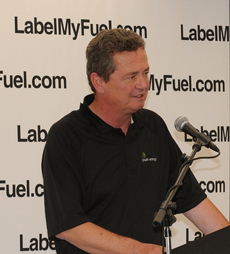 The polling data was released in conjunction with an announcement by U.S. Rep. Bruce Braley, D-Iowa, that he intends to introduce legislation mandating that all gasoline sold in the U.S. carry country-of-origin labeling (COOL). Growth Energy launched a
  Meet the Metalback motorcycle concept. Designed by Jordan Meadows, a man with plenty of street cred when it comes to vehicular design. The Metalback concept combines alternative fuels and recycled materials in a missle-shaped machine drawn straight from some science fiction dystopian future. And it just plain old looks cool.
 The
The  While agreeing with ABO’s contentions with the study, Riggs Eckelberry, CEO of algae-biofuel maker Origin Oil, says the research does prove that the old way of turning algae into biodiesel is not a valid method anymore. And it’s not a method his company practices.
 Eckelberry says the Virginia study confirms earlier research that OriginOil did that found you need to co-locate algae-growing operations with other CO2 producers, you can’t use vast amounts of land, and non-potable water must be used, among other things. But Eckelberry says the algae industry has done a poor job getting that word out, with his own company’s research all but ignored months ago. He hopes this will serve as a wake-up call for the algae industry’s advocacy group.
 Hutchinson Salt was the first mine of any kind to use B99. Since 2003, the company has used between 17,000 and 30,000 gallons of B99 a year, depending on the demand for salt.
 “Given what we know about algae production pilot projects over the past 10 to 15 years, we’ve found that algae’s environmental footprint is larger than other terrestrial crops,” said Andres Clarens, the study’s lead author. “Before we make major investments in algae production, we should really know the environmental impact of this technology.”