World’s First Hybrid Biomass-Solar Refinery Announced

John Davis

A Colorado company has come up with a way to harness to power of the sun to unlock the energy in biomass.

This post from the CalFinder blog says Sundrop Fuels has developed the world’s first hybrid solar-biomass refinery that uses concentrated solar power (CSP) to heat plant scraps and wood chips to create biofuel:

The use of solar power to reduce consumption of biomass at the refinery should considerably improve their product’s energy balance, i.e. energy put into production versus energy pulled out. Sundrop’s SurroundSun reactor technology is similar to relatively new Power Tower tech now used to create solar thermal electricity. In fact, Sundrop has licensed CSP technology from well-known start-up eSolar to make their prototype biorefinery a reality.

Instead of using mirrors to reflect sunlight and to heat water or molten salts in a central tower, Sundrop Fuels’ design will use that solar energy to heat biomass to very high temperatures. The solar heat “blasts organic materials with super high temperatures…tearing apart the materials at the molecular level…which creates a synthetic gas that can be formed into gasoline or diesel,” said Sundrop CEO Wayne Simmons.

Sundrop officials admit they will have to burn some biomass to hit the temps needed, but the process will get about 30 percent of the heat needed from the sun.

The company is hoping to find some investors for a demonstration project and another $100-150 million to build an 8-million-gallon-a-year plant.

biomass, Solar

Biodiesel Provisions Laid Off from Jobs Bill

John Davis

So close … but yet so far. A provision in the U.S. Senate’s jobs bill that would have restored the $1-a-gallon biodiesel blending credit … and preserved about 23,000 jobs on its own … started the day in the employment measure. But it found itself in a position many looking for jobs are familiar with: last hired, first fired.

The Hill reports that the provision, sponsored by Iowa’s Sen. Charles Grassley, a Republican, didn’t make the cut as Senate Majority Leader Harry Reid, a Democrat from Nevada, pared-down the jobs package to omit several energy provisions:

“Clearly, the National Biodiesel Board is disappointed that Senate leadership decided to pull the biodiesel tax incentives from the current jobs bill,” said Michael Frohlich, a spokesman for the trade group. He added that leadership should recognize that “saving 23,000 jobs that are in immediate jeopardy is inextricably linked to a true job-saving and creation agenda.”

The trade group calls the credits vital to the battered industry. Frohlich said the producers will seek to have the Senate add extension of the credits – which lapsed at the end of 2009 – to the current package or another measure soon.

“This really is an immediate need to this industry,” he said.

Extension of the credits is a top priority for Grassley, the Finance Committee’s top Republican. Iowa has over a dozen biodiesel plants, according to the Iowa Renewable Fuels Association.

Jill Kozeny, a spokeswoman for Grassley, said there is biodiesel production in 44 states overall. “They are losing jobs since the credit expired at the end of the year, and restoring the credit as quickly as possible is essential to saving these renewable energy jobs,” she said.

The bottom line is Grassley will have to go back to work to find another way to get the renewal up for a vote, perhaps attached to another one of the many jobs bills Reid’s office is promising.

Biodiesel, Government, Legislation, NBB

REG Outlook

Chuck Zimmerman

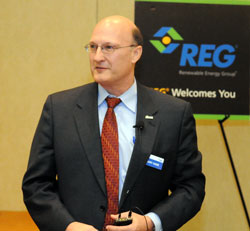
Gary HaerDuring the National Biodiesel Conference, Renewable Energy Group (REG) held an outlook conference at which they provided an overview of the company as well as a look ahead. One of the speakers was Vice President, Sales and Marketing, Gary Haer.

Gary says the new RFS-2 gives the industry a good foundation for demand. He says the industry took a step back last year but he sees good market opportunities coming. Another driver for growth will be state initiatives like those in states like Minnesota. Some are in place now or are expected at a future date. He says REG assists in these state processes with staff that work on government relations. Other drivers include the biodiesel specifications that may require labeling in some states.

Gary says that the company plans to have a free webinar available on RFS-2 on February 24th. Information about it should be available on their website.

REG has released several reports that are available for download:

“Feedstock and Biodiesel Characteristics” (pdf)
Steryl Glucosides Study (pdf)
Moisture Study (pdf)
Soap Study (pdf)

You can listen to Gary’s comments below.

National Biodiesel Conference Photo Album

Biodiesel, Biodiesel Conference, conferences

NBB Eye On Biodiesel Award Winners Announced

Chuck Zimmerman

Here are this year’s National Biodiesel Board “Eye on Biodiesel Award” winners. These were presented during the last general session. Award descriptions were provided by NBB.

Terry TaylorImpact: Terry Taylor, Sysco Corporation.
Sysco, North America’s leading foodservice marketer and distributor, has led the way in implementing biodiesel in private industry. The company first began using biodiesel in 2005 as part of its comprehensive sustainability program. Terry Taylor, Sr., Director ˆ National Purchasing, says he saw it as a greener alternative that was a simple way to help our country also reduce its use of foreign oil. Sysco has distribution centers across the nation and in Canada and has a company policy to use biodiesel blends, wherever possible, up to B20. The company today uses about 2 million gallons annually of blended product in its fleet of 9,000 diesel tractors and straight trucks, and 11,000 refrigerated trailers.
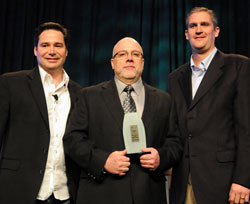
Wayne HettlerInspiration: Wayne Hettler, St. Johns Public Schools, St. Johns, Mich.
This Michigan school bus fleet manager convinced his district to switch to B20 in 2002. It has since clocked more than 3 million miles on B20. His enthusiasm for biodiesel has helped inspire other fleets make the switch. He has talked to many school districts and other fleets from across the U.S., offering technical advice and support. Hettler also partnered with NBB to provide detailed data on maintenance. His records showed that thanks to fewer oil changes and not needing to buy fuel conditioner, his fleet saved money with biodiesel.
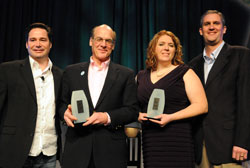
AOCS and Gina ClapperIndustry Partnership: The American Oil Chemists’ Society and Gina Clapper.
AOCS is a global professional scientific society in the fats, oils, surfactants, detergents and related materials fields. In keeping with its mission to be a forum to promote the exchange of ideas, information, and experience, AOCS has provided numerous opportunities for those in the biodiesel field to share knowledge, including two international congresses on biodiesel, several publications, short courses, and technical sessions at its annual meeting. Technical Specialist Gina Clapper has been instrumental in coordinating the development and approval of new biodiesel test methods. Faster, simpler, more cost-effective tests help the industry provide high quality biodiesel meeting ASTM standards at a lower cost to consumers. Clapper also has taken leadership roles within International Organization for Standardization (ISO) activities and the Biodiesel Expert Panel of the AOCS.
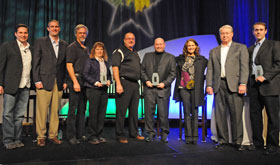
State Soybean AssociationsInitiative: The Iowa Soybean Association, Minnesota Soybean Growers Association, and Nebraska Soybean Association.
When NBB issued a call to action for the biodiesel industry to submit comments to EPA on its proposed Renewable Fuels Standard rules, soybean farmers answered the call. These three organizations led the way for the biodiesel industry in submitting comments into the EPA. They alone generated more than a third of the 8,000 comments biodiesel supporters submitted regarding the proposed standard. The result demonstrated biodiesel’s and the Renewable Fuel Standard’s importance to a broad range of stakeholders.

Ramiro LopezInfluence: Ramiro Lopez, City of Irving, Texas.
Lopez initiated B20 in the City of Dallas in 2002. Since then he has mentored other fleets, and about a dozen fleets now use biodiesel in the area. He has also mentored fleets nationwide, and spoken at national events about his successful program. He now works for the City of Irving.

“The biodiesel industry is blessed with many champions and true believers,” said Joe Jobe, NBB CEO. “Each of these winners has helped carry the biodiesel torch, fostering understanding, mentoring others and encouraging broader use of a cleaner burning, sustainable fuel.”

National Biodiesel Conference Photo Album

Biodiesel, Biodiesel Conference

New Wisconsin Wind Turbine Plant to Employ 600+

John Davis

A new wind turbine blade plant in Wisconsin is expected to put more than 600 new workers on the job.

This post on the GreenRightNow.com Web site says the Energy Composites Corp. (ECC) facility in Wisconsin Rapids got some help in the form of $238 million in municipal tax-free bonds from a pool of money created with federal stimulus dollars:

“Tax-free bonds are a critical component of our financing plan for the 535,000 square foot plant,” noted Sam Fairchild, Energy Composites’ CEO, in a statement. “Development costs for our new factory are too large for traditional Industrial Development financing programs, and the Recovery Zone Bond program, which expires at the end of 2010, is precisely the right solution at precisely the right time…

The 535,000 s.f. plant will be capable of making wind blades 65 meters in length that can supply both onshore and offshore wind farms, and will be build with “a maximum range of flexibility in production design” to be able to accomodate technological advances. The facility will partner with Mid-state Technical College, where prospective employees can get training in blade fabrication.

So at a time when we hear about how too many of the stimulus bucks are going overseas and stimulating economies overseas, it’s nice to hear about some of the money staying home and helping here.

Wind

Propel Launches $20 Mil Biofuels Stations Expansion

John Davis

Sacramento-based Propel Fuels has announced it is investing $20 million into an effort that will put its biofuels, as well as hydroge and electric vehicle charging areas, into stations in every major market in California.

This company press release says the move supports California’s emissions reduction goals while stimulating jobs:

“California has the largest fleet of alternative fuel vehicles in America and the market is significantly underserved,” said Matt Horton, CEO of Propel. “This funding allows us to build on strong consumer demand and bring alternative fuels to more than 2 million alternative fuel vehicles on California roads today.”

Concerns over the price, long‐term supply and environmental impacts of petroleum have led California companies to invest hundreds of millions of dollars into advanced biofuel production technologies. With numerous advanced biofuel production facilities preparing to break ground in the state, Propel’s fueling infrastructure is a critical link between California’s citizens and the next generation of low
carbon fuels. In addition to liquid fuels, Propel’s retail platform is extensible to meet demand for future transportation technologies including hydrogen and electric vehicles.

Propel officials believe they have the right business model for the current and future demands for renewable fuels.

biofuels

Tennessee Town to Put In Biodiesel Brewer

John Davis

A town in Tennessee has bought a new biodiesel processing system that will also reduce the city’s waste.

Biofuels International reports the city of Clarksville got some help from a federal grant that allows Clarksville Gas and Water to convert used cooking oil into the green fuel:

The city hopes that the biodiesel produced will eventually power the city’s buses. This will cost significantly less, as ordinary diesel is priced at almost $2.80 per gallon (€2).

‘We think that we’re procuring this product for about $0.92 to $0.95 a gallon. That’s, of course, very much lower than diesel,’ said Tommy Williams, a supervisor at the wastewater plant in Clarksville.

The feedstock is donated used cooking oil from a dozen restaurants, keeping the grease out of the sewer lines and providing biodiesel into buses and other city vehicles.

Biodiesel

Movie Review – Crude

Joanna Schroeder

Yesterday I reviewed the book Crude World and today I watched the documentary Crude directed by Joe Berlinger. Ironically, Crude follows the multi-year struggle of 30,000 indigenous and colonial rainforest dwellers of Ecuador as they struggle to hold Chevron accountable for what many environmentalists are saying is the world’s worst case of oil contamination ever. This story was told in one chapter of Crude World, but you don’t really embrace the full effect of the devastation and human struggling until you witness it yourself.

The lawsuit was filed against Texaco but when Chevron merged with Texaco in 2001 they inherited the suit. Originally filed in the United States, the suit was dropped and moved to Ecuador where against all odds, the courts proceeded with the case. The people are led by local lawyer Pablo Fajardo who is being assisted by American lawyer Steven Donzinger. The documentary covers three years of the case and follows the plaintiffs to three continents and begins with the judges orders to visit the contamination sites.

Eventually, the judge orders a third party to come in and test the various contamination sites (which Chevron has claimed to test and found no pollutants that exceed U.S. EPA regulations). When the 4,000 page report is released in 2008, it “recommends compensation for environmental remediation, excess cancer deaths, impacts on indigenous culture, and Texaco’s ‘unjust enrichment’ from its operations.” The monetary cost: $27 billion dollars.  Read More

book reviews

Second Ethanol Blend Pump Offered in Missouri

The second ethanol blender pump has opened in Missouri. The Temp Stop is located at 100 SE Todd George Road in Lee’s Summit, Missouri. The station will offer E20, E30, E85 and regular gasoline.

“With the addition of these blender pumps, consumers can seize the opportunity to utilize a homegrown, renewable fuel,” said Bradley Schad, Missouri Corn associate director of ethanol blends. “Not only does ethanol burn cleaner than gasoline, it helps reduce our dependence on foreign oil and keeps U.S. dollars here at home.”

According to the Missouri Corn Growers Association, the Temp Stop blender pumps are part of a pilot program with Missouri Corn and the Missouri Department of Agriculture Division of Weights and Measures.

“We’re proud to be part of this movement to promote a cleaner environment,” says Terry Green, CEO of Temp Stop in Lee’s Summit. “Together with our fuel supplier, CarterEnergy, we’re making E20, E30 and E85 available to our customers and offering them more choices than ever before when it comes to refueling their vehicles. These blended fuels give them a way to join the ‘green’ movement, too.”

Missouri Corn is currently working with additional retailers to establish more ethanol blending pump facilities in the state.

blends, corn, E85, Ethanol, Ethanol News, News

Fuel Change Time

Chuck Zimmerman

If you’ve ever attended a National Biodiesel Conference then you know Emily Richards and Jason Brock. These music stars are passionate about their belief in renewable fuels and have been regular performers at the conference.

This morning they took the stage during the closing general session and played some songs from a new album they’ve put together to promote biodiesel. I’ll have more on that in a later post as well as more stories from the conference. You can also find coverage on the Biodiesel Conference Blog.

In the meantime, I thought you’d enjoy a video of Emily and Jason being joined on stage by National Biodiesel Board Chairman, Ed Hegland and CEO, Joe Jobe. They did a variation of a song you’ll recognize and so give a listen to “Time For A Fuel Change.”

You can also listen to the song here.

Biodiesel, Biodiesel Conference, Video