RFA E-15 Ad

Getting Biodiesel Policy Right

Chuck Zimmerman

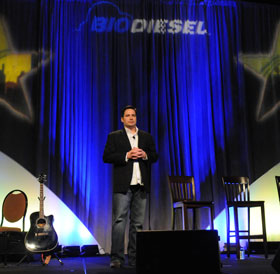
Joe JobeJoe Jobe, CEO of the National Biodiesel Board took the stage to lead the final general session today. I spoke to him afterward to get his comments on the conference and the industry in light of what the speakers have said during the last several days.

Joe says “it’s really been good” referring to the conference. There was an expectation that attendance would be down and especially with the weather and the announcement of the final rule on the RFS-2 last week but people showed up. Joe says that NBB is planning webinars to help the industry understand the new rules. He says that he echoes a feeling of optimism as expressed by many of the speakers who were on the program. Looking ahead he says that the industry is policy driven and NBB will work as hard as it can to “get the policy right.” That includes not only the RFS-2 but a long term biodiesel tax credit.

You can listen to my interview with Joe below.

National Biodiesel Conference Photo Album

Biodiesel, Biodiesel Conference

Feeding The Biodiesel Machine

Chuck Zimmerman

Feedstock PanelThe final general session of the National Biodiesel Conference featured a panel session titled, “Feeding the Biodiesel Machine: Understanding Feedstock Realities of Today and Tomorrow.”

Captivating new feedstocks for biodiesel have grabbed headlines around the world. But which hold the most promise for expanding the biodiesel industry’s immediate and long-term feedstock needs? What’s the secret behind playing the commodities market… and winning? In this panel we heard from industry experts with the inside track on feeding the feedstock machine. They included Dr. Dick Auld – Texas Tech University, Anne Frick – Prudential, Dallas Hanks – Utah State University, FreeWays to Fuel, Mary Rosenthal – Algal Biomass Organization and David Slade – Renewable Energy Group.

You can listen to the panel discussion below.

National Biodiesel Conference Photo Album

Audio, Biodiesel, Biodiesel Conference, feedstocks

RFS-2 Importance To Biodiesel Industry

Chuck Zimmerman

RFS-2 SessionThere have been three panels discussions on the new RFS-2 at the National Biodiesel Conference and they had to be moved to larger than scheduled rooms to handle all the people who wanted to hear about the new rules. The National Biodiesel Board is working on this issue and will be producing several webinars on the topic in the near future.

In the meantime, to learn more about it, I spoke with Paul Argyropoulos, EPA Senior Policy Advisor, Office of Transportation & Air Quality, who spoke at one of the sessions. I asked him what’s most important for the industry to know now. To start with he says, “We have a final rule which I think provides certainty to the market.” He then provides some additional points of importance specific to the biodiesel industry. I can’t figure out how to summarize them and they’re too long to translate so you’ll have to listen to the interview to hear them. That’s just the way it is with regulations this long and complicated. At this point he encourages you to dig into the regulations and understand what the reporting requirements are. He says they’re willing to work with you and they’re planning to produce some webinars as well. Paul says you can go to their website to get more information.

You can listen to my interview with Paul below.

National Biodiesel Conference Photo Album

Audio, Biodiesel, Biodiesel Conference, Government

National Biodiesel Conference Music

Chuck Zimmerman

Hello from the final general session at the National Biodiesel Conference. Emily Richards and Jason Brock are performing for us once again. I’ll have a very special announcement from them for biodiesel supporters to post later today.

I’m busy taking lots of photos for the Conference and a little behind on posts but will get caught up by tomorrow so don’t get too impatient. I’ve got good interviews on RFS-2 and all the activity from this morning’s session.

So stay tuned.

Biodiesel, Biodiesel Conference

Bright Lights of Vegas to be Powered by Wind

John Davis

A Nevada utility will get some of its power from wind energy.

This story from Las Vegas Review-Journal says NV Energy has signed a a deal to buy energy from a wind farm near Ely for the next 20 years:

Pattern Energy Group of San Francisco will build the 150-megawatt Spring Valley Wind Project, which would be Nevada’s first major, utility-scale wind plant.

NV Energy already has announced plans to codevelop with RES Americas the 200-megawatt China Mountain Wind Project near the Idaho border, but that project is still in the environmental-impact statement permitting process.

The Spring Valley project is scheduled for completion by late 2011. Neither company disclosed the terms of the agreement.

“We’re pleased to add more clean renewable energy for our customers, and this project is a good example of developing renewable energy resources in remote parts of our state,” said NV Energy President and Chief Executive Officer Michael Yackira in a statement.

In addition to creating clean energy, the wind farm will create more than 150 jobs during construction with another 10 permanently employed at the wind farm.

The deal is part of a state requirement that NV Energy get 25 percent of its power from renewable sources by 2025.

Wind

Biodiesel, Ethanol Key in “Big Oil” vs. “Big Ag” Fight

John Davis

It’s Big Oil versus Big Ag in the fight for the heart and soul … but mostly the pocketbooks … of transportation fuels users in this country, and biodiesel and ethanol are playing a key role in the battle.

This interesting post on the Cleantech Blog
says that Exxon, Chevron, and Shell … aka “Big Oil” … are having their petro-dollars cut into as we use more fuel-efficient cars and run on renewable fuels produced by “Big Ag” … ADM, Bunge, and Cargill. And the EPA’s new Renewable Fuels Standard … RFS2 … this year will cut into Big Oil’s gas and diesel sales by 8 percent … billions of dollars Big Oil doesn’t want to let slip away:

Exxon Mobil’s CEO Rex Tillerson famously referred to ethanol as “moonshine.” Now Exxon is investing $300 million in Craig Ventor’s Synthetic Genomics with plans to produce fuel from algae. BP Biofuels was voted 2009 Biofuels Corporation of the Year by the World Refining Association at its 4th annual Biofuels Conference. BP has poured hundreds of millions into basic biofuel research and into a variety of partnerships including biobutanol with DuPont and Virgin Fuels, and energy cane in the U.S. with Verenium. Shell has established a $12 billion sugarcane ethanol joint venture with Brazil’s Cosan (CZZ).

In the future, if biotech can deliver low-cost liquid hydrocarbons from biomass that can be profitably blended at the refinery, then Big Oil may partner with industrial agriculture. Valero (VLO), the largest refiner in the U.S. bought a number of ethanol plants at deep discounts from bankrupt VeraSun.

The post goes on to talk derisively about how Big Oil and Big Ag are battling for control of the EPA, federal tax breaks, and billions of federal funds.

You might not agree with everything the author had to say in the post, especially the parts where he puts down the use of corn and soybeans for ethanol and biodiesel, but it’s an interesting take on the new biofuels battles.

Biodiesel, Ethanol, Ethanol News, News

Evolution Fuels to Put in Arkansas Biodiesel Truck Stop

John Davis

A company that turns gas stations into renewable fuel filling spots will open up its latest station in Arkansas.

This press release from Evolution Fuels, Inc. says the company has inked a lease agreement with J&J Developments, Inc. to put in a truck stop featuring biodiesel in Mountainburg, Arkansas:

The truck stop, which will be operated under the Company’s subsidiary, Legends Travel Centers, is located at 901 Highway 282 SW in Mountainburg, which is just off of Interstate 540, approximately 20 miles south of Fayetteville, AR. Under the terms of the lease, Evolution Fuels will assume operations of the truck stop on February 15, 2010. The Company plans to re-image the truck stop over the course of the next 30 days, and to offer a blend of biodiesel at the truck fuel pumps as soon as possible.

According to the release, this is part of a plan by Evolution and J&J to rollout renewable fuel stations that also include various blends of ethanol in the region over the next few months.

Biodiesel

POET to Announce Cellulosic Ethanol Plans

POET, the largest ethanol producer in the world, plans to announce plans of their process for Project LIBERTY, a 25-million-gallon-per-year cellulosic ethanol plant in Emmetsburg, Iowa. According to their press release, POET’s Senior Vice President of Science and Technology Mark Stowers will speak Thursday at the F.O. Licht’s 3rd Annual Developing and Commercialising Next Generation Biofuels conference in London detailing.

Project LIBERTY’s construction is scheduled to begin this year and will use corn cobs as feedstock. POET has operated a pilot cellulosic ethanol plant in Scotland, S.D. since November 2008. The location of this new plant will be alongside the Emmetsburg grain ethanol plant making a more efficient process.

A documentary of POET’s pilot cellulosic ethanol plant can be found by clicking here.

Cellulosic, Ethanol, Ethanol News, News, POET

Idaho Power to Add More Geothermal Energy

Joanna Schroeder

While alternative energy continues to get a boost from the Obama administration, geothermal still doesn’t seem to be garnering much of the spotlight. However, the energy sector is growing and recently the state of Idaho announced that it will increase its percentage of energy output from wind, solar and biomass and is looking to add more geothermal derived energy.

Photo Credit: U.S. Geothermal Inc.

Based its 20 year Integrated Resource Plan (IRP) filed with the state last December, the most promising form of geothermal energy for Southern Idaho is binary cycle geothermal development. In this type of plant, the hot geothermal water is passed through a heat exchanger which then heats a binary liquid. From there, the liquid is vaporized and the vapor spins the turbine-generator unit where it is then reliquefied and reused in the heat exchanger. After a portion of geothermal water is used for heat, it exits the plant and is returned back to the reservoir.

The first project, Raft River, is already producing electricity and Idaho Power is looking to develop additional projects over the next decade. To date there are only 12 binary cycle geothermal plants in operation in the US.

In the near-term, Idaho Power plans on adding 266MW of wind capacity in 2010 through long-term power purchase contracts and plans to have over 600MW of wind by the end of 2012. In addition, they have hired Black and Veatch to conduct a feasiblity study for solar techologies.

In an effort to increase geothermal funding and projects across the US, the industry is gathering in San Francisco next week for the GeoPower Americas conference where the goal is to raise more attention to this promising form of alternative energy.

Geothermal, Solar, Wind

Greenhouse Gas Services Acquires StormFisher

Joanna Schroeder

Virgina-based Greenhouse Gas Services, a company that invests in and develops projects that reduce greenhouse gases, announced today that it has acquired Toronto-based StormFisher Ltd. StormFisher operates projects in North America focusing on turning food or agricultural byproducts into natural gas and electricity. As part of the deal, StormFisher investor Denham Capital is now an investor in Greenhouse Gas Services which is a GE AES venture.

Mauricio Vargas, CEO of Greenhouse Gas Services said of the transaction, “Adding the StormFisher team and its pipeline of shovel-ready biogas projects expands Greenhouse Gas Services’ business line and complements our carbon platform. As carbon and renewable energy policies continue to evolve, we see tremendous opportunity and growth for us in North America.”

The company anticipates breaking ground this year on its first biogas project, a 2.8-megawatt facility in London, Ontario that will convert more than 100,000 tonnes of organic materials from agri-food producers into renewable energy through anaerobic digestion. The electricity produced will be sold to the Ontario Power Authority.

“This deal brings together StormFisher’s project development expertise and pipeline of new opportunities with the carbon credit specialization of Greenhouse Gas Services,” said Bas van Berkel, President of StormFisher. “It represents the combination of two very entrepreneurial firms with the backing of multi-billion dollar companies.”

In addition to the project in Ontario, the company is currently developing other biogas facilities in Wisconsin and California, which are expected to be operational by the end of 2011.

biogas, Electricity, Energy, Utilities