ACE Conference 2026

Mazda to Use E85 in Australian Race

Mazda Australia will use E85 to power its turbo rotary Mazda RX-8 SP at the upcoming Targa Tasmania rally. According to carsales.com, the organizing team of Targa Tasmaia, is encouraging competitors to drive hybrids or cars running on low-carbon-content fuels. Mazda Motorsport has opted to run its turbo rotary rally car on the low-emitting E85 blend fuel. Already used in V8 Supercars, Targa Tasmania is the second major motorsport event in Australia to introduce this renewable fuel with event organisers committed to delivering zero net emissions by the 20th Anniversary event next year.

But, it doesn’t look as though Mazda is going to offer E85 compatible vehicles on a global scale anytime in the very near future. “I guess it’s one of those infrastructure things we have to embrace,” noted Mazda Austrailia MD Doug Dickson. “Ethanol as a fuel has probably lost a bit of prominence recently; it’s probably something that needs to be brought back to the forefront, but then the world tends to be concentrating on electric, where there’s probably far higher costs of infrastructure development than there is for E85.

Targa Tasmania will be held from April 27 – May 3. Driving the E85-powered Mazda RX-8 SP is South Australian Steve Glenney.

E85, Ethanol, Ethanol News, News

Ethanol Report on Prices

Cindy Zimmerman

Ethanol Report PodcastPrices for ethanol are down right now compared to gasoline, which means drivers are saving money at the pump when they fill up with ethanol blends. But we could be saving even more if blenders could add up to 15 percent ethanol in regular gasoline.

In this edition of “The Ethanol Report,” Renewable Fuels Association Vice President for Research Geoff Cooper talks about the current price differential between gasoline and ethanol and how much could be saved if the blend level were higher than the current ten percent.

You can subscribe to this twice monthly podcast by following this link.

Listen to or download the podcast here:

Audio, Ethanol, Ethanol News, Ethanol Report, RFA

Higher Ethanol Blends Could Mean Savings at the Pump

Cindy Zimmerman

Renewable Fuels Association LogoAccording to the Renewable Fuels Association, American drivers could be saving 12-19 cents per gallon if more ethanol were allowed in gasoline.

Based on current wholesale prices, ethanol is selling for $0.70-$0.80 less than gasoline before the federal tax incentive for blenders is taken into account. This means gasoline blended with the statutory limit of 10% ethanol (E10) should cost at least 7-8 cents per gallon less at the pump than conventional gasoline without ethanol. However, if blenders were allowed to blend up to 15% (E15) ethanol in each gallon, drivers could be saving up to an additional nickel on every gallon.

The savings are even greater when the value of the $0.45 per gallon tax credit claimed by gasoline blenders is passed through to consumers. Gasoline blenders receive the tax credit for every gallon of ethanol they blend with gasoline. When the full value of the credit is passed through to the consumer on E15, the fuel would be a whopping 19 cents per gallon less expensive than conventional gasoline without ethanol at today’s prices. This translates to a savings of about $3 per fill-up for the average vehicle or approximately $150 per year for the average driver.

“As gas prices soar this spring like every other before it, drivers are being forced to pay higher prices than they otherwise should be,” said Renewable Fuels Association President Bob Dinneen. “Based on the economics today, gasoline refiners and blenders would be clamoring to use more ethanol but are prevented from doing so by EPA. It’s time for EPA to update its fuel regulations and allow for the use of 15% ethanol blends for all vehicles, giving American consumers the break at the pump they deserve.”

The Environmental Protection Agency is currently considering a waiver request to increase the amount of ethanol allowed in a gallon of gasoline from 10 to 15%, which would allow refiners and blenders flexibility to increase the blend level when it is economically advantageous to do so.

Ethanol, Ethanol News, RFA

Input Given for Developing Wind Energy on Public Lands

Joanna Schroeder

As wind energy is developed on both public and private lands, there is a concern regarding the impact on wildlife and habitat. Today, the Wind Turbine Guidelines Advisory Committee, created in 2007 under the Federal Advisory Committee Act, sent final recommendations to Secretary of the Interior, Ken Salazar, designed to further the development of wind energy while reducing the environmental impacts of the projects. Less than a week ago, Salazar received final recommendations on the Cape Wind Project.

Photo Credit: fdmount While the proposed guidelines are currently voluntary for developers, they will be considered by Interior Department officials as they finalize regulations for wind energy development of both private and public land. The committee recommends that developers receive incentives to adopt the guidelines.

In a news release from the U.S. Fish & Wildlife Service issued today, Director Rowan Gould stated, “The Interior Department strongly supports the development of renewable and sustainable energy, including wind generated electricity. On behalf of the advisory team, I am pleased to present Secretary Salazar these recommendations aimed at responsibly producing wind power on our public lands while protecting our nation’s wildlife resources.”

The report is broken down into two areas: policy issues and “science‐based technical advice on how best to assess and prevent adverse impacts to wildlife and their habitats while allowing for the development of the Nation’s wind energy resources.” The second component was devised as a five-tiered approach.

Highlights of the Committee’s recommendations include:

• A decision-making framework that guides all stages of wind energy development;
• Reliance on the best available science when assessing renewable energy projects and their potential environmental impact; and
• Use of landscape-scaled planning that recognizes the need to think long-term about protecting our nation’s economic and natural resources.

You can download a copy of the final recommendations here.

Electricity, News, Wind

Sopogy Features Solar Hybrid Electricity & H20 System

Joanna Schroeder

Sopogy, Inc. has partnered with Eckerd College in St. Petersburg, Florida to showcase its SopoNova solar panels. The project, developed by STG International, has been designed to be a model for cost-effective, stand alone solar power solutions for health clinics in Africa.

According to the company, the MicroCSP system generates solar energy by reflecting the sun’s energy from mirrors into a receiver tube, heating a transfer fluid to create steam. The steam then spins a turbine that drives a generator and produces electricity. The system also includes storage for use on cloudy and rainy days.

“A particularly important breakthrough has been Sopogy’s development of smaller scale parabolic trough collectors that can be built at a lower cost, using commonly available manufacturing facilities and conventional materials,” says Tal Ziv, VP of Operations at Sopogy. “Not only can our modules be produced locally, but our collectors can also be manufactured anywhere in the world.”

One of the features that makes the system unique is that it combines both solar energy to produce electricity and hot water. This system will provide three kilowatts of electricity, enough to power a health clinic that sees up to 100 patients a day as well as produce up to 300 litres of hot water for clinic use.

“This project exemplifies the efforts of organizations committed to environmental sustainability,” said Darren T. Kimura, CEO of Sopogy. “Sopogy is proud to focus on the triple bottom line using our technology to create local jobs, generating green energy, while staying focused on our business.”

Electricity, News, Solar

Geothermal Energy Grows 26% in 2009

Joanna Schroeder

According to a new report from the Geothermal Energy Association (GEA), geothermal energy showed 26 percent growth in new projects under development in 2009 in the US. According to the new report, “2010 US Geothermal Power Production and Development Update,” 188 projects are underway in 15 states which could eventually produce as much as 7,875 MW of new electric power per year. Nevada is leading the way with over 3,000 MW under development. Other fast growing states include Utah, New Mexico, Idaho, and Oregon with Louisiana, Mississippi and Texas all reporting their first geothermal projects.

“Geothermal power can be a critical part of the answer to global warming,” said GEA’s Executive Director, Karl Gawell. “For example, California could achieve its 2020 goal for global warming emissions reductions just by keeping energy demand level and replacing its coal-fired generation with geothermal.”

Once these projects are completed, they will add over 7,000 MW of baseload power capacity, which is enough to provide electricity for 7.6 million people, or 20 percent of California’s total power needs. This is also roughly the amount of total power used in California from coal-fired power plants.

“These geothermal power projects will create substantial sources of new employment across the country,” said Gawell. “Not only are we seeing more and more development and hiring in places with a long history of geothermal like Nevada and California, but for the first time these jobs are being created in the Gulf Coast, in states such as Louisiana and Mississippi. Along with a huge number of new construction jobs, geothermal power also creates many permanent positions that can never be outsourced.”

Together, the direct, indirect and induced employment created by these projects is estimated by GEA to be 29,750 permanent jobs and 112,000 person-years of construction and manufacturing employment. In addition, the projects under development will represent capital investment of more than $35 billion when completed. The full report is available by clicking here.

Electricity, Geothermal, News

Grilling with Ethanol

Cindy Zimmerman

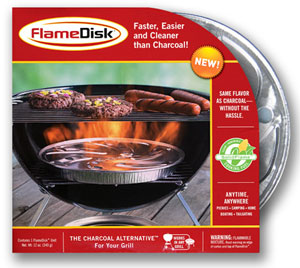
Grilling enthusiasts will find a new product that uses ethanol as an alternative to charcoal or propane on the shelves of many grocery and hardware stores this summer.

flamediskThe FlameDisk® actually utilizes proprietary solidified ethanol and is the first ethanol product to be used exclusively for outdoor grilling, according to manufacturer Sologear, the Wisconsin-based company that invented the product. They are marketing FlameDisk as “more eco-friendly than charcoal and lighter fluid because it features renewable ethanol. Ethanol is extremely clean burning and generates 90% fewer pollutants than charcoal. The FlameDisk®’s aluminum casing is also recyclable.”

“We buy our ethanol from an ethanol manufacturer in 200 proof,” said Sologear president Chad Sorenson. “Then we convert it from a liquid into a solid with a special chemical process that we’ve developed. Nothing like this has ever been done to my knowledge.”

Each FlameDisk utilizes one pint of domestically produced ethanol, which makes it a new market for the fuel, albeit a small one. “Obviously, the largest volume consumer of ethanol is the transportation industry and we’d have to go a long way to cut into those volumes,” Sorenson said. “But it has a lot of significant potential with about 3.8 billion grilling occasions in the U.S. every year and we are already selling product overseas so we think over time this could be a significant new use of ethanol that may have not been considered prior to this.”

The FlameDisk is already on the market and available at places like Ace Hardware, Home Depot, and True Value with a suggested retail price of $4.99.

Listen to an interview with Chad Sorenson to find out more about the FlameDisk.

Audio, corn, Ethanol

Colorado’s First Blender Pump Opening a Success

Colorado’s first ethanol blender pump dispensed 512 gallons of fuel April 8 during its inaugural day of operation at the Stratton Equity Coop in Burlington.

During a grand opening event for the pump, Colorado Commissioner of Agriculture John Stulp said the annual U.S. consumption of nearly 10 billion gallons of ethanol has reduced crude oil needs by seven percent. He said home-grown ethanol has a positive impact on America’s economy while reducing the need for U.S. troops to defend the nation’s oil import supplies.

Dan Slinger, general manager of Stratton Equity Co-op, is excited to have the first blender pump in Burlington. Many of the co-op’s members grow corn. “We’re marketing about three million bushels of our members’ corn that’s going into ethanol production,” said Slinger.

Steve Scott of the Colorado Corn Growers Association said ethanol has energized the corn business by raising prices above the cost of production while also adding 250,000 jobs nationwide. The construction and operation of ethanol production plants has brought new economic activity to many rural communities.

The Burlington pump is under a pilot program that should lead to more blender pumps statewide. Colorado Corn is working with state officials and others to find locations for nine additional blender pumps.

blends, corn, E85, Ethanol, Ethanol News, News

Ethanol Ads Debut in California

Cindy Zimmerman

A battleground for corn ethanol was one of ten locations where Growth Energy held viewing parties Monday to debut a new national television campaign.

The Growth Energy “ad watch party” event was held in California’s state capitol of Sacramento to unveil the six new commercials that will be airing over the next six months as part of a $2.5 million national advertising effort being called the “America’s Fuel” campaign. Among those who attended the event were representatives of the California Ethanol Vehicle Coalition (CEVC), the International Institute for Ecological Agriculture (IIEA), Propel Fuels and Genencor, a Palo Alto, CA based innovator of enzymes used in ethanol production.

“California leads the nation in the consumption of ethanol through its sheer volume of gasoline use, and yet it continues to get a bad name because of false information put out there by Big Oil and other special interests. These ads are finally educating the public and telling them the facts about ethanol – it’s clean, it’s renewable and it’s creating jobs,” said Joe Irvin, Executive Director of the CEVC.

However, the Low Carbon Fuel Standard developed by the California Air Resources Board could ultimately prohibit the use of corn ethanol in the state. The ethanol industry has filed suit against the state charging that the measure violates both the Supremacy Clause and the Commerce Clause of the U.S. Constitution.

Watch one of the six ads in the “America’s Fuel” campaign here:

Ethanol, Growth Energy, Video

Corn Growers Say Concerns Not About Ethanol

Cindy Zimmerman

NCGAThe National Corn Growers Association (NCGA) is concerned about the company the meat industry is keeping in an “unholy” anti-ethanol alliance with some environmental groups that also have an anti-meat agenda.

The alliance, which kicked off a major campaign last week opposing the proposed increase in the allowable level of ethanol in gasoline to 15 percent, includes the American Meat Institute, along with organizations like the Natural Resources Defense Council and the Environmental Working Group. NCGA CEO Rick Tolman noted in an editorial that “AMI’s “allies” in this fight roundly condemn corn and soybean production as environmentally unfriendly. An NRDC representative, in recent Congressional testimony, suggested that we grow “too much” corn in the United States and we ought to be growing less. NRDC also has promoted eating “grass-fed” over “corn-fed” beef.”

American_Meat_Institute_LogoAMI responded to NCGA’s concerns that they remain “committed to our opposition to ethanol subsides and tax credits, a position that is supported by a broad cross-section of producers, processors, consumers and, especially, American taxpayers.”

Not the point, responded Tolman, it’s not about ethanol:

Our concern, and our members’ outrage, is with the choice of allies and the tactics being employed. For example, here is one of their statements: “More corn ethanol is bad for the environment. Producing more corn ethanol could threaten air quality in many communities, destroy millions of acres of forests around the world, and increase emissions of greenhouse gases. In particular, plowing up forests to grow more corn could increase farmland runoff, expanding low-oxygen dead zones that hurt commercial fishermen.”

That statement is really about the radical environmental groups view about corn production. Think of the damage these and other statements make to the image of hard working corn producers. One would think that the members of AMI – companies such as Smithfield, Tyson and Hormel – support corn production. Substitute the phrase “corn-fed beef” instead of “corn ethanol” and you can easily see the danger.

He compares it to the fable about the scorpion and the frog, where the frog agrees to carry the scorpion across the river on his back. Once across the river, the scorpion stings the frog and kills him. As he is dying, the frog says, “But I carried you across the river! Why did you sting me?” The scorpion replies that the frog knew he was a scorpion, and that’s what scorpions do.

NCGA’s message to AMI is, “Rejoin the rest of agriculture and step away from the scorpion.”

corn, Ethanol, food and fuel, NCGA