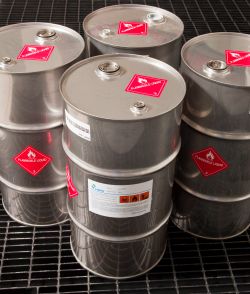
GM Offering Natural Gas Vans for Fleets

John Davis

Automaker General Motors is offering some natural-gas-powered vans, but they won’t be for the average driver.

USA Today reports GM will offer compressed natural gas (CNG) and liquefied petroleum gas (LPG) in versions of the Chevrolet Express and GMC Savana full-size vans for commercial fleets:

“We’re listening to our fleet customers and dealers about offering options that help them achieve their business objectives,” said Brian Small, general manager of GM’s fleet and commercial operations. “The industry commitment to expand the CNG and LPG infrastructure in key fleet markets was an enabler to allowing us to introduce these options now.”

To make the van work on natural gas, GM’s Vortec six-liter V-8 engine receives hardened exhaust valves and intake and exhaust valve seats for improved wear resistance.

Both CNG and LPG vans will carry GM’s limited new vehicle warranty including the 5-year/100,000 mile transferable GM powertrain limited warranty.

GM officials say this will make it easier for commercial customers to choose a CNG or LPG vehicle … and makes the auto giant the only manufacturer to offer the option with this level of support and availability.

Car Makers, Natural Gas

Ethanol Report on Exports

Cindy Zimmerman

Ethanol Report PodcastAs Renewable Fuels Association (RFA) president Bob Dinneen was in Seville, Spain talking about American ethanol in the world market, the organization released a new report on rising U.S. ethanol exports.

“The Paradox of Rising U.S. Ethanol Exports: Increased Market Opportunities at the Expense of Enhanced National Energy Security?” highlights how the nation quickly evolving from a net importer of ethanol into a net exporter, sending our home-grown fuel to countries like Canada and the Netherlands, and even Brazil and OPEC nations in Middle East.

The question becomes, do we want to export our biofuels and the benefits they provide, or do we want to use them here at home to help secure our energy future? Or both?

RFA’s Matt Hartwig discusses the issue in this edition of “The Ethanol Report.”

You can subscribe to this twice monthly podcast by following this link.

Listen to or download the podcast here:

Ethanol, Ethanol News, Ethanol Report, Exports, International, RFA

RFA President Tweets Global Ethanol Meeting

Cindy Zimmerman

RFA DinneenRenewable Fuels Association (RFA) president and CEO Bob Dinneen has been keeping his Twitter followers up to speed on the activities at the World Biofuels conference in Seville, Spain this week. Industry leaders from all over the world are meeting at the event, where Dinneen did a presentation on American ethanol in the world market.

Here are a few of Bob’s tweets from Spain:

Brazilian contingent did not attend World Biofuels Conf for first time ever. Speculation is that as their production falls, so does interest
.

At World Biofuels Conf – lots of talk about increased US ethanol exports, including exports of ETBE to Europe. ETBE still used here.

At World Biofuels Conf in Seville, EPA’s Margo Oge says “oil spill in the gulf a reminder of the cost of our dependence on petroleum.”

At Biofuels Conf in Seville, EPA’s Oge notes “uncertainty” with ethanol lifecycle analyses and commits EPA to evaluating new science.

At World Biofuels Conf, panel on Lifecycle Analysis discusses need for consistent metrics and transparancy in LCA. Does EPA meet that goal?!

In his address, Dinneen noted the tremendous increase in efficiency for U.S. ethanol industry over the past decade and that increased ethanol output in Brazil has come primarily by increasing acreage, while increased production in the United States has come through higher corn yields.

Ethanol, Ethanol News, Exports, International, RFA

Dresser Wayne Continues Warranty for E15

Dresser Wayne has announced that all of their standard dispensers have always, and will continue to, cover the use of ethanol blends up to 15 percent ethanol. Warranties on higher blends of ethanol are increasingly important as blender pumps and ethanol dispensers are installed across the country to give consumers more choice at the filling station.

In a letter to their Partners, Scott Negley, Director, Alternative Fuel Products for Dresser Wayne said, “You may have heard recent industry announcements regarding warranty coverage on E10 and E15 dispensers. Based on some of the questions we have been receiving it is apparent that this announcement is creating some confusion in the market place. . . One of the most important points that I would like to make is that all standard Dresser wayne dispensers have always been warranted up to E15. That said, we understand that navigating the Underwriters Laboratory (UL) approvals and dispenser warranty is supported up to E15, the UL approval only applies to E10. Nothing has changed there. It is unknown whether UL will change their position to reflect the increased ethanol allowance for standard equipment which is expected to be announced by the EPA this summer.”

Dresser Wayne currently offers the first Eco Fuel dual hose blend dispenser which has received UL certification blends up to 25 percent ethanol. The Reliance mechanical fleet dispenser is also certified up to 25 percent ethanol.

Recently, Gilbarco Veeder-Root made a similar announcement for their fueling dispensers.

E85, Ethanol, Ethanol News, News

How to Spend BP’s Profits on Alt Energy Programs

Joanna Schroeder

The pressure continues to mount as BP attempts to ebb the flow of oil in the Gulf of Mexico. As of today, oil has reached Florida and now four states have been affected: Louisiana, Alabama, Florida and Mississippi. BP has responded in part by offering $70 million to the four states to help promote tourism – an effort to offset the loss of dollars in other industries. One of the industries most affected is the fishing industry that has been all but shut down. And while fisherman are out of work, seafood prices have already risen more than 20 percent. But, don’t worry, according to Tony Hayward, BP Group Chief Executive, in the overall scheme of things, this oil spill isn’t that bad. Interesting since most are predicting that this will be the worst oil spill in US history.

So, who exactly isn’t this oil spill bad for? Marine life? The fishing industry? Consumers? It appears that the only organization it’s not so bad for is BP who makes $93 million in profits every day.

I keep seeing this obscene number, $93 million everywhere and it led me to ask the question, what would you do with 3.8 days of BP’s profits, or $300 million to develop our country’s alternative energy program? I used this number because this is how much money BP had spent on clean-up efforts one week after the spill – less than 4 days of their profits. I reached out to nearly a dozen associations asking them the question but only a few responded. Here are a few of respondents answers.

“Many people have asked me what I’d do with the same amount of money BP will have to spend to clean up this mess. My answer is quite simple: Invest in Algae technologies. Algae for wastewater treatment, Algae for CO2 capture, Algae for Pharmaceuticals, Algae for high grade animal feed for livestock, Algae for fertilizer, Algae for biobased polymers, and finally: Algae technologies to produce an entire suite of advanced biofuels. The time has come to enact a serious and aggressive energy policy that will not only free us from our addiction to oil but will provide us with a new and long term prosperity for decades to come.” –Sean O’Hanlon, Executive Director, American Biofuels Council

“A 2009 study by Sandia National Laboratory, ‘The 90-Billion Gallon Biofuel Deployment Study,’ shows that the capital investment needed for biorefinery construction and biofuel infrastructure to meet 30 percent of our transportation fuel needs is around $250 billion. However, that amount is “actually of similar magnitude to petroleum-related investments required to establish and maintain 40 billion gallons per year of domestic oil production,” according to the study. $350 million could fund construction of one or two commercial-scale advanced biofuel biorefineries. This may sound like a large investment for little return, but those first plants could assure institutional investors and commercial lenders that putting their money behind new advanced biofuel technology is worth the risk.” –Brent Erickson, executive vice president of the Biotechnology Industry Organization’s Industrial & Environmental Section

Erickson also noted that in 2007 BP announced a $500 million investment over 10 years to create the Energy Biosciences Institute for research into advanced biofuel technology. He stressed that additional investments in advanced biofuel deployment are now needed to move the industry forward.Read More

biofuels, Oil, Opinion

DF Cast: Biodiesel Producers Reiterate Call for Incentive

John Davis

Biodiesel producers, large and small, have renewed their call for Congress to move on the federal $1-a-gallon biodiesel tax incentive.

During a recent webinar hosted by the National Biodiesel Board CEO Joe Jobe, Bernie Crowley of Delta American Fuel in Helena, Ark.; Gen-X Energy Group in Pasco, Washington President Scott Johnson; Bobby Heiser with Nittany Biodiesel; and Renewable Energy Group’s CEO Jeff Stroburg made their case to the media.

In this edition of the Domestic Fuel Cast, you can hear what they had to say, including how they not only need the tax incentive renewed now, but also how they need a more permanent solution to save jobs, to save the biodiesel industry, and considering the ecological disaster unfolding in the Gulf of Mexico, to save the environment.

Listen to the conversation in the player below.

You can also subscribe to the DomesticFuel Cast here.

Audio, Biodiesel, Domestic Fuel Cast, Government, Legislation

Ohio Ethanol Supporters Visit DC Lawmakers

Joanna Schroeder

A delegation of four ethanol supporters from Ohio were welcomed today in our nation’s capital by Growth Energy. The visit is the most recent in a series of fly-ins organized by the ethanol association to show lawmakers the depth of support for federal policy that encourages the growth and continued development of ethanol.

The delegation includes:

  • Mark Borer, GM of POET Biorefining – Leipsic
  • Robert Flynn, GM of POET Biorefining – Fostoria
  • Dave Brooks, GM of POET Biorefining – Marion
  • Mike Irmen, Director of Ethanol Services, Andersons, Inc.

“As representatives of Ohio’s ethanol plants, we are excited about the opportunity to visit Ohio’s elected officials and discuss the many economic benefits that the industry is providing to Ohio’s citizens,” said Borer who is also the President of the Ohio Ethanol Producers Association. “Ohio has seen rapid growth in ethanol producing capabilities since 2008 and it has had tremendous impact on our employees, farmers and local communities.”

Borer continued, “This recent growth has given Ohio the latest technology and some of the most capable facilities in the nation and we look forward to working with our representatives in support of the industry to ensure we maximize the economic and environmental benefits, while positioning America for the energy independence that we so desperately need.”

While in D.C., the delegation will personally meet with Sen. Sherrod Brown (D), Reps. Patrick Tiberi (R), Steve Austria (R), Jim Jordan (R), Zack Space (D) and Bob Latta (R). In addition, the Ohio group will meet with staff members of Sen. George Voinovich (R), Rep. Marcy Kaptur (D) and House Minority Leader John Boehner (R). The meetings will focus on how the expansion of America’s ethanol industry could help strengthen the U.S. economy by creating jobs and reducing our country’s dependence on foreign oil.

Ethanol, Growth Energy, News

RFA’s Bob Dinneen to Address World Leaders

Joanna Schroeder

The World Biofuels 2010 conference will kick off in Seville, Spain, tomorrow and Bob Dinneen, President and CEO of the Renewable Fuels Association, will address world leaders. In anticipated remarks, Dinneen will challenge the claims that American ethanol production can’t cost compete with other producers such as Brazil. In addition, Dinneen will address misperceptions about indirect land use.

“Despite claims from other ethanol producers, America is the world’s low cost producer of ethanol today,” said Dinneen. “Advancements in ethanol production technologies together with the unprecedented productivity of American farmers allow American ethanol producers to cost-effectively supply domestic markets and increasingly those around the world.”

With consumer sensitivity to prices at the pump heightened with recent events, it is interesting to note that ethanol has sold as a discount to gasoline by as much as 80 cents per gallon wholesale before any tax incentives were incorporated. The price coupled with incentives should have saved consumers 12 cents per gallon on E10. According to RFA, by comparison, if the gasoline were blended with Brazilian ethanol, the price would be 11 cents higher per gallon.

Dinneen will also address the growing presence of American ethanol producers in the world markets with 2010 expected to break all records for fuel ethanol exports.

“The emergence of U.S. exports of ethanol to markets once dominated by Brazil demonstrates that a true global market for ethanol is developing.” said Dinneen. “As the low cost producer of ethanol today, America is enjoying the same opportunities that many thought were solely the province of Brazil. Such competition in the world market undermines the continued claims that U.S. and other nations’ ethanol import policies are barriers to trade. Rather, inconsistent policies that vacillate based on the fortunes of domestic ethanol producers introduce the kind of uncertainty that world trade abhors. As the market is clearly showing, consistent policies across the globe will reward the low-cost producer. “

Ethanol, Ethanol News, International, RFA

Poll Shows American Frustration Over Oil

Cindy Zimmerman

As Congress holds hearings on the oil spill, a new study finds most Americans are ready to do what it takes to reduce dependence on oil.

CFAThe Consumer Federation of America (CFA) report shows that, “even before the Gulf oil spill and Congressional hearings, Americans strongly supported reduced oil consumption and tougher fuel economy standards. In a late March survey commissioned by CFA and undertaken by Opinion Research Corp. (ORC), 87% of respondents said it is “important that the country reduce its consumption of oil,” while more than half (54%) said this was very important.”

“Our survey data strongly suggest that the American public is getting very close to the point, if they’re not already there, where they are prepared to support radical measures to break our nation’s dependence on oil and oil imports,” said Jack Gillis, CFA Director of Public Affairs.

However, the report only appears to focus on increasing fuel economy for vehicles as the answer to lowering dependence on oil, specifically that the federal government “should increase its fuel economy standard to 50 miles per gallon by 2025.” Increasing the number of flex-fuel vehicles on the road and availability of ethanol as an alternative fuel were not addressed.

Oil

Oklahoma House Passes Renewable Energy Bill

Joanna Schroeder

The Oklahoma Energy Security Act, House Bill 3028 sponsored by House Speaker Chris Benge of Tulsa, was passed yesterday by the House, 91-2. The bill now goes to the Senate for consideration. If the bill passes the Senate, Oklahoma will become the 32 state to have passed state renewable energy legislation. The bill would require 15 percent of all electricity generated in Oklahoma to come from renewable sources such as wind by 2015.

Although Oklahoma is a major natural gas and oil state, it imports significant amounts of coal to generate its electricity. Under the leadership of Democratic Governor Brad Henry, the state pushed for the development of wind energy and biofuels and at the end of 2009, boasted 1,130 megawatts of installed wind capacity, placing the state fourth in the Midwest behind Iowa, Minnesota and North Dakota for total wind generation. The states utilities are now planning projects to improve the grid in order to handle the extra capacity generated by additional wind energy projects.

Interesting to note, Oklahoma’s bill sets a higher standard than either of the versions of the Federal Renewable Energy Standard that is still in consideration. The House bill calls for 20 percent renewables by 2020 with the option of 5 percent coming from efficiency improvements. In addition, state governors can ask for a weaker standard if they can’t meet the Federal mandate. The Senate, however, sets the bar lower with only 15 percent of the nation’s electricity coming from renewables by 2020 while simultaneously a large portion of that energy gain coming from efficiency improvements.

Legislation, News, Wind