
The ribbon cutting ceremony to open the 2010 Fuel Ethanol Workshop was short and sweet, with a welcome from BBI International Vice President Tom Bryan and Chairman Mike Bryan, greetings from welcome reception sponsor Growth Energy, and a special announcement about the return of the Ethanol Car to the Indy series by ICM’s Dave Vander Griend. It all took about 5:00 and you can watch it here on YouTube.

Growth Energy Sponsors Ethanol Expo Open
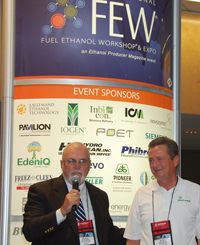 Ethanol producer group Growth Energy sponsored the grand opening of the 2010 Fuel Ethanol Workshop & Expo on Monday in St. Louis.
FEW organizer Mike Bryan introduced Growth Energy CEO Tom Buis, who said a few words of welcome to the crowd gathered around for the ribbon cutting to kick off the 26th annual event. “We all know we have tremendous challenges facing this industry and we all want to work really hard so that the industry continues to grow, we reduce our dependence on foreign oil, improve the environment and create jobs right here at home,” said Buis.
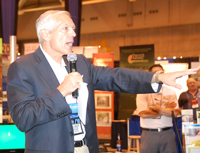 After the expo opened, Growth Energy co-chairman Gen. Wesley Clark gave a rouse the troops speech to the ethanol producers on the trade show floor, stressing the importance of domestically produced ethanol for our energy security. “There’s no point for America in getting hooked on somebody else’s liquid fuel when we can grow it right here ourselves,” said Clark. He noted that Brazil has agreed to sell ethanol to Iran, which he says is crossing the line. “I am just so proud of America’s agricultural community and what we’re doing here at home. How could we as a nation not want to maximize what we can do with our own land? Why would we want to outsource that to someone else?”
Listen to back to back interviews with Buis and Clark in the player below.
East Coast States Form Offshore Wind Consortium
 A group of 10 states along the U.S. East Coast have signed an agreement with the the Department of the Interior to form the Atlantic Offshore Wind Energy Consortium.
CalFinder.com says the group will also promote solar and biomass power:
Federal approval of Cape Wind, the United States’ first offshore wind farm near Cape Cod, essentially gave offshore wind the green light up and down the nation’s coasts. This agreement by the DOI and 10 East Coast states essentially assures us that wind energy will be developed in abundance with the full support of federal and regional governments.
The 10 states to sign the memo are: Delaware, Maine, Maryland, New Hampshire, New York, New Jersey, North Carolina, Rhode Island and Virginia. Six states also formed intergovernmental “leasing task forces” to develop and facilitate leases for private companies to build offshore wind farms. Florida and South Carolina did not sign the memo, but are developing leasing task forces as well. Apparently, Georgia is cooperating in some way, shape or form.
The efforts are expected to help create green jobs in construction, operation and manufacturing of renewable energy systems in the region. In fact, the Department of the Interior has set up a renewable energy office in Virginia to help coordinate the efforts.
Natural Gas Becoming Mainstream Fuel
A trend in Canada that shows natural gas moving from a niche fuel to the mainstream might be an indication of a more prevalent direction for that fuel worldwide.
This article from the Globe and Mail (thanks to @pickensplan on Twitter for the tip!) says environmental benefits, plentiful supplies and low costs are helping improve natural gas’ prospects:
For natural gas to become a major player in powering vehicles, companies and governments need to commit big dollars to infrastructure and technology. In some parts of North America, that commitment is under way.
In Quebec, Robert Transport is among the early adopters in Canada. The large trucking company, based in Boucherville, has a fleet of 750 trucks and plans to buy 80 new rigs with natural gas engines, with the first rigs arriving early next year.
Fuelling stations are a crucial part of the needed infrastructure, and remain a significant challenge. Robert Transport plans to build three for itself along the Montreal-Toronto corridor, in a partnership with Gaz Métro LP.
Natural gas emits fewer greenhouse gases compared with diesel refined from crude oil. Beyond the environmental benefits, the cheaper cost of gas compared with diesel was the big factor in the decision, said Daniel St-Germain, vice-president of asset management at Robert Transport.
“The economic aspect is very important,” Mr. St-Germain said.
The article also points to Beijing Olympics in 2008 and the Port of Los Angeles as great examples of how natural gas is helping places all over the world go green. In addition, some companies are telling investors and analysts that this could be the year that is the tipping point for a favorable natural gas future.
USDA Nears Finish of Biomass Crop Assistance Rules
 USDA officials say they are close to finalizing the rules for the Biomass Crop Assistance Program (BCAP), a measure that was in the 2008 Farm Bill and is designed to encourage farmers to grow new crops for energy production. But there’s still some work to do before it is finally implemented.
“We have put out a proposed rule, received over 24,000 comments, we’ve evaluated those comments and are in the process of then working on writing the final rule based on the proposed rule and the comments we got,” says Jonathan Coppess, Administrator of the USDA’s Farm Service Agency. Plus, he says the ag department will need to do an environmental impact statement.
Coppess says there two main provisions in BCAP: 1. the assistance for establishment provision, that has the federal government reimbursing farmers for 75 percent of the costs of establishing a new biomass crop; and 2. matching payments for the collection, harvesting, storage and transportation of biomass products.
The rule should be ready by this fall, however, there is one more hurdle to clear. Congress still has 60 days to comment.
Connecticut Gov Signs Biodiesel Heating Oil Mandate
 Connecticut Yankees (and any other immigrants to the Nutmeg State) will be able to stay warm … and green … in winters in the future, thanks to biodiesel.
That state’s Governor Jodi Rell has signed into law a 2 percent biodiesel in heating oil mandate that kicks in next summer. However, Heatingoil.com reports it does have some conditions attached:
Although the governor’s signature officially made the mandates the law of the state, a provision in the bill holds off final implementation of the requirements until Massachusetts, New York and Rhode Island pass similar legislation. Massachusetts already has a 2 percent biodiesel requirement on the books, and mandate proposals are in the works in the New York and Rhode Island state legislatures.
Heating oil and petroleum association officials say the legislation will save money for consumers, while reducing greenhouse emissions by more than 40 percent and adding jobs to the state’s biofuels industry.
Ethanol Issues at Corn Utilization Conference
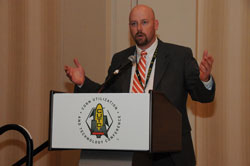 Indirect land use change and DDGs quality were two of the ethanol-related topics that were featured at the 2010 Corn Utilization and Technology Conference (CUTC) sponsored by the National Corn Growers Association and held last week in Atlanta.
Geoff Cooper with the Renewable Fuels Association took part in the event and chaired one of the technical sessions. “Five or six years ago if you had come to this conference, you would not have heard many mentions of greenhouse gases and carbon footprint and things like that, but those issues are front of mind with the industry today and those themes really permeated a lot of the sessions this year.”
Cooper says there was some discussion about an environmental group lawsuit over the Renewable Fuel Standard that claims EPA did not account for the “Global Rebound Effect.” “In essence, what the theory suggests is that by using more biofuels in the United States, we’re driving down oil consumption, which results in oil prices decreasing, and because oil prices are lower then people in other parts of the world start using more oil,” Cooper said. “So they’re suggesting that would occur as a result of the RFS 2 and that those emissions should be attributable to biofuels like ethanol.”
Of course, he points out that the goal of the RFS 2 is to reduce oil consumption. “So we find it a little questionable that now they would be suggesting that it’s a bad thing that we’re reducing our oil consumption in the U.S. as a result of that policy,” Cooper said.
The theme of the Corn Utilization and Technology Conference was “Corn: America’s Renewable Resource” and Cooper says since this year’s crop is expected to be another big one, increasing markets continues to be important. “Corn is a great crop with a lot of utility, let’s put it to work,” he said.
Listen to an interview with Geoff Cooper in the player below and see photos from the conference on Flickr.
TransTech Energy Adds Icom’s Propane Systems
TransTech Energy has reported that they have signed an agreement with Icom North America to install and service Icom’s patented JTG propane liquid injection fuel system on government and commercial fleet vehicles. The JTG fuel system can be installed on nearly any gasoline vehicle with multi-point injection. According to TransTech they anticipate selling more than 3,000 systems during the first three years which will provide the recipients with lower emissions and improved fuel economy.
 “TransTech Energy is well-respected throughout the propane industry as a leading contractor for propane storage-facility engineering and construction,” said Ralph Perpetuini, CEO of Icom North America. “Interest in propane as an alternative fuel continues to grow; it will lead to increased business for both of our companies and enable the further expansion of the propane vehicle industry in the USA.”
Icom’s technology has been installed on more than 100,000 vehicles worldwide as a bi-fuel (gasoline-propane) fuel system. In the US, the mono-fuel version (propane only) has been installed on more than 5,000 vehicles. Targeted vehicles for the fuel system include taxis, police cars, municipal fleets, and any commercial vehicles.
Britt Medley, CEO of TransTech concluded, “Icom’s bi-fuel system allows owners to operate their vehicles in a gasoline-only mode without affecting normal driving. Installation is non-invasive and the engine’s original computer serves as the main system controller, a feature fleet managers like to see with an aftermarket alternative fuel system.”
Revving up for Iowa Corn Indy 250
 The state of Iowa is getting in the racing mood this week as the 4th annual Iowa Corn Indy 250, presented by Pioneer, is upon us. The race will be held on Sunday, June 20 at the Iowa Speedway in Newton.
Iowa Corn Growers CEO Craig Floss says the race has provided them with a great platform for positive messages about corn use in food, fuel and feed for the livestock industry. “The momentum that was created the first couple of years is still paying dividends to us,” said Floss. “We’re reaching more people than ever. We have a nationwide television audience. The name recognition has really grown here in Iowa and beyond throughout the Midwest.”
Floss says they have a number of events planned this week in advance of the race. Iowa Secretary of Agriculture Bill Northey is helping to kick off the week on Tuesday by traveling to work at the Iowa state capitol in a modified 2-seater Indy car celebrating the fact that the race will be running on locally-grown corn ethanol.
On Thursday, the Iowa corn growers and Pioneer will be sponsoring a pump promotion in Des Moines, offering E85 for just 85 cents a gallon and regular E10 for 10 cents off. Marco Andretti with Andretti Autosports and sponsored by Venom energy drink will be signing autographs and pumping ethanol for customers and fans at the event to be held at the Guthrie Street Kum & Go from 5:30-7:30 pm.
Iowa corn growers have retained the sponsorship of this race as the only IndyCar Series race to run on corn ethanol since Brazil’s ethanol industry took over sponsorship of the series and provides fuel for the rest of the races. “Ethanol is good for Iowa, it’s good for Indy, and the only difference between an Indy driver using it and the general consumer is the speed limit,” Floss says.
Listen to or download an interview with Craig Floss in the player below.
Ready for 2010 Fuel Ethanol Workshop
 The “world’s largest gathering of ethanol producers” gets underway today in St. Louis as the 26th annual International Fuel Ethanol Workshop & Expo boasts that 500 ethanol plant employees representing 11.7 billion gallons, 170 plants and 80% of installed capacity will be in attendance.
Following the FEW ribbon-cutting ceremony at 5:30 pm, Gen. Wesley Clark, retired four-star general and co-chairman of Growth Energy, will host the Expo Grand Opening and welcome reception. The opening event will also feature a memorial scholarship fundraiser and tribute to ethanol pioneer Kathy Bryan, who passed away shortly after last year’s event.
 Renewable Fuels Association (RFA) President and CEO Bob Dinneen will present the keynote address at the expo on Tuesday morning. As one of the industry’s most accomplished industry voices on the Hill, Dinneen champions the RFA’s mission to increase the production and use of grain and cellulosic ethanol and to create a dynamic, robust industry. He has been named one of America’s “top lobbyists” by The Hill, and he regularly testifies before federal agencies and congressional committees. Dinneen will give an update on the industry’s legislative priorities, kicking off one of the more practical FEW plenary sessions in recent history.
The expo features more than 120 industry professionals delivering presentations across five topic tracks. This year’s line-up was assembled from over 240 abstracts which were vigorously reviewed by a panel of nearly 40 industry professionals. The result is a compilation of presenters addressing our industry’s most current concepts, processes, technologies, challenges, and opportunities. Topics as varied as plant optimization, advances in fermentation, carbon monetization, and industry salary trends are all available in this one, content-packed event.
Be sure to watch for complete coverage of the FEW right here on DomesticFuel and via our Twitter twitter.com/domesticfuel.