Verenium Corporation announced its financial results for the second quarter of 2010 and the outlook is positive. On the enzyme side, the company reported increased total product revenue by 27 percent for the 2nd Quarter compared to the 2nd Quarter in 2009 and a 15 percent increase in revenue over 1st Quarter sales of this year. In the biofuels space, Verenium is best known for its development of enzymes to produce cellulosic ethanol.
 “This has been a transformational quarter for Verenium. The transaction we announced with BP around the sale of our cellulosic biofuels business firmly positions us to focus our capital and human resources on the continued development of a leading industrial biotechnology and commercial enzymes business addressing lucrative, growing markets,” said Carlos A. Riva, President and Chief Executive Officer of Verenium. “I’m pleased with the progress we’ve seen across the business over the last quarter, notably, growing product revenues and continued successful efforts to aggressively manage expenses.”
The company has in fact had a good year. According the company’s financial report, total revenues for the second quarter and six months ended June 30, 2010 were $20.0 million and $33.0 million, respectively, compared to $16.3 million and $30.7 million for the same periods in 2009. Product revenues represented more than 60 percent of total revenues in both periods. They also finalized the sale of their cellulosic biofuels business to BP and their pilot facility located in Jennings, Louisiana, received $4.9 million from the Department of Energy.




 Missouri Congressman Roy Blunt, fresh off a primary win to be the Republican candidate for Senator, stopped at the
  Asked why he voted against a bill this year that would have reinstated the tax credit, Blunt replied that it included tax increases that he was against. “It’s not necessary to slow down one part of the economy in order to encourage another,” Blunt said. He is hopeful that there will be another vehicle to bring back the tax credit before the end of this Congress. “They’re talking now about an energy bill, sometimes called “Energy Light,” because it wouldn’t have the burdensome and ill-conceived cap and trade,” he said. “Hopefully, we can move forward with things that encourage all kinds of American energy.”
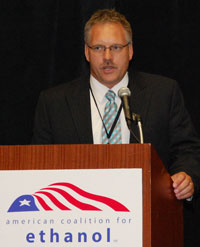 NCGA President Darrin Ihnen, a grower from Hurley, S.D., addressed the conference on the organization’s efforts to promote ethanol and their work with ACE and other ethanol organizations to ensure ethanol supporters speak with a unified voice in Washington on issues important to the industry.