

Last year, the U.S. Environmental Protection Agency (EPA) proposed an E15 label to support their ruling that cars manufactured after 2007 had the option of fueling with the 15 percent ethanol, 85 percent gasoline blend. The ethanol industry was not too happy with the result and the Renewable Fuels Association (RFA) said yesterday in a letter to the EPA their version of the label “will do little, if anything, to promote the successful introduction of a new fuel to the marketplace.”
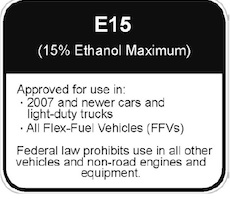 The letter continued, “The label shortcomings include leading, unscientific statements, confusing technical information and unwarranted warnings. The label as written will seriously impair long-term progress towards achieving the country’s stated goals for renewable fuels. It unnecessarily will promote skepticism and concern over any future broader approval for E15 and create the false perception that E15 is an inferior fuel.”
One area of the label that offended the ethanol industry was the use of words such as “Warning,” “Danger,” or “Caution,” and the RFA states these words are reserved to alert consumers to possible physical danger but are not warranted with E15. The association also supports the ability for gasoline marketers to have some flexibility in determining the size, color and shape of label to best fit their marketing programs. In addition, they would like to see one label for E15, not two and believe that no label should be required for E10.
In light of these concerns, the RFA has proposed an alternative label (black label) that they believe will more accurately provide consumers with the information they need without additional alarm. The label contains the four elements the EPA is requiring for the final label: 1) an information component; 2) a legal approval component; 3) a technical warning; and 4) a legal warning.
You can view the RFA’s complete comments about the proposed E15 label here.
*UPDATED POST*
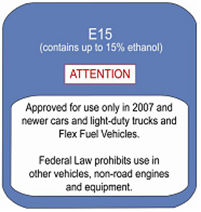 Growth Energy, the organization that officially filed the E15 waiver back in 2009 also submitted an alternative E15 label for consideration today (blue label). In their letter to the EPA, the organization said, “Growth Energy supports label content and design that provides information to consumers necessary for an informed fuel choice. Growth Energy believes the label should be simple and informative and should state at the top “E-15 (contains up to 15% ethanol).” Further, the label should provide that E-15 is “approved for use only in 2007 and newer cars, light–duty trucks, and Flex Fuel Vehicles.” Finally, the label should provide “Federal law prohibits use in other vehicles, non-road engines and equipment.”


 Now that 2010 is just a memory and Congressional leaders are returning to Washington this week to open the first session of the 112th Congress, what does the future hold for ethanol?
 In this edition of “The Ethanol Report,”
 Indore Oil partnered with Protec Fuel to offer E85 through the group’s turnkey E85 infrastructure program. “Over the past three years we at Indore Oil Company have been working in concert with Protec Fuel to give customers in the Atlanta, Georgia and surrounding areas the option of having E85 as a renewable fuel source for their flexible fuel vehicles,” said Mihir Patel, General Manager of Indore Oil Company. “The relationship with Protec and the people that make everything possible within the company such as Steve Walk are wonderful and a joy to work with. It is a pleasure and fulfilling to think we are working together to provide a renewable source of fuel that will help reduce our dependence on foreign oils and help the environment at the same time.”
 The winner for December is Michelle Stahlhut, an


 One of the ups was traffic here on Domestic Fuel. We had a total of more than 315,000 unique visitors in 2010, up 17 percent from 2009. Your reporters did 1537 posts this year, including 160 with audio interviews, podcasts and recorded press conferences. The