RFA E-15 Ad

Biofuels Messaging Webinar

Cindy Zimmerman

A webinar on messaging for the biofuels industry will be held Wednesday, January 26 from 2:00 – 3:00 PM central time.

The webinar, “Back to the Basics: Three Reasons the Biofuels Message Has Gone Bad,” will discuss how ineffective messaging by the industry has helped lead to a decline in public support for biofuels in recent years, and how we can do better.

Presented by renewable energy PR specialist Joanna Schroeder, who writes for Biofuels Journal, Domestic Fuel and numerous other publications, this is an opportunity for anyone involved in the business to understand and change the biofuel messaging dynamics. Registration information is available here from gotomeeting.com.

Biodiesel, biofuels, Ethanol, Ethanol News

Southeastern Alabama Gets E85 Pumps

Cindy Zimmerman

Flex fuel vehicle (FFV) drivers in southeast Alabama now have two new locations to get 85 percent ethanol fuel with the opportunity to get mid grade ethanol blends in the future.

Inland Stores (a subsidiary of Southwest Georgia Oil Company) has replaced all of its dispensers at their SunValley Market stores in Enterprise and Dothan, AL with new blender dispensers. The new dispensers offer the traditional Regular, Midgrade, and Premium gasoline products, and now E85. The new dispensers also have the ability to offer another ethanol-blended fuel at a later date. These two sites are the first in Alabama, and some of the few in the United States, to have E85 available from all of its dispensers, giving drivers of FFV the ability to fuel with E85 from any dispenser.

According to Inland officials, ethanol used at both Alabama sites is produced at the First United Ethanol plant located just across the Alabama-Georgia border in Camilla, GA, less than 100 miles away. In addition, the company acknowledges support from Bosselman BioFuels Solutions, Alabama Clean Cities Coalition, Growth Energy, Alabama Soybean and Corn Association, and First United Ethanol were all key to establishing these new E85 fueling sites.

“We congratulate and commend SunValley Market/Inland Stores for their forward thinking and for taking the initiative to provide dispensers with the capability to not only offer E85, but also the ability to offer future fuel with different blends of ethanol,” said Mark Bentley, Executive Director of the Alabama Clean Fuels Coalition. “In 2006, there were no public stations pumping E85 fuel in the state. Last year, considering both public and private stations, E85 fuel displaced over 700,000 gallons of traditional gasoline in the State of Alabama. With the addition of these two sites, there are now 15 public stations making E85 fuel available to the general public.”

Inland Stores owns and operates 17 SunValley Market & Deli convenience stores in southern Alabama and plans to continue adding E85 capabilities to more of its locations.

E85, Ethanol, Ethanol News, Growth Energy

Valero Invests in Michigan Cellulosic Ethanol Plant

John Davis

Energy company Valero Energy Corporation will invest up to $50 million dollars into one of the world’s first commercial scale wood-based cellulosic ethanol biorefineries to be started later this year in Kinross Charter Township, Michigan.

This press release from biofuels company Mascoma Corporation says the deal through Mascoma’s operating subsidiary, Frontier Renewable Resources LLC, with Valero, the nation’s largest independent oil refiner, is a sign of just how viable cellulosic ethanol is and will help commercialize the green fuel:

As further support of the project, Valero would provide project development and construction oversight services. The biorefinery is planned to have an annual production of 40 million gallons of low-carbon cellulosic ethanol, to be covered by the off-take arrangement with Valero. Frontier will use hardwood pulpwood, which is selectively harvested, naturally regenerated, and is an underutilized, abundant resource in the area surrounding the Kinross biorefinery. Mascoma’s 200,000 gallons of cellulosic ethanol per year demonstration facility in Rome, New York, has demonstrated the viability of the technology over the past two years and sets the stage for the commercial facility.

“Valero’s proposed investment in our first commercial-scale production facility proves the economic practicality of Mascoma’s technology for the conversion of woody biomass into ethanol,” said Bill Brady, Chief Executive Officer of Mascoma. “We are also thrilled to have Valero as a shareholder in Mascoma Corporation as there are many synergies even beyond the Kinross facility, where the technologies we have developed could be helpful to Valero’s business.”

“Adding Valero as a partner is the perfect addition to complete this project,” said Steve Hicks, Chief Executive Officer of Frontier Renewable Resources and President & CEO of J.M. Longyear, LLC. “The culmination of Mascoma’s leading Consolidated Bioprocessing (CBP) technology, coupled with Longyear’s expertise in supplying the raw materials, is the perfect compliment for a leading oil company to come in as an equity and off-take partner.”

The release goes on to say that Mascoma recently acquired SunOpta BioProcess Inc. (SBI) to give the company the technology to convert non-food cellulose into ethanol.


biofuels, Cellulosic, Ethanol, Ethanol News, News

Scholarships for Minnesota Biodiesel Essays

John Davis

High school seniors in Minnesota will have the chance to receive scholarships for their essays on biodiesel.

Biodiesel Magazine
reports the American Lung Association in Minnesota and the Minnesota Soybean Growers Association are sponsoring the writing contest, now in its fifth year:

“We’re always looking for new ways to get young people involved and informed about biodiesel,” said Robert Moffitt, communications director for the Clean Fuel and Vehicle Technologies Program of the American Lung Association in Minnesota. “Minnesota is really a pioneering state for the use of biodiesel, and what better place to hold a biodiesel essay contest than here—the first state in the union to require biodiesel in all diesel sold…This is our fifth year, and we’ve always had a very good response. There is some very innovative and creative thinking out there from our young people, and we just wanted to be a part of that.”

According to Moffitt, two scholarships will be awarded this year. “The first place scholarship winner will receive $1,000 that they can use at the post-secondary school of their choice,” he said. “The second place winner will win a $500 scholarship.”

Open to high school seniors in Minnesota, applicants will need to write an essay on biodiesel in 1,000 words or less, using their own biodiesel topics or one of three topics provided:

– Biodiesel’s benefits to Minnesota

– Expanding biodiesel’s use: opportunities and challenges

– How you can impact biodiesel use in your area

Applications must be received by 4:30 p.m. on March 30. More information is available here.

Biodiesel

Car Czar: More US Autos to Use More Biofuels

John Davis

More American vehicles will be using more biofuels, as well as electricity and natural gas, in the next 12 years … according to the man in charge of the U.S. government’s investments in General Motors and Chrysler – aka, President Obama’s “car czar.”

This article from Reuters
says that U.S. Treasury official Ron Bloom believes the U.S. auto industry will change more in the next dozen years than it did during the past 50 … including the use of alternative energy:

“We will take substantial steps toward using electricity, bio-fuels, and natural gas to power our cars, and those vehicles still using oil will consume far less of it,” Bloom said.

While the percentage of cars using alternative fuels a dozen years from now will still be relatively small, Bloom said, “the shift will be viewed as inevitable, and the trajectory of change will be accelerating with take-off velocity in sight.”

Bloom equates the increase in auto intelligence in the next 12 years to the same leap cellphone technology made in the last dozen years.

biofuels, Car Makers, Electric Vehicles

Kyocera Launchs Interactive Solar Power Website

Joanna Schroeder

Kyocera Corporation has launched a new fun, interactive and educational website aimed at people of all ages to learn about solar energy and its role in combating global environmental concerns. The “Solar Power Expo” website is designed to give the student the experience of visiting a large outdoor solar power exposition with five unique pavilions featuring diverse themes. With engaging and fun visuals and music, visitors can look around the pavilions interacting with various features that introduce the marvel of solar power, the history of the company’s solar power business, and the various environmental activities that they are engaged in. Previously only in Japanese, the site is now available in English to help reach a larger audience.

The five solar learning pavilions include:

  • Pavilion 1: SAVING THE EARTH – An introduction with photos and graphs to the environmental problems the world faces, and the solutions that are available through solar power.
  • Pavilion 2: MARVELS OF THE SUN – Watch a six minute video with music illustrating the history, makeup and secrets of the sun.
  • Pavilion 3: PAINTING THE SUN – An exhibition of sun-related drawings by children from around the world.
  • Pavilion 4: SOLAR POWER BY KYOCERA – Features diagrams explaining how solar energy is converted into electricity by the photovoltaic effect. Also, a history of Kyocera’s solar power business activities since 1975.
  • Pavilion 5: OUR SOLUTION – An outline of the solutions the Kyocera Group is working towards. Along with an introduction to the environmental and social responsibility activities of the Group.

The Kyocera Corporation was founded more than half a century ago, and has been involved in the solar power business for more than 35 years. The company  has been proactive in research, development and the promotion of solar power along with its other environmental activities. With the Solar Power Expo, Kyocera hopes to help increase awareness about environmental issues and the amazing capabilities of solar power as a clean energy source.

Education, Solar

Ethanol Industry Responds to Corn Harvest Report

Joanna Schroeder

The United States Department of Agriculture (USDA) released its final report on the total 2010 corn crop and supply and well as its updated estimates of corn use. The total 2010 corn production was 12.45 billion bushels, the third largest crop in U.S. history.

There were some unanticipated changes in the report as well. First, the corn yield was lower – 152.8 bushels per acre but overall, this is still the 4th highest. The reduction in yield was offset by the addition of 100,000 harvested acres. Second, the USDA increased its demand forecast to 4.9 billion bushels for the marketing year that runs from September 1, 2010 through August 31, 2011. This should equal ethanol production of nearly 13.5 billion gallons. When taking into account the contribution of distillers grains and other feed co-products of ethanol production, USDA lowered its livestock feed usage by 100 million bushels.

Ending stocks of corn were reported at 745 million bushels, down from last month’s report.

The Renewable Fuels Association (RFA) took time to analyze the report and determine how it may impact the ethanol industry. They stated, “While not as large as originally thought, the 2010 corn crop is quite robust considering the challenges much of the Corn Belt endured. With the 4th highest yields and 3rd largest crop on record, American farmers once again demonstrated their ability to produce a safe and abundant corn supply.”

RFA also noted that USDA kept their ethanol production estimates for the 2010/2011 marketing year in line with industry expectations. The organization also thinks it highly unlikely that the USDA will reverse their numbers in the future, especially in a higher direction due to the constraints of the E10 blend wall and the anticipated slow adoption of E15 ethanol blends.Read More

corn, Ethanol, Ethanol News, Growth Energy, RFA

EPA Delays Decision on Biogenic Carbon Emissions

Joanna Schroeder

The Environmental Protection Agency (EPA) has announced that they will be delaying any decisions on greenhouse gas permitting requirements (GHG) for carbon dioxide from biomass combustion and other biogenic emissions. Last fall, the EPA said that they were considering adding these types of emissions to the required reporting under the Renewable Fuels Standard (RFS2) Tailoring Rule. With this news, the Renewable Fuels Association (RFA) expressed gratitude.

“EPA’s deferral of permitting requirements for biogenic emissions sources is good news and it is the right step, given that the science clearly shows using biomass for energy does not add to atmospheric CO2 levels on a net basis,” said RFA President Bob Dinneen. “Failure to exempt biogenic ethanol fermentation emissions from the GHG Tailoring Rule’s permitting requirements would have been unnecessarily costly and burdensome for our industry. Inclusion of biogenic fermentation emissions meant the permitting requirements would have applied to many ethanol plants that otherwise would not have been subjected to requirements. We appreciate EPA’s sensible approach to this complex issue and look forward to working with the agency on a commonsense solution.”

Agriculture Secretary Vilsack also made remarks about the delayed ruling. “I strongly support EPA’s announcement today that it is starting an expedited rulemaking so that it can defer for three years greenhouse gas permitting requirements for biomass and that it is also undertaking a scientific assessment of how emissions from biomass should be treated under the Clean Air Act.”

Vilsack continued, “America’s forest owners, farmers and ranchers can play a crucial role in providing renewable energy from wood, switch grass and other agricultural products. Homegrown energy can provide jobs in rural America while reducing greenhouse gases. Markets for woody biomass in particular can be especially important in allowing the US Forest Service and other landowners to reduce the threat of catastrophic wildfire while restoring more natural conditions in our forests. EPA’s action today will provide the agency with the time it needs to ensure that greenhouse gas policies properly account for the emissions and carbon sequestration associated with biomass.”

The deferment of a decision means for the time being, biogenic CO2 emissions from ethanol fermentation will not be subject to newly enacted permitting requirements under EPA’s GHG Tailoring Rule for at least three years. In the past, biogenic emissions had never been considered for monitoring because they are naturally occurring as plants die and decay and their emissions are offset when the carbon is removed from the environment by living, thriving plants – a process known as photosynthesis.

Therefore, the industry was alarmed when the EPA failed to exempt biogenic carbon emissions from determinations of the applicability of the Prevention of Significant Deterioration and Title V Permitting Programs under the GHG Tailoring Rule. You read a history of RFA’s comments on the issue to the EPA here.

Ethanol, Ethanol News, RFA

Raptor Opens Florida’s Newest Biodiesel Plant

John Davis

No, it’s not a scene from Jurassic Park where the dinosaurs become environmentally conscious, but rather, a company that Raptor Technology Group, Inc. is in the process of acquiring has started up a new biodiesel plant.

This company press release
says Raptor Fabrication and Equipment, Inc. got the first batch of ASTM certified biodiesel and will now begin its commercial production of biodiesel fuel at Fort Lauderdale-based Greenwave Biodiesel’s 3.6 million-gallon-a-year refinery, using Raptor’s mid-sized, multi-feedstock production system:

“The Greenwave plant is our first launch of the new year and we have introduced exciting new remote monitoring technology in the plant giving us the ability to monitor production and diagnose any problems increasing overall production and customer satisfaction,” said Tom Gleason, President and CEO of Raptor Fabrication and Equipment. “With the reinstatement of the federal biodiesel tax-credit and facilities we currently have in production for customers, 2011 is expected to be a strong year for Raptor,” added Gleason.

Biodiesel

Latest Poll Shows Mixed Response On Biofuels Policy

Chuck Zimmerman

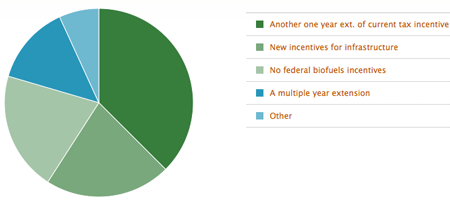
It should be an interesting year in the biofuels debate. The response to our latest poll shows some pretty divided results which might make it interesting to see how Congress handles things after hearing from their constituents. In answer to the question “What do you think will happen with biofuels policy this year?” Our results are that 38% say there will be another one year extension of the tax incentive, 22% say there will be new incentives for infrastructure, 20% say there will be no federal biofuels incentives, 14% say there will be a multiple year extension and 6% chose other. If you chose other then feel free to comment with what you think will happen.

Our next ZimmPoll is now live and asks the question, “What do you think about the number of farm groups? Let us know what you think and thank you for participating.

ZimmPoll is sponsored by Rhea+Kaiser, a full-service advertising/public relations agency.

ZimmPoll