RFA E-15 Ad

UNICA Expects Decline in Brazil Ethanol Exports

Cindy Zimmerman

Ethanol exports from Brazil could drop by as much as 18% this season compared to last year, according to the Brazilian Sugarcane Industry Association (UNICA).

UNICAUNICA is expecting a slight increase in ethanol production this year, however. “Ethanol production should reach 25.51 billion liters in the 2011/2012 season, a 0.52% increase compared to the last harvest, when the total reached 25.37 billion liters,” the organization reports. According to UNICA’s Technical Director, Antonio de Padua Rodrigues, increased ethanol production combined with a drop in exports will result in an increase of almost 500 million liters of the biofuel in the domestic supply. “However, this increase in ethanol supply for domestic use is lower than the expected growth in demand, given accelerated sales of flex vehicles,” he said.

Of the 25.51 billion liters of ethanol expected in the new season, 17.21 billion will be hydrous ethanol and 8.30 billion will be anhydrous ethanol. This volume of anhydrous ethanol is sufficient to meet the 25% blend with gasoline, even if a smaller share of the flex fuel fleet uses hydrous ethanol as expected, as consumers that own flex-fuel choose gasoline because of pricing.

The forecast for the 2011/2012 Brazilian sugarcane harvest calls for 568.50 million tons, up 2.11% compared to last year. The country is expecting an overall recovery in agricultural productivity after a lengthy dry spell, but UNICA is projecting that average productivity of the total sugarcane area for the 2011/2012 harvest will decline compared to the previous harvest, due to factors including the aging of cane fields and a reduction in the amount of cane that was not processed in the prior harvest and therefore has been growing for nearly two years.

Brazil, Ethanol, Ethanol News, UNICA

Farm, Biodiesel Maker Seek Canola Growers

John Davis

DRM Farms and SunPower Biodiesel have teamed up to find farmers in Wisconsin, Michigan, Minnesota and the Dakotas to grow canola for SunPower’s Cumberland, WI refining operation to make its Premium Cold Flow Biodiesel:

Canola is quite adaptable with regard to soil type, and has shown profitability on marginal crop lands where other crops are not as feasible. It has revealed drought tolerance and preference to cooler temperatures, making canola ideal as a featured or alternative crop in the mid-western region of the United States.

The selling price for the seed will ultimately depend on the quality and current canola commodity values. Other oil seeds, such as sunflower, camelina and flax, will also be considered for purchase.

SunPower Biodiesel is getting some money for the project from the Wisconsin Clean Transportation Program, administered through the Wisconsin Office of Energy Independence and Wisconsin Clean Cities.

Biodiesel

Biodiesel Board Backs Obama’s Backing of Biofuels

John Davis

The National Biodiesel Board has joined the chorus of biofuel groups applauding President Obama’s call for boosting the production of domestic fuels:

“The biodiesel industry is already poised for a record year in which we will displace nearly a billion gallons of petroleum with a renewable fuel produced right here in the United States,” said Manning Feraci, NBB’s Vice President of Federal Affairs. “We are ready and able to meet the nation’s Advanced Biofuel goals and in the process create new jobs, improve the environment and enhance the nation’s energy security.”

As Cindy and Joanna reported earlier, other groups, including the Renewable Fuels Association, Growth Energy, the Biotechnology Industry Organization (BIO), and the Advanced Ethanol Council, have given their support to Obama’s Blueprint for A Secure Energy Future that outlines a comprehensive national energy policy.

“Over the next two years, we’ll help entrepreneurs break ground on four next-generation biorefineries – each with a capacity of more than 20 million gallons per year. And going forward, we should look for ways to reform biofuels incentives to make sure they meet today’s challenges and save taxpayers money,” Obama said.

NBB points out that biodiesel is America’s first advanced biofuel.

Biodiesel, Government, NBB

DF Cast: Community Solar a Good Choice for Individuals

John Davis

Community solar projects have always been good for the environment, but a company in New Jersey is making them pay for individual investments, especially senior citizens living on fixed incomes.

In this edition of the Domestic Fuel Cast, I talk with Pete Ramsey, the Director of Business Development for GeoGenix. He explains that having an entire neighborhood put in a solar project helps realize some economies of scale … being able to have crews simultaneously work on several solar projects, materials, logistics, and things like that. He says doing community solar, as opposed to each individual putting up his or her own panels, also makes a lot of sense for senior citizens, who could realize a return on their investment in less than five years.

Ramsey admits there a lot of factors that go into figuring those returns: how much electricity is already used, the pitch and position of the roof, the type of system the owner wants, and so forth. That’s why he says it’s important to do individual assessments and discuss what system is right for each home.

It’s a pretty interesting conversation, and you can hear more of it here: Domestic Fuel Cast

You can also subscribe to the DomesticFuel Cast here.

Audio, Domestic Fuel Cast, Solar

Ag Secretary Promotes Biofuels for Jobs

Cindy Zimmerman

tom vilsackU. S. Secretary of Agriculture Tom Vilsack made a visit to St. Louis earlier this week where he was the keynote speaker at the St. Louis Agribusiness Club meeting. As part of his address, he noted the importance of biofuels production for rural economies.

Vilsack noted that there are about 600,000 people in rural America who would describe themselves as farmers or ranchers, but who rely on off-farm income to make ends meet. “What do we do for those folks? What we do for those folks is to create more diverse income opportunities. It’s one of the reasons why I’m a big proponent of biofuels and renewable energy,” he said. Vilsack said biofuels create new market opportunities for those farmers. “I know and they know that when we reach 36 billion gallons of renewable energy and fuel in this country we’re going to create a million new jobs in rural communities.’

Vilsack believes that next generation biofuels from agricultural waste will help rural America even more. “That’s why we are focused on making sure we have an expanded biofuels industry. It only makes sense with the instability in the Middle East. Why not try to create opportunities here at home?”

Listen to or download Vilsack’s biofuels comments here: Secy Vilsack in St. Louis

biofuels, Ethanol, Ethanol News, USDA

RFA Analyzes USDA Report for Ethanol

Cindy Zimmerman

Renewable Fuels Association Logo The Renewable Fuels Association (RFA) hosted a webinar this morning to discuss the new USDA Prospective Planting and Grain Stocks reports and what they indicate for America’s supply of corn and how demand from ethanol production might play into food pricing this year.

Some of the main points made by RFA VP of Research and Analysis Geoff Cooper about the reports relative to ethanol and food prices are:

1. The additional corn acreage is coming through crop switching, not land expansion
2. An average 159.7 bushels per acre will maintain current carry-out levels
3. 2011 ethanol production expected at 13.8-14 bg; about 5 billion bushels of corn
4. USDA is likely underestimating ethanol yield
5. On net basis, ethanol using only 23% of the 10/11 corn supply – not 40%
6. Food price inflation expected to be in line with average of 3.4%
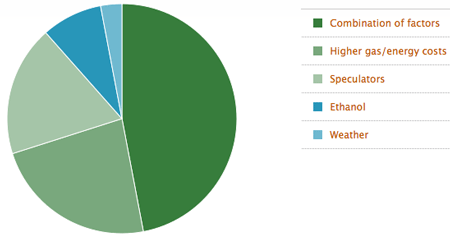
7. Energy prices and speculation more important factors in food price increases
8. Corn is a minor cost component of most retail food items
9. Just 12 cents of every retail food dollar goes to the farm level
11. U.S. corn exports have not declined as ethanol use has expanded
12. U.S. ethanol uses 3% of world grain supply; grain not being “diverted” for fuel use

Cooper notes that the USDA prospective plantings report should be taken “with a grain of salt” since it only indicates farmers’ current intentions and will likely change as planting season gets underway.

Link to RFA power point presentation.

Listen to Geoff Cooper’s presentation here: RFA's Geoff Cooper on USDA report

Audio, corn, Ethanol, Ethanol News, Food prices, RFA, USDA

Corn Stocks are Down, Plantings Expected Higher

Cindy Zimmerman

USDAUSDA expects more five percent more corn to be planted this year according to the Prospective Plantings report released this morning, but stocks are down 15% from last year at this time.

Corn growers intend to plant 92.2 million acres of corn for all purposes this year, up 5 percent from last year and 7 percent higher than in 2009. If realized, this will be the second highest planted acreage in the United States since 1944, behind only the 93.5 million acres planted in 2007.

In the new Grain Stocks report today, USDA says corn stocks in all positions on March 1, 2011 totaled 6.52 billion bushels, down 15 percent from last year. “Of the total stocks, 3.38 billion bushels are stored on farms, down 26 percent from a year earlier. Off-farm stocks, at 3.14 billion bushels, are down slightly from a year ago. The December 2010 – February 2011 indicated disappearance is 3.53 billion bushels, compared with 3.21 billion bushels during the same period last year.”

“This morning’s acreage estimate clearly shows that American farmers respond to signals from the marketplace,” said Renewable Fuels Association Vice President of Research and Analysis Geoff Cooper this morning. “There is every expectation that farmers will once again produce the corn that is needed to meet all demands.”

According to Cooper, based on this acreage estimate, corn yields would need to average 159.7 bushels per acre to maintain current carry-out levels. “To increase carry-out stocks to near one billion bushels, an average yield of 163.5 bushels per acre would be needed,” he said. “Such a yield is entirely possible and in line with trend yield growth from the last 15 years. In 2009, American farmers set the all-time yield record at 164.7 bushels per acre.”

Cooper will be providing more analysis on what the reports mean for the ethanol industry in a webinar this morning at 10:00 AM Eastern. To get info on how to tune in, please email Taryn Morgan at tmorgan@ethanolrfa.org.

corn, Ethanol, Ethanol News, RFA

Book Review – Climate of Corruption

Joanna Schroeder

In the past several years, there seems to be a growing number of people who believe that global warming is a very orchestrated political and environmental hoax. As hype around Earth Day is growing (April 22, 2011), I thought it would be interesting to read, “Climate of Corruption: Politics and Power Behind the Global Warming Hoax,” by Larry Bell. Now Larry Bell is no more a climate scientist than Al Gore. He is a space architect and doesn’t pretend to be anything different. But Bell believes there is a conspiracy amongst us relating to the horrors of climate change that center around fossil-fuel CO2 emissions.

He writes, “Understand that the real impetus behind the cooked numbers and doomspeak of the global warmers has little to do with the state of the environment and much to do with shackling capitalism and transforming the American way of life in the interests of global wealth redistribution (“social justice”).

Bell acknowledges that climate change is real – only that it is not man-made- and says that no one can reliably predict what Earth’s global climate will be in a decade or longer. What he sees as the real problem is the global energy supply dilemma, one that he believes has no simple solution.

Throughout the book, Bell lays out his case for his way of thinking beginning with “outing” those who are “cooking the climate books.” This includes Al Gore as well as the United Nations’ Intergovernmental Panel on Climate Change (IPCC). In other words, he “sets the record straight.” From there, he highlights those that he believes are political hijackers of science – meaning policy makers who have molded climate science research to support their own agenda – mainly cap and trade. (I fondly call this crap and raid.) Bell argues that all forms of cap and trade are scams.Read More

biofuels, book reviews, Environment, global warming, Solar, Wind

Obama Sticks to His Guns on Biofuel Policy Support

Joanna Schroeder

President Obama is sticking to his guns in his support of biofuels, among other energy sources, as viable ways for America to reduce its dependence on foreign sources of oil. This morning, his administration released its plan for a comprehensive energy policy their report, “Blueprint For A Secure Energy Future.”

As a result of the report, the biofuel and biotech industries came out in support of the president’s commitment to biofuels.

Biotechnology Industry Organization (BIO) President and CEO Jim Greenwood thanked President Obama and his administration for its leadership in supporting the commercial development of biorefineries.

“Continued reliance on foreign petroleum threatens not only our economy, but also our energy and national security,” said Greenwood. “Next generation biorefineries utilizing renewable biomass to produce advanced biofuels, biobased products and renewable chemicals offer the potential to help stabilize energy prices and revitalize U.S. rural and manufacturing communities. The policies announced today by President Obama will provide important support to path-breaking biotechnology companies seeking to build commercial-scale cellulosic and advanced biorefineries.”

BIO’s Executive Vice President, Brent Erickson, added that to continue the momentum in the commercialization of biofuels, Congress and the country’s energy policy must enable federal agencies to serve as leaders in creating an open marketplace for biofuels to compete.

Also responding to the report was Brooke Coleman, the executive director of the Advanced Ethanol Council. Coleman reiterated that the biofuels industry is ready and waiting to assist the country in meeting its domestic energy needs and also called upon the administration to work with the industry to create a “responsible transition and transformation of current biofuel tax policy and investments in ethanol vehicle technology and fueling infrastructure.”

Coleman concluded, “Challenging capital markets, economic uncertainty, and uncertain federal policy have worked to slow the commercialization of promising advanced ethanol technologies. By committing to policies that accelerate the commercial production of ethanol from a wide range feedstocks, the nation can gain more control over its energy future. Ethanol production from wood wastes, grasses, municipal solid waste, and other non-traditional feedstocks will go a long way to making America truly independent of a need to import oil.”

advanced biofuels, BIO, biofuels, Biotech, Government

Ethanol Group to Host Webinar on Plantings Report

Cindy Zimmerman

The first big crop report of the season is due out on Thursday and the ethanol industry is ready to interpret what it means for them.

Renewable Fuels Association LogoFollowing the release of the U.S. Department of Agriculture’s prospective plantings forecast in the morning, the Renewable Fuels Association (RFA) will host a webinar to detail what the report means and how America’s supply of corn and the demand from ethanol production play into food pricing.

The webinar, “Understanding the 2011 Planting Outlook, Ethanol, and Food Pricing,” will be presented by RFA Vice President of Research and Analysis Geoff Cooper at 10:00 AM Eastern on Thursday. It is free to join in, all you have to do is RSVP by emailing Taryn Morgan at tmorgan@ethanolrfa.org.

corn, Ethanol, Ethanol News, RFA, USDA, Webinar