RFA E-15 Ad

UC Davis Strives for Zero Net Energy Campus

Joanna Schroeder

University of California, Davis is striving to become a zero net energy campus. The first development will be the UC Davis West Village. The development will combine advanced energy efficient design features that include a 4 megawatt (MW) SunPower solar power system. The solar system, comprised of both rooftop and solar canopies installed in parking areas, will generate the equivalent of 100 percent of the community’s electricity demand. Once complete this fall, this is expected to be the largest zero net energy development in in the country. The project is the result of a public-private partnership between UC Davis and West Village Community Partnership, a joint venture between San Francisco-based Carmel Partners and Urban Villages of Denver.

“I applaud UC Davis, SunPower Corporation, Carmel Partners, and the CEC [California Energy Commission] for their collaboration, dedication, and leadership in developing the largest zero net energy project in the United States,” said Lieutenant Governor Gavin Newsom. “This is a demonstration of California’s excellence in sustainability, and should set an example for the rest of the nation.”

The first phase of the 130-acre project will include apartment housing for 2,000 students, an education center for Los Rios Community College, recreation and study facilities, a village square surrounded by neighborhood-serving retail, and 343 single family homes for sale to faculty and staff. Students will be welcome beginning with the fall semester for two student housing components of the community, The Ramble Apartments and Viridian.

“West Village is a paradigm shift in creating both a great place to live and a model Zero Net Energy community,” said Nolan Zail, senior vice president for Carmel Partners. “Using aggressive energy efficiency measures and on-site renewable energy generation to meet community energy demand, this holistic approach offers new solutions in the design and construction of large-scale sustainable communities,” Zail added.

The UC Davis West Village will integrate sustainable design enabling those living in the community to reduce their reliance on automobiles, limit energy consumption and enjoy the benefits of the local climate. Building designs optimize solar orientation, utilize energy efficient appliances and incorporate materials from renewable sources. Increased efficiencies will be achieved by providing UC Davis West Village residents with tools to enhance control of their own energy use, including programmable energy management systems and SunPower monitoring, which provides information on solar system power generation and electricity usage.

Electricity, Energy, Solar

FAO Studies Pros & Cons of Bioenergy

Joanna Schroeder

FAO has released a new report that contains methodology designed to aid policymakers assess the pros and cons of investing in the bioenergy industry. The “Bioenergy and Food Security (BEFS) Analytical Framework” was written to help governments evaluate the potential of bioenergy as well as assess its possible food security impacts. The framework was developed over a three-year time frame and cites development and field tests that took place in Peru, Tanzania and Thailand.

The report is comprised of a series of step-by-step evaluations that seek to answer critical questions regarding the feasibility of bioenergy development and the impacts on food availability and household food security. In addition, social and environmental dimensions are also considered. The paper also serves as a platform for bringing key ministries and institutions together so they can work on the same page.

“Our goal is to help policy-makers take informed decisions regarding whether bioenergy development is a viable option and, if so, identify policies that will maximize benefits and minimize risks,” explains Heiner Thofern, who heads FAO’s Bioenergy and Food Security (BEFS) project.

The drive to biofuels have been driven by both worries over greenhouse gas emissions from fossil fuels as well as high oil prices and energy security concerns. FAO believes that one important benefit of investments into the bioenergy sector is that it could spark much-needed investment in agricultural and transport infrastructure in rural areas. This would create jobs and boost household income. These benefits could lesson both poverty and food security concerns. FAO has also conducted separate studies that show small-scale bioenergy projects not designed for export markets can improve food security and help boost rural economies.

“FAO has been saying for years that under-investment in agriculture is a problem that seriously handicaps food production in the developing world, and that this, coupled with rural poverty, is a key driver of world hunger,” says Thofern. “Done properly and when appropriate, bioenergy development offers a chance to drive investment and jobs into areas that are literally starving for them.”

Yet while there are major potential benefits to bioenergy production, FAO warns there are also potential negatives. They write that large-scale biofuel production could come at the expense of food production, leading to less food available, and higher food prices. In addition, deforestation is also a concern. Therefore, potential risks and benefits need to be weighed.

bioenergy, biofuels, food and fuel, Indirect Land Use, International, Research

50% of India’s Fuel Needs Could Be Met By Biofuels

Joanna Schroeder

One million jobs could be created in India over the next decade through the transformation of agricultural waste into biofuel. Should this occur, biofuels could meet 59 percent of the demand for liquid transportation fuels by 2020. This according to the Bloomberg New Energy Finance study, “Next-generation Ethanol: What’s in it for India,” commissioned by Novozymes. Already, the Indian government has announced its Indian Biofuels Policy that calls for 20 percent of its transportation fuel to be biofuels by 2017.

The study was released at an event organized under the aegis of the Danish Embassy in India in cooperation with the Ministry of New and Renewable Energy. Consuming 17.3 billion litres per year of gasoline, India is the world’s 6th largest consumer of energy. Through 2020, demand is expected to grow 8.5 percent every year. Based in a barrel of crude oil at $100 USD, India would spend $19.4 billion USD on imported gasoline by 2020.

“By converting agricultural residues into fuel ethanol, India has the potential to reduce its dependence on imported petroleum,” said Thomas Nagy, Executive Vice President for Novozymes. “What’s more interesting is that this can be achieved without changing today’s agricultural land-use patterns or cultivating new energy crops. In addition, we already have the technology ready for deployment.”

According to the report, biofuels from agricultural residues could become a critical alternative to liquid transportation fuels. However, for this to happen, the report says issues such as policy implementation, the absence of incentives for the collection of the ag residue (only 25 percent of the waste is currently recovered by the fields) and infrastructure need to be addressed in order for biofuels to play a critical role in India’s energy needs.

Expanding on the policy requirements, the report lays out the need for India-wide mandates, coherent and innovative polices at the centre and state levels and cohesive policy incentives. Only these measures, says the report, will encourage stakeholders to make necessary changes and investments.

biofuels, biomass, Ethanol, International, Research

Book Review – Energy Myths & Realities

Joanna Schroeder

This week I decided to bone up on some energy 101 so I read “Energy Myths & Realities” by Vaclav Smil, an energy scientist. He discusses eight myths and attempts to set the record straight by disseminating the true facts around the issues. He believes several of the myths have been mired in the past while others are perpetuated by the media.

For example here is one myth that he demystifies: Electric cars will replace conventional cars in the near future. The reality according to Smil: Electric cars are expensive, their adoption rate will be slow, and internal combustion engines will dominate the market for decade to come. He also believes that EVs will not provide much, if any, energy savings.

So why does it matter if there is discourse among energy advocates? Because, says Smil, these incorrect facts and fallacies are hampering the development of effective new energy policies and wasting time and money that could be better used in pursuit of a constructive, scientific approach to the global energy challenge.

Here are some other myths that Smil addresses, all dished up as solutions, or part of a solution for our energy woes.

• The world will soon run out of oil.
• Carbon sequestration is the solution to global climate change.
• Ethanol will replace gasoline as a significant source of automobile fuel.
• Wind power will soon become the world’s leading source of electricity.

I’ll play my hand here and agree with Smil that carbon sequestration is not a solution. In fact, I believe it is a multi-billion dollar farce. Yet where I diverge with Smil is while he believes various forms of alternative energy should have no role, or will only play a small role, I think it’s shortsighted to ignore parts of the energy portfolio that are right in front of us. But I digress.Read More

algae, biofuels, book reviews, Electric Vehicles, Energy, Wind

Don’t Mess with the RFS

Joanna Schroeder

The U.S. biofuels industry sent a message to Congress today asking them not to mess with the RFS. Specifically, the industry encouraged lawmakers “to stand firm in the face of calls to waive or repeal the groundbreaking biofuels provisions included in the Energy Independence and Security Act of 2007 (EISA), including the Renewable Fuels Standard (RFS).”

Several biofuel organizations came together to sign the letter including Michael McAdams, president of the Advanced Biofuels Association; the Honorable Jim Greenwood, president and CEO of the Biotechnology Industry Organization; Bob Dinneen, president and CEO of the Renewable Fuels Association; Brooke Coleman, executive director of the Advanced Ethanol Council; and Brian Jennings, executive vice president of the American Coalition for Ethanol.

The letter, delivered to Rep. Fred Upton (R-MI), chairman of the House Committee on Energy and Commerce, was in response to several current proposed bills and amendments that hinder or help the domestic biofuels industry. Also targeted was ranking member Rep. Henry Waxman (D-CA) as well as U.S. Sen. Barbara Boxer (D-CA), chairman of the Senate Committee on Environment and Public Works and its ranking member, U.S. Sen. James Inhofe (R-OK).

The message to Congress remained the same and stressed that the biofuels industry is creating jobs, helping to reduce America’s dependence on foreign oil and is a strong contributor to the nation’s economy, providing $53 billion. A recent report found that additional job creation from advanced biofuels production under the RFS could reach 807,000 by 2022. The letter also stressed that the industry is “committed to ensuring the U.S biofuels policy is implemented in a way that builds upon current technologies and fosters the development of new ones.”

The letter also expressed that “calls to reduce, waive or eliminate the RFS would send a chilling signal to markets at time when dozens of new biofuels technologies are traversing the so-called “Valley of Death” to first commercialization.” More capital investments are needed to bring biofuel technologies to commercialization.

A full copy of the letter can be found here.

Biodiesel, biofuels, Cellulosic, Ethanol

New E85 Station Opens in Redwood City, CA

Joanna Schroeder

A new E85 station has opened in Redwood City, California, the hometown of Propel Fuels. As gas prices remain high, more and more California motorists are moving to renewable fuels to fill their tanks. This is just one of many E85 stations that Propel plans on opening in the Bay area (San Francisco). In an event to officially open the station, Redwood City Mayor Jeff Ira was on hand along with Jack Broadbent, Executive Officer of the Bay Area Air Quality Management District. Also showcased was the latest in renewable fuel vehicle technology from General Motors and Mercedes-Benz.

“Propel is a perfect example of the type of company we’re looking to attract here in Redwood City,” said Mayor Jeff Ira. “We’re very proud to be the home of such a forward-looking company that is poised to do great things for the economy and environment in California.”

Broadbent added, “Motor vehicles are the largest source of air pollution in the Bay Area. Carpooling, keeping your car tuned, and using lower-carbon fuels is something many drivers can do now to help reduce air pollution.”

Propel is the leading retailer of E85 and biodiesel on the West Coast. The company operates its Clean Fuel Points (stations) throughout California and Washington State, with more than 75 sites planned across California within the next year. In California, there are more than 1 million flex-fuel vehicles and nearly 20 million across the U.S.

“People feel powerless in the face of rising gas prices. Beginning today, we’re providing drivers on the Peninsula something they’ve never had – true choice at the pump. We’re offering a way to make progress towards reducing our nation’s dependence on petroleum fuel and the carbon emissions from our vehicles,” said Matt Horton, CEO of Propel.

Propel’s newest station is co-located at the Redwood City Valero station at 503 Whipple Avenue (at the intersection of Whipple Avenue and Veterans Boulevard) in Redwood City. As part of the opening celebration on May 17-20, Propel will provide Redwood City drivers and fleets ten dollars of free E85 Flex Fuel or Biodiesel. The free fuel promotion encourages local drivers to experience filling with clean, quality certified, renewable fuels.

Biodiesel, E85, Ethanol

App Use Strong On Smartphones

Chuck Zimmerman

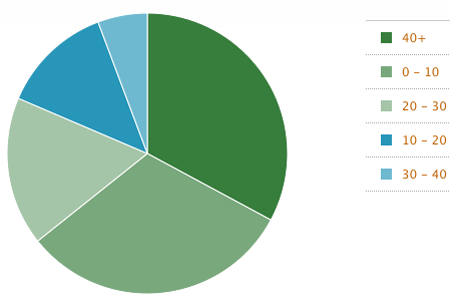
According to our latest ZimmPoll you’re using lots of apps on your smartphones. Well, at least some of you are. Over a third of our respondents said they have more than forty apps on their smartphone. That was followed though by another third who said they only have zero to ten apps. Seventeen percent said they have 20 to 30 apps, thirteen percent said 10 to 20 and five percent said 30 to 40 apps. That’s a lot of apps! It’s amazing how useful these devices are becoming and apps are what make that possible.

Our new ZimmPoll is now live. We’re asking the question, “Will USDA forecast for record 13.5 billion bushels of corn come true?” There’s been a lot of flooding and cool weather in the corn belt this spring. How much do impact will that have? Let us know what you think and thank you for participating.

And if you have any questions you want to suggest for future ZimmPolls please let us know.

ZimmPoll is sponsored by Rhea+Kaiser, a full-service advertising/public relations agency.

ZimmPoll

ICM Files for Corn Oil Separation Patent

Joanna Schroeder

ICM has announced the company has filed for a non-provisional patent application with the U.S. Patent and Trademark Office (USPTO) and an international patent application under the Patent Cooperation Treaty (PCT) with the U.S. as receiving office. The patent will cover ICM’s newest development to its Advanced Oil System, a corn oil extraction technology. Also filed was a petition to request participation in the USPTO’s “Green Technology Pilot Program” that encourages accelerated examination and issuance for “green” technologies.

ICM says their Advanced Oil System solves some of the current yield issues with corn oil extraction technologies due to emulsification, an industry wide challenge to achieving consistent high oil recovery rates. The company’s improved technology delivers a much higher conversion rate than currently possible with first-gen technologies. The Advanced Oil System consists of separate skid mounted units that can be installed at plants without oil extraction technology, or as an add-on to plants that already have invested in ICM’s first generation corn oil extraction equipment. They are deploying their first commercial Advanced Oil System at an ICM-designed 110 MGY ethanol plant. The system was commissioned last week and in operation.

Chris Mitchell, Executive Vice-President of ICM said, “We have focused our efforts on developing solutions that deliver quick payback and ongoing value-added co-product streams to the renewable energy industry. We believe our competitive advantage comes from providing our customers with a competitive advantage of their own—the highest-yielding and most reliable oil separation technology available.”

The Advanced Oil System design and method falls outside of all patent claims of GreenShift Corporation’s patent, according to Brian Burris, general counsel for ICM. “Our patent pending system does not separate oil directly from the concentrated thin stillage. ICM’s system implements special processing to release oil from an emulsion concentrate, which results in a higher recovery of corn oil from the ethanol process.” ICM now has two differentiated solutions that allow the operator to control the quantity of oil removed from the process: the Tricanter Oil Separation System and the Advanced Oil System.

Company Announcement, corn, Ethanol

Algae Waste Water, Ag Runoff Projects Underway in Europe

Joanna Schroeder

OriginOil, Inc. and its French partner Ennesys have confirmed they are working with various institutions to develop two separate large-scale algae projects. Global 500 Multinational Bouygues Construction has engaged Ennesys to study the integration of waste water algae production in two building projects in the Greater Paris region both at the scale of a million square feet (80,000 m2 and 150,000 m2). The algae produced will be converted to fuel, electricity and industrial chemicals. The project, in part, was spurred by France’s RT 2020 sustainable energy law that calls for all major buildings to have a positive energy balance by the year 2020.

“Europe and France have made unconditional sustainability commitments, and this is driving fast-moving commercial algae projects for us in France,” said Riggs Eckelberry, OriginOil CEO. “We are committed to supplying our technology, know how and integrated supplier network to help Ennesys get these projects up and running quickly.”

The second project will focus on marine fuel applications. ITSASOA is collaborating with Ennesys on a plan to absorb agricultural runoff using algae that will then converted to fuel for fishing vessels. ITSASOA is an advanced biofuels program financed by the Ministry of Agriculture and Fisheries and the European Union.

“Algae in France has taken off with the new eco-building law that forces large developers to innovate without delay on their new projects,” added Pierre Tauzinat, Ennesys president. “Due to its many benefits, algae is more productive than solar panels, and will generate continuing jobs here in France. That’s a huge benefit over solar, which is often manufactured in other countries and generates few jobs once installed.”

algae, biofuels, Company Announcement, International

KiOR Breaks Ground, Signs FedEx

Joanna Schroeder

KiOR has had a busy week. They recently announced a ground fuel supply agreement with FedEx. Under the agreement, KiOR will supply renewable diesel blendstocks for purchase by affiliates of FedEx Corporate Services. This is the company’s first end-user agreement. The oil will be produced at the company’s first commercial production facility in Columbus, Mississippi that is scheduled to go online in the second half of 2012. KiOR has broken ground on the plant, and when in production will convert 500 tons of biomass a day into 11 million gallons of oil.

“We are excited to be working with a premier transportation company like FedEx,” said Fred Cannon, KiOR’s President and CEO. “This agreement with the services company of direct end users is another step toward delivering our fuel blendstocks to the market.”

In addition to the agreement with FedEx, KiOR also has an agreement with the Hunt Oil Refinery in Tuscaloosa, Alabama and Catchlight Energy, a joint venture between Weyerhaeuser and Chevron to provide oil. The oil can be processed at a refinery or used directly by cars, once the oil is refined into gasoline and diesel at the Columbus facility. This announcement was highlighted by Gov. Haley Barbour during a ceremonious groundbreaking ceremony.

The biorefinery has received local investments of $190 million and statewide more than $500 million. Once the first plant is complete, KiOR has plans to add four more sites, two in Mississippi and two with undetermined locations.

“This is an unbelievable accomplishment, and it’s a game changer for our country,” said Barbour.

Cannon added during the groundbreaking, “Every gallon or barrel of fuel we make in Columbus is a gallon or barrel of fuel we don’t have to import from another country, some of which don’t like America very much.”

biofuels, green diesel, Oil