ACE Conference 2026

Hino Trucks Approved for B20

Joanna Schroeder

Hino Trucks has approved its product line of class 4 and 5 cab overs as well as class 6 and 7 conventional trucks for use up to a 20 percent biodiesel blend (B20). The company says all of its 2011 and 2012 model year trucks powered with its 3-Series engines are approved to use up to B20 blends that meet ASTM D6751 and D975 standards. In addition, B20 is also approved to fuel Hino’s new diesel-electric hybrid cab anticipated to be released this fall.

“It is our strong commitment to design and assemble trucks that are at the forefront of environmental friendliness and that help to reduce our overall dependency on foreign oils,” said Glenn Ellis, Vice President of Marketing and Dealer Operations for Hino Trucks. “By offering the class 4 and 5 market a diesel-electric hybrid cab over that can use up to B20 biodiesel, our customers now have an option for a commercially acceptable alternative fuel truck.”

According to Hino, they are the only company that offers class 6 and 7 conventional trucks to meet the 2010 EPA emission requirements without the use of credits. Hino trucks built prior to model year 2011 are approved to use B5 blends.

Biodiesel, biofuels

Siemens Secures Contract for Idaho Solar Project

Joanna Schroeder

Yesterday, I spent the day checking out what was happening in the global solar industry at the InterSolar North America conference held in San Francisco, California. With more than 20,000 attendees and nearly 800 exhibitors, there is proof that the solar industry is gaining traction.

One company making news is Siemens Industry, Inc. who announced they received a multi-million dollar order from Interconnect Solar Development to supply solar technology for the 20 MW Murphy Flats solar project located in Idaho. Once complete, this will be Idaho Power Company’s first commercial solar project integrated into its electricity grid. Siemens will be manufacturing the solar technology, that includes inverters, transformers and containers, will be manufactured at its plant in West Chicago.

“The Siemens team demonstrated a true understanding of our project objectives, and the team made a significant investment of their time and expertise to bring additional solar power to electricity customers in Idaho,” said Bill Piske, founder of Interconnect Solar Development, LLC. “Siemens Answers for Industry event first allowed our team the opportunity to learn about the integrated solutions provided by Siemens, as well as the company’s significant portfolio of PV project experience in utility applications.”

According to Siemens, their solar solutions will provide one of the lowest Levelized Cost of Electricity (LCOE) and their IGBT technology-based inverters are expected to deliver efficiencies greater than 98 percent. The Murphy Flats project will also feature Siemens PV-WinCC SCADA software.

Richard Myers, director of solar vertical market management for Siemens added, “We are proud that Interconnect Solar chose Siemens to be its partner for the Murphy Flats project. Additionally, our service and support will ensure uptime and plant efficiency throughout the project lifecycle by providing a 20-year customer service agreement.”

You can view photos from the InterSolar North America conference in my event photo album.

Electricity, Energy, Solar

REG New Owner of SoyMor Biodiesel

Joanna Schroeder

Renewable Energy Group (REG) is the new owner of the SoyMor Biodiesel LLC facilities located in Albert Lea, Minn. The purchase included SoyMor’s biodiesel plant as well as its soy lecithin facility. The 30 million gallon per year (mmgy) biodiesel plant has been idle since 2008 and REG is already in the process of hiring 20 full-time employees for the various positions including administration, plant operators and load-out staff.

“Renewable Energy Group is proud to add this production-proven, strategically-located facility to our network of owned and operated biorefineries,” said REG’s CEO Jeff Stroburg. “With nationwide demand for biodiesel growing steadily through implementation of the Renewable Fuels Standard (RFS2) and Minnesota’s continued biodiesel consumption leadership, we expect to quickly ramp up production at REG Albert Lea, LLC.”

REG is currently the country’s largest biodiesel producer and this addition brings the company’s annual biodiesel nameplate production capacity to more than 210 mmgy. Prior to the purchase of SoyMor, REG was the contractor and manager for the 30 mmgy refined vegetable oil feedstock biodiesel facility that began production in April 2005. As part of its strategy, REG will upgrade the plant’s technology to enable the facility to produce biodiesel from a multitude of feedstocks such as lower cost natural fats and oils including used cooking oil and inedible corn oil produced by corn ethanol plants.

Stroburg added, “With a foundation in agriculture and expertise in domestically-produced, renewable energy, REG is proud to bring green-collar jobs to this rural economy while supporting ag producers in Minnesota and across the Midwest. Our REG manufacturing team is already on-site at the facility to re-start the biodiesel process in order to have high quality, REG-9000® biodiesel available in the market very soon.”

Biodiesel, biofuels, REG

Codexis Scales Up Cellulosic Enzyme Production

Joanna Schroeder

Codexis has confirmed plans to scale-up the commercial manufacturing of its proprietary cellulase enzymes. These enzymes are manufactured to convert lignocellulosic biomass to fermentable sugars, and ultimately bioproducts including biofuels, biochemicals, and bio-based performance ingredients in household products such as laundry detergents and shampoos. The enzymes will be produced at the Fermic S.A. de C.V. facility located in Mexico City, Mexico.

Prior to this commercial launch, they produced the enzymes at 20,000 liter scale. This achievement represented the first time an enzyme product was manufactured and using their Codexis CodeXporter enzyme expression system. In addition, the cellulase enzymes were created using the Codexis CodeEvolver direct evolution technology and plans to use this product to support biofuel projects and their market expansion into biochemicals.

“High-performance cellulase enzymes will soon be in high demand for cost-effective production of renewable products from biomass,” said Alan Shaw, Ph.D., President and CEO “This is both an important commercial milestone for Codexis and a significant development for customers, who are responding to market demand for sustainable products.”

biochemicals, biofuels, Cellulosic, Energy

WM Commissions 1,000th Natural Gas Truck

Joanna Schroeder

This week, Waste Management (WM) commissioned its 1,000th natural gas truck. The company is the largest owner and operator of natural gas burning heavy duty trucks in North America. The truck was commissioned during a ceremony in Carson, California and on hand was Long Beach Mayor Bob Foster. The truck will be dedicated to picking up recyclable materials.

“This is a special milestone in our journey to develop the cleanest fleet of heavy duty trucks in our industry,” said Duane Woods, senior vice president at Waste Management. “We are pleased that we have so many natural gas trucks now in service, particularly in Southern California where clean air is such a critical issue.”

One third of WM’s fleet is now fueled by liquified natural gas (LNG) derived from the decomposition of organic waste delivered and processed at the Altamont Landfill located in Livermore, California. The plant began producing LNG in November 2009, and in this time has been generating up to 13,000 gallons of LNG per day.

WM says that LNG is a “virtually zero-carbon transportation fuel,” and with its current fleet, will displace nearly 8 million gallons of petroleum and 45,100 metric tons of greenhouse gas emissions per year.  In addition to its fleet, the company also has 17 compressed natural gas (CNG) and LNG fueling stations located at its facilities with more installations under development. The company also hopes to develop a new landfill-gas-to-LNG facility at its landfill located in Simi Valley, California, a facility that would be similar to its LNG facility at Altamont.

Mary Nichols, chair of the California Air Resources Board, added, “I’m pleased to celebrate the opening of this new facility that’s quite literally turning trash into fuel, and helping us reach our environmental goals by reducing our greenhouse gas emissions and creating a healthier atmosphere for all Californians.”

Compressed Natural Gas (CNG), Liquefied natural gas (LNG), Waste-to-Energy

Email Is Certainly Not Dead Yet

Chuck Zimmerman

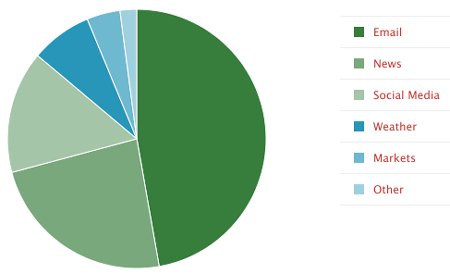
Email got you down? Inbox overflowing? Yeah. We all deal with it. I have a love/hate relationship with email. It’s a fact of business life though. It’s also what dominates our attention when we get online first thing in the morning according to our latest ZimmPoll.

So here’s the results in answer to our question, “What’s the very first thing you check online each day?” 47% of you say it’s email. 24% say news; 15% say social media; 8% say weather; 4% say markets and 2% say other. I’m tempted to say that more people are checking social media than weather and markets but we’re not “scientific.” However, these are interesting results don’t you think?

Our new ZimmPoll is now live. We’re asking the question, “How accurate do you believe the USDA acreage predictions are?” Let us know what you think.

ZimmPoll is sponsored by Rhea+Kaiser, a full-service advertising/public relations agency.

ZimmPoll

Researchers Study Alage in Roman Baths for Biofuels

Joanna Schroeder

Here is an interesting place to find feedstock for biodiesel – the Roman Baths. University of Bath researchers in the Department of Biology & Biochemistry are studying the algae growing in the Roman Baths as a source to produce biodiesel. The algae, growing in high temperature waters of the bath, may be a key to meeting growing biofuel needs.

Holly Smith-Baedorf, a PhD student, has made this project her own. “Algae are usually happiest growing at temperatures around 25 degrees celsius and that can limit the places in which it can be cultivated on a large scale,” said Smith-Baedorf. “Areas where these ideal conditions are available also usually make good arable areas and are therefore needed for food production. In an ideal world we would like to grow algae in desert areas where there are huge expanses of land that don’t have other uses, but the temperatures in these zones are too high for algae to flourish.”

Where the conditions seem to be ideal are the Roman Baths. Smith-Baedorf explains that algae cells are quite versatile and can change any of their characteristics in response to their environment. Therefore, the protected environment provided by the baths make it an ideal environment for adaptation and thus research and the team has identified seven different types of algae in the baths.

Another area she is studying is the ability to remove the oil from the algae – an important element to producing cost-effective algal biofuels. Therefore, the research team is also looking for a species of algae with a weaker cell wall, high oil content and the possibility to use cheap filtration techniques, keeping production costs low.

The research team is led by Professor Matt Davidson and also includes collaborators from the University of the West of England. The team is growing seven types of algae harvested from the Roman Baths over a range of temperatures and comparing them to ‘control’ algae known for being good for producing biodiesel at normal temperatures.

Professor Rod Scott added, “The results of this study will help us identify whether there is a particular algae species among the seven identified in the Roman Baths that is well adapted to growing at higher temperatures and also suitable for producing sufficient amounts of biodiesel to make wide-scale production viable.”

algae, biofuels, Research

LS9 To Test UltraClean Diesel, May Open Brazil Biodiesel Plant

Joanna Schroeder

LS9 has been making news with the announcement that they will collaborate with MAN Latin America to test their renewable diesel in both stationary engines and operational fleet vehicles in Brazil. The testing will cover performance, emissions, fuel consumption, and engine durability testing, as well as field testing of the company’s biofuel in Volkswagen trucks and buses.

“Our collaboration with MAN Latin America reinforces our commitment to producing cost-effective, high-quality biofuels and making renewable, sustainable biodiesel made from sugarcane and other renewable sugars widely available to global consumers,” said Ed Dineen, CEO of LS9. “Through this alliance, we intend to further demonstrate the high quality of our drop-in biofuels for the Brazil market, and to move closer to the commercialization of LS9 UltraClean Diesel.”

According to LS9 their UltraClean Diesel has been custom engineered to meet or exceed relevant diesel fuel standards while providing compelling economic and environmental benefits relative to petroleum diesel. The company also says their current fatty acid methyl ester (FAME) product has achieved the key parameters of B100 (100 percent biodiesel) – ASTM 6751 (United States), EN 14214 (European Union), and ANP 7 (Brazil) standards. LS9 believes its biodiesel overcomes several challenges inherent in first-generation biodiesel including a higher cost of production, poor oxidative stability and/or poor cold flow.

In other LS9 news, Bloomberg has reported the company is considering building Brazil’s largest biofuel and specialty chemical plant. While plans have not yet been finalized, current plans include a plant that could produce up to 200 million gallons of biodiesel and chemicals per year. This size plant would be two-thirds bigger than the country’s next largest facility.

“Brazil is going to be a focal point for us,” said Dineen in the Bloomberg article. “We envisage multiple production units there.”

He stressed that since the plans are not complete, the final plant could be smaller and the decision will be made based on feedstock availability and offtake interest. In addition, they are considering building a 75 million gallon per year plant that only produces biochemicals.

biochemicals, Biodiesel, biofuels, Brazil

The CEC Awards $29M to Advanced Biofuels Projects

Joanna Schroeder

I sometimes wonder what in the world California is thinking. I just wrote about Feinstein’s attack on biofuels in the state, yet today the state’s biofuels industry scored a victory when the California Energy Commission (CEC) announced the approval of more than $29 million for advanced biofuels projects. The CEC completed the first two years of its program funding cycle by awarding $29,675,072 to seven different projects through its Alternative and Renewable Fuel and Vehicle Technology Program (AB 118).

“This is a major milestone for our program because it means we have awarded all $175 million from the first two years of the AB 118 program, plus another $14 million from the 2010-11 funding cycle,” said Energy Commission Vice Chair James Boyd. “We have awarded more than 82 grants, public agency agreements and program support contracts totaling $189.4 million in AB 118 funding, leveraging more than $425 million in private match funding and creating or retaining about 5,600 jobs.”

The CEC estimates that the awards will infuse more than $44.5 million into the state’s biofuels industry and they estimate that the monies will create or retain 616 construction, engineering and management jobs over the next three years. The projects range from reducing petroleum consumption and greenhouse gas emissions to providing jobs through the advancement of biofuel technology to the installation of alternative fuel infrastructure aimed at fleets.

Awardees include:

  • Alameda-Contra Costa Transit District ($3,000,000 – Match Share $2,663,175) – AC Transit will construct a new hydrogen bus fueling station in Oakland.
  • Biostar Systems ($3,372,314 – Match Share $3,372,314)  – BioStar Systems is partnering with Sonoma County Water Agency and Sonoma County Transit to produce 148,000 cubic feet per day of pipeline quality biomethane from dairy waste and food processor waste to support the Sonoma County Transit natural gas fleet.
  • South Coast Air Quality Management District ($2,600,000 – Match share $6,000,000) – The South Coast Air Quality Management District and their numerous partners will install and upgrade 11 compressed natural gas (CNG) and liquefied natural gas (LNG) fueling stations throughout Southern California.
  • USA Waste of California ($489,040 – Match Share $1,051,021)  – USA Waste will upgrade a liquefied natural gas (LNG) station in the City of Corona (Riverside County) to add storage tanks, vaporizers and dispensers that will also add compressed natural gas (CNG) to their current LNG dispensing capabilities.
  • CR&R, Inc. ($4,520,501 – Match Share $18,166,460)  – CR&R estimates that this project planned for the City of Perris in Riverside County will produce 120,000 million BTUs of pipeline quality biomethane from nonrecyclable municipal waste using a two-stage anaerobic digestion process.
  • Pixley Biogas ($4,672,798 – Match Share $4,910,925)  – Pixley Biogas intends to build an anaerobic digestion facility in the community of Pixley (Tulare County) that will process more than 36 million gallons of manure from three nearby dairies and produce biogas to be used at the adjacent Calgren Renewable Fuels ethanol biorefinery.
  • High Mountain Fuels ($11,020,419 – Match share $11,020,419) – High Mountain Fuels intends to convert renewable landfill biomethane to liquefied natural gas for use as transportation fuel at the Simi Valley landfill facility in Ventura County.
advanced biofuels, biofuels, biogas, biomethane, Compressed Natural Gas (CNG), Hydrogen, Liquefied natural gas (LNG)

Ethanol Attacks in California Continue

Joanna Schroeder

Policymakers in California are once again attacking its ethanol industry. Led by California Senator Dianne Feinstein (D-CA), she has plans in the works to limit incentives for production and use of biofuels that would cause taxes to be raised, an increase in use of foreign oil, reduce jobs, and increase pollution. According to the California Ethanol Vehicle Coalition (CEVC), Sen. Feinstein has “long harbored what many observers feel is an irrational vendetta against ethanol.” This despite the fact that the state consumers 20 percent of the nation’s gasoline and more than 60 percent of the gas comes from imported oil.

Feinstein’s goal is to reduce, if not end, California’s as well as the country’s use of corn-based ethanol. On a national level she co-authored legislation that ended support for current ethanol programs. Less than two weeks ago, the Senate came to a compromise to end ethanol incentives via the Ethanol Reform and Deficit Reduction Act, sponsored by Feinstein, John Thune (R-SD) and Amy Klobuchar (D-MN). The compromise included an end to the ethanol tariff as well as to the Volumetric Ethanol Excise Tax Credit (VEETC) that gave the ethanol blender of record a 45 cent incentive to blend the fuel. Should the house pass the same measure, it would take effect on July 31, 2011.

The California Senator’s ire is not limited to corn-based ethanol, although the California Ethanol Producer Incentive Program is under fire and she is lobbying to increase gas taxes and ethanol blended fuel taxes in the state. In addition, she is gunning to limit funds dedicated to building biofuel infrastructure including the installation of E85 or blender pumps. If this isn’t enough, she is also attacking incentives for cellulosic and algal biofuels.

One industry that would suffer a dramatic setback should the federal legislation be signed into law, are those retailers who sell E85 (eighty five percent ethanol, 15 percent gasoline). In California, the 50 plus retailers who sell E85 are looking at shutting off the pumps because they won’t be able to sell the fuel at competitive prices.

“If you were trying to stifle biofuel technology, increase reliance on imported oil, eliminate jobs, and increase pollution, you could not have done a better job than this,” said Joe Irvin, executive director of CEVC. “Senator Feinstein continues to talk about saving taxpayers money when she just pushed through this $1.1 billion increase in the federal fuel tax to California consumers by raising tax on ethanol blends from $13.6 cents to 18.1 cents.”Read More


algae, biofuels, Cellulosic, Ethanol, Legislation, Opinion