ACE Conference 2026

Biodiesel Industry Update

Joanna Schroeder

There are some changes taking place in the biodiesel industry. Enervation Advisors has purchased its third biodiesel plant, this one located in Adrian, Michigan. The company has purchased the closed NextDiesel plant and its first step is to update the technology and put the plant back online. When this occurs, the plant will operate as LVA Adrian Biofuel LLC. This is the third distressed biodiesel plant Enervation Advisors have purchased – the other two are located in Iowa.

Down south, Vanguard Synfuels, LLC held a grand opening of its newly refurbished 15 million gallons per year biodiesel plant today. The plant is located in Pollack, Louisiana and was founded by a local group of foresters and loggers who turned a vacant ammonia plant into a biodiesel biorefinery. The plant became idle in 2007 due to high soy oil feedstock prices but the company has updated its technology to enable the plant to produce biodiesel from various feedstocks including used cooking oil and waste fats from poultry, fish and farm animals.

In other positive news for biodiesel, government trucks in Athens, Georgia are running on biodiesel again. Many Athens-Clarke County vehicles operated on biodiesel until 2007 when their distributor stopped selling biodiesel. This year, the county began purchasing the renewable fuel from a new supplier, Down to Earth Energy, based in Monroe. Nearly 200 county-owned tractors, trucks, bulldozers and other heavy equipment use about 20,000 gallons a month of B5 which is produced locally form cooking oil pine trees and algae.

Biodiesel, biofuels

The Search For Used Cooking Oil

Joanna Schroeder

Used cooking oil is in high demand. Cream City Grecycling, a division of Fushion Renewables, is in search of used cooking grease from local Milwaukee, Wisconsin restaurants. After collecting the used cooking oil, the company will then turn it into biodiesel. The company has a goal of collecting at least 30,000 gallons a month by the end of the year and 50,000 gallons per month by the end of 2012.

“I think sustainability and this local flavor is something that Milwaukee really gets,” said Robert Stensberg, a quality control manager for Fusion Renewables in an article in the Journal-Sentinel.

Since launching in July, the company is offering 50 cents to $1.50 for a gallon of used grease depending on the purity. They also offer free collection containers and pick up. The pay their collectors about $2 per gallon and estimate that the recycling and refining process costs around $1.30. Biodiesel is selling on the market for around $3.50 a gallon right now. All in all, they estimate that after the used grease is converted in biodiesel, they earn about 70 cents after the $1 per gallon federal tax credit. The company currently has 5 employees and hopes to expand soon.

“We have a feeling this is going to be really successful here. We can capture a lot of market share, and we’re doing a good thing for the city,” said Jake Turetsky, a company consultant. “We’re paying restaurants for it and turning it into a renewable fuel that’s used right here in Milwaukee.”

Biodiesel, biofuels

Improving Safety at Biorefineries

Joanna Schroeder

Many of us have had the opportunity to visit an ethanol or biodiesel plant and have experienced first hand the safety measures a plant has in place to keep its workers, and visitors safe. Yet despite precautions, accidents can still happen. Unfortunately for the biofuels industry, these rare occurrences tend to get major media play while the hundreds of days a plant goes without an accident is never reported.

Accidents can happen anytime, anywhere in any type of refinery – whether it be oil, natural gas, ethanol or biodiesel. So it is always good to keep safety top of mind. Therefore, energy.agwired.com is going to launch a four-part series on Biorefinery Plant Safety.  The series will focus on the areas where plants should be especially aware. Part One will focus on eliminating slips, grips and falls. Part Two will focus on interactions with chemicals. Part Three will focus on equipment, while Part Four will focus on everything else.

To help kick off the series, this week’s ZimmPoll question, sponsored by RHEA + KAISER asks the question, “What do you think the biggest safety issue is at a biorefinery?” While the series will explore safety, it will also feature real-world examples of accidents or measures biofuel plants have taken that have prevented accidents. So we’d like to hear from you. If you are willing to share your experience with DomesticFuel readers, please email your story to DomesticFuelEditor@hotmail.com.

I’ll even throw in a little incentive – one person who contacts me with a story will get a chance to win one of the books I’ve reviewed on this site, your choice.

biofuels, Ethanol, safety

Technology Generates Electricity on Flexible Plastic

Joanna Schroeder

New Energy Technologies has announced they have successfully generated electricity on flexible plastic using their ‘spray-on’ coating methods. Last year, the company engaged in a successful public demonstration of its SolarWindow application on glass. When applied, electricity is generated from the glass, but doesn’t block the sun – you can see still the view outside your window. Since this breakthrough, the company has been working on applications beyond glass.

“Today’s breakthrough supports a brand new commercial application for our core SolarWindow™ technology and is the direct result of numerous patent-pending methods, materials, and processes we have worked hard to invent and develop,” said Mr. John A. Conklin, President and CEO of New Energy Technologies, Inc.

There is optimism from the scientific community that commercially developed electricity-generating flexible plastic could be deployed as tinted window film, which remains see-through while generating electrical power. The achievements from New Energy researchers were accomplished by spraying the electricity-generating coatings onto flexible, lightweight lab-scale plastic (polyethylene terephthalate or “PET”) at room temperature and at low pressure. The company believes this product will lower manufacturing costs and is now moving forward with plans for commercial development.

Electricity, Energy, Solar

Protec Fuel Celebrates E85 in Little Rock

Cindy Zimmerman

A promotion offering 85% ethanol fuel for 85 cents a gallon will celebrate the grand opening of five new E85 pumps in the Little Rock, Arkansas area next week.

Florida-based Protec Fuel supplies the fuel and conducted installation of Coulson Oil‘s E85 pumps which are already open to the public. The big celebration will be held on August 10 at the Shell SuperStop in Little Rock, starting at 10:00 am. The event will feature the $.85 fuel promo for flex-fuel vehicles and speakers will include Lt. Governor Mark A. Darr, Energy Office Director Scott Hamilton, and company representatives.

More information about the event is available on-line from Coulson and Protec Fuel.

E85, Ethanol, Ethanol News, Flex Fuel Vehicles, Promotion

Iowa to Showcase Ethanol Pride During Straw Poll Week

Cindy Zimmerman

Fueled with PrideAs the media heads to Iowa next week for the August 13 Straw Poll in Ames, they will have the opportunity to learn more about the importance of ethanol to the state and the nation.

Iowans Fueled with Pride is hosting a series of events during the week to provide the media with opportunities for first-hand interaction with leaders in Iowa’s agriculture and renewable fuels industries. As two of the most innovative sectors of the economy, renewable fuels and crop production have experienced great advances during the last four years. The “hands on” events will provide media with up-to-the-minute information on the efficiency, productivity and energy security benefits of renewable fuels.

The Renewable Fuels Association (RFA) and the Iowa Renewable Fuels Association (IRFA) are sponsoring the events, which will begin on Tuesday, August 9, with an Iowa farm family tour. On Wednesday, Dahl’s Foods in Des Moines will host a ride and drive event to allow the media to test drive the latest flexible fuel vehicles (FFVs) and biodiesel vehicles. On Thursday, the Iowans Fueled with Pride Straw Poll site will be set up near the media parking lot at Hilton Coliseum in Ames, offering the chance to meet with Iowa’s ethanol and biodiesel industry leaders and a mobile education trailer.

The premier event of the week will be on Friday, starting with an ethanol plant and livestock farm tour, followed by a visit to Iowa State University’s BioCentury Research Farm, and culminating with a media availability by Iowa Governor Terry Branstad at the Iowans Fueled with Pride Straw Poll site. All day Saturday, visitors and media are invited to stop by the site to tour the mobile education trailer and learn the latest facts on the production and use of renewable fuels.

Find out more on the Iowans Fueled with Pride website.

Ethanol, Ethanol News, Government, politics, RFA

ACE Urges Ethanol Industry to Contact Congress

Cindy Zimmerman

ACEMembers of the American Coalition for Ethanol (ACE) are being urged to contact their congressional representatives during down time this month.

ACE Executive Vice President Brian Jennings says there are three key issues important to the ethanol industry that they are encouraging members to discuss with congressmen and senators during the August Recess. They include the offer by the ethanol industry “to sacrifice our tax credit for deficit reduction, next-generation biofuels, and incentives for small ethanol producers and infrastructure. Congress missed an opportunity to include this ethanol reform plan in the debt ceiling deal but should look for ways to advance this plan when they return to Washington, DC.”

In addition, Jennings says members should ask Congress to take a look at oil tax subsidies to reduce spending, and jobs legislation, with specific focus on clean energy jobs. “Provide your Members of Congress concrete examples of how ethanol has created jobs and benefited your community so they are armed with information they can use in trying to convince their colleagues in Congress to be more supportive of ethanol in the context of jobs legislation this fall,” said Jennings in a memo to members.

ACE, Ethanol, Ethanol News, Government

Movie Review – Deep Green

Joanna Schroeder

This week I watched the documentary, “Deep Green,” written and produced by Matt Briggs. The documentary takes the position that global warming is real and global warming is serious but, “We can fix this.” Using a combination of animation shorts such as “The Krill is Gone” along with interviews of leading global warming influencers, the documentary says that if we don’t cut out carbon emissions between 80-90 percent in the next few years, it will be too late to reverse its course and well, we’re doomed.

The documentary travels to nine different countries including Germany, Sweden, China and the U.S. to take a look at actions taken to solve global warming. The film features green building projects, renewable energy technologies such as wind and solar and highlights energy efficiency strategies. Briggs interviewed several environmental “who’s who’s” including Lester Brown, the founder of the Earth Policy Institute; David Suzuki, Co-Founder of The David Suzuki Foundation; James Woolsey, former CIA Director and founding member of Set America Free Coalition; Michael Pollan, author of Omnivore’s Dilemma; and Amory Lovins, Co-founder, Chairman and Chief Scientist of the Rocky Mountain Institute.

The documentary was well done and beautifully produced and did an excellent job on intertwining commentary, with interviews, with animated shorts, and solutions. And Brigg’s solutions are not presented as once and done, a strategy often undertook. He continues to lay out solutions over, and over so that you walk away with some solid personal actions you can take to mitigate your own personal carbon footprint.Read More

book reviews, Environment, global warming

POET Biorefining – Caro Receives Green Honor

Joanna Schroeder

POET Biorefining – Caro has received the 2011 Green Agri-Business Designation from the Michigan Agri-Business Association. The ethanol plant received the award for its efforts to integrate environmental practices into its operations. The award focuses on efforts by companies to protect Michigan’s natural resources, conserve energy and reduce impact on water land and air.

“The Michigan Agri-Business Association wants to shine a light on the many agricultural businesses that are doing the right thing, and keeping Michigan’s natural resources strong and healthy,” MABA President Jim Byrum said. “Conservation, sustainability and energy efficiency are a way of life for these Michigan businesses, saving both money and resources. These businesses are good for both our industry and Michigan’s future, and we want to highlight their efforts.”

To reduce water use while improving water quality, POET Biorefining – Caro uses a total water recovery system to eliminate wastewater discharge and a waste heat recovery system that recycles both heat and water. It uses the Load Toad DDGS loader to get more product onto each rail car and conducts a recycling program.

David Gloer, GM of POET Biorefining – Caro added, “We produce renewable fuel, so reducing waste and energy use is a natural focus for POET Biorefining – Caro,” General Manager David Gloer said. “It’s a great honor to be recognized by the MABA for those efforts.”

Company Announcement, Environment, Ethanol, water

Rapeseed Research to Help Optimize Plant Oil Production

Cindy Zimmerman

New energy department research is aiming to increase the use of plant oils as renewable resource by optimize the production of oil in the seeds.

Scientists at the U.S. Department of Energy’s (DOE) Brookhaven National Laboratory have developed a computational model for analyzing the metabolic processes in rapeseed plants — particularly those related to the production of oils in their seeds. Their goal is to find ways to optimize the production of plant oils that have widespread potential as renewable resources for fuel and industrial chemicals.

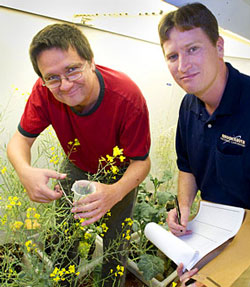
“To make efficient use of all that plants have to offer in terms of alternative energy, replacing petrochemicals in industrial processes, and even nutrition, it’s essential that we understand their metabolic processes and the factors that influence their composition,” said Brookhaven biologist Jorg Schwender, pictured here on the left with research associate Jordan Hay on the right.

The scientists focused on the plant seeds, where oils are formed and accumulated during development. “This oil represents the most energy-dense form of biologically stored sunlight, and its production is controlled, in part, by the metabolic processes within developing seeds,” Schwender said.

The model they have developed is helping them to determine the effects of variables such as light and nutrients on oil production in plant seeds, and which genes and reactions are necessary for oil formation, and which make oil production most effective.

Read more here.

biofuels, feedstocks, Research