
NEC 2027

Bill Would Promote Fuel Choice

Cindy Zimmerman

Senators Maria Cantwell (D-WA) and Dick Lugar (R-IN) have introduced a bill that would ensure most new vehicles in the United States are capable of running on a range of domestically produced alternative fuels starting in 2015.

By introducing competition among fuels, the Open Fuels Standard (OFS) Act aims to bring about significant reductions in fuel prices paid by U.S. consumers. Transportation fuel choice could also sharply reduce U.S. dependence on foreign oil and reduce the $200 billion “monopoly premium” the Department of Energy calculates U.S. consumers currently pay to OPEC (Organization of the Petroleum Exporting Countries) and other foreign oil producers each year through excessive petroleum prices. Keeping this money within U.S. borders would sharply cut the U.S. trade deficit, safeguard U.S household income, and provide capital and market incentive for investment in new U.S. energy infrastructure.

“For too long oil has had a monopoly over transportation fuel and American drivers have had no choice but to pay volatile and elevated prices at the pump,” said Cantwell. “Phasing in vehicles that can run on fuels other than petroleum will allow a whole host of new domestic sources of transportation fuel to come online, which should reduce our dangerous overdependence on foreign oil and help keep American dollars here at home. I am encouraged by the broad bipartisan and stakeholder support for the Open Fuels Standard Act which I believe is a recognition that this approach will really help diversify our nation’s energy supply and spur investment and job creation.”

The Open Fuels Standard Act requires that starting in 2015, 50 percent of new vehicles manufactured or sold in the United States be flex fuel capable – meaning able to run on non-petroleum fuels such as domestically-produced ethanol or methanol or other alcohols in addition to, or instead of, petroleum-based fuels. In 2018, 80 percent of new vehicles would need to be flex fuel capable.

Growth Energy CEO Tom Buis said the legislation would help open the market, so that Americans have access to alternative fuels, like ethanol. “If we are ever going to reduce our dependence on foreign oil and allow consumers a fuel choice, we will need an open market. An open market will drive the investment into cellulosic ethanol and other biofuels,” said Buis.


Ethanol, Ethanol News, Government, Growth Energy

Joint Deal to Improve First Generation Ethanol

Cindy Zimmerman

Two companies have signed a joint agreement to develop an improved first generation ethanol process with enhanced performance economics.

The agreement between Codexis and Raizen Energia S.A. announced today focuses on a range of targets, including improving performance of yeasts now used in ethanol production. Codexis is an industrial biotechnology company and Raizen is Brazil’s largest sugar and ethanol producer.

Under the terms of the agreement, Raizen and Codexis will deploy the Codexis CodeEvolver(TM) directed evolution technology platform to improve Raizen’s current process for producing ethanol made from sugar. Raizen produced 600 million gallons of ethanol in 2010. The parties anticipate pilot production at Raizen’s Bonfim mill.

Read more about the partnership here.

Brazil, Ethanol, Ethanol News

GeoGenix Offers Residential Solar Discounts

Cindy Zimmerman

>New Jersey-based GeoGenix, a SunPower Elite dealer, is offering residential solar systems at a reduced price through the “Drive Green for Life” program that was recently announced by Ford and SunPower Corp.

The “Drive Green for Life” program offers buyers of the 2012 Ford Focus Electrica zero-emissions driving experience that allow electric vehicle (EV) drivers to reduce lifetime auto costs and eliminate long-term EV charging costs. The program refers Focus Electric buyers to SunPower Elite Dealers who will install a high-efficiency, 2.5-kW SunPower solar system on their homes for less than $10,000* after state and federal incentives.

“This is an interesting program, because it will help to stimulate further solar market growth, especially here in New Jersey where state incentives are so strong,” said Gaurav Naik, principal at GeoGenix. “Eco-conscious consumers now have yet another reason to install a solar system. We hope that this partnership will increase demand for solar installations and expand our client base through Ford referrals.”

The 2.5 kilowatt rooftop solar system is comprised of the SunPower® E18 Series solar panels that produce an average of 3,000 kilowatt hours of electricity annually. These high-efficiency solar panels generate approximately 50 percent more electricity than conventional panels and utilize a smaller footprint on the roof. The system was sized to accommodate a customer who drives about 1,000 miles per month.

Learn more about GeoGenix in the Domestic Fuel podcast from March.

Electric Vehicles, Solar

Novozymes Supports FuelChoiceNow

Cindy Zimmerman

Novozymes has joined FuelChoiceNow, a coalition announced last week to create more open access to alternative fuels.

Novozymes“The formation of this new coalition proves that momentum is continuing to build behind biofuels. Consumers deserve to have a choice with their fuel and our economy needs the jobs,” said Adam Monroe, President of Novozymes North America. “Novozymes is proud to be working with these forward-thinkers to give consumers more choices when buying a car and filling it up. By freeing our country from costly foreign oil, we are helping consumers and our economy at the same time.”


Novozymes, which specializes in enzymes for converting biomass into biofuels, is one of 22 advanced biofuel and alternative energy companies involved in the coalition, which also includes Abengoa Bioenergy, Battery Ventures, Propel Fuels, and Qteros.

advanced biofuels, Cellulosic, Ethanol, Ethanol News

DOE Finalizes Cellulosic Ethanol Loan Guarantee

Cindy Zimmerman

The Department of Energy has finalized a $105 million loan guarantee to support the development of one of the nation’s first commercial-scale cellulosic ethanol plants.

POETThe loan guarantee and financing allows POET to construct Project LIBERTY, a 25 million-gallon-per-year cellulosic ethanol plant in Emmetsburg, Iowa.

“This project represents a pioneering effort to make broad scale deployment of cellulose ethanol a reality,” said Secretary of Energy Chu making the announcement on Friday. ”Producing the next generation of biofuels can not only reduce America’s oil dependency, it can also create vast new economic opportunities for rural Americans.”

POET estimates the project will fund approximately 200 construction jobs and 40 permanent jobs and generate around $14 million in new revenue to area farmers who will provide the corn crop residue.

The first commercial cellulosic ethanol plants will demonstrate that the 1 billion tons of biomass available in the United States can be a major force in overcoming the country’s reliance on foreign oil, POET CEO Jeff Broin said. “Financing has been a key hurdle to getting the first commercial-scale cellulosic ethanol plant up and running. We’re excited to show the world the tangible results of a decade of work by our researchers and engineers,” said Broin.

Project LIBERTY will be located next to the existing grain ethanol plant, POET Biorefining Emmetsburg, and will share roads, land and other infrastructure. Additionally, the cellulosic plant will produce biogas as a co-product, enough to completely power itself and eliminate the majority of the natural gas required to operate the adjacent grain ethanol plant.

Cellulosic, Ethanol, Government, POET

Ethanol Group Says Changing RFS is “Bad Policy”

Cindy Zimmerman

Legislation reportedly being drafted that would change the Renewable Fuels Standard would be a bad policy move, according to the Renewable Fuels Association (RFA).

Renewable Fuels Association LogoReuters reported this week that a bill is being drafted in the House that would “reduce the federal mandate to use fuel ethanol when corn supplies are tight” in an effort to keep livestock feed prices lower, according to a congressional staff member. Rep. Bob Goodlatte (R-VA) and Rep. Jim Costa (D-CA) are named as likely sponsors of the legislation.

“Seeking to relegislate the RFS in this manner would do nothing to address the concerns raised by the livestock constituents of Reps. Goodlatee and Costa,” said RFA President and CEO Bob Dinneen. “Research clearly demonstrates that implementing an RFS waiver trigger based on the stocks-to-use ratio will not have the effects on corn prices desired by livestock and poultry interests, nor will it mean more corn is immediately available for feed use. Rather than knee-jerk policy reactions, Congress should maintain the integrity of the RFS to help drive job creation and wean America from its addiction to foreign oil.”

Dinneen also cautioned that if this effort were to be successful, the loss of ethanol in the fuel supply lead to increased prices at the pump. “In fact, given the disproportionate impact on food pricing exerted by energy and fuel prices, raising gas prices by reducing ethanol use would exacerbate concerns with rising food prices,” said Dinneen. “This is simply the wrong policy to address corn supply concerns.”

Ethanol, Ethanol News, RFA

Re-Opened Biodiesel Plant is a “Jewel”

Cindy Zimmerman

The Renewable Energy Group (REG) just hated to see the 30 million gallon capacity biodiesel plant standing idle near Albert Lea, Minnesota for the past three years, so the company decided to do something about it.

“It’s a great plant that needed to run,” Brad Albin, REG Vice President of Manufacturing, said at the plant’s re-opening on Monday. “It had no where to go but was a jewel just sitting here ready to run.”

REG originally built the plant in 2005 for SoyMor, which ran it for three years before shutting down in 2008. “We’re very lucky to have brought this plant up within about four weeks,” said Albin. “It was actually the largest 30 million gallon plant years ago and what’s great about it is that it’s highly efficient and we’ve already got it up to just about 90% throughput.”

Since Minnesota has a state requirement for biodiesel blends, Albin says it was important to get the plant back on line. “Minnesota is a great user of biodiesel so it was just natural that we build it, we’d run it, get back and get it going again,” he said of the plant which uses soybean oil as its primary feedstock.

Listen to or download interview with Brad Albin here. REG VP Brad Albin

REG Albert Lea Biodiesel Plant Photo Album

Audio, Biodiesel, REG, Soybeans

Sheriff Uses Drug Money for Propane Fueled Cruisers

Cindy Zimmerman

Confiscated drug money is helping to clean up the community of Iredell County, North Carolina by putting propane-fueled law enforcement vehicles on the road.

Iredell County Sheriff Phillip Redmond recently had 13 Ford Crown Victoria cruisers converted to run on propane autogas using money confiscated from illegal drug activity.
“We put dirty money to good use by re-purposing seized assets from our drug interdiction program to match grant funding for the autogas conversions,” says Sheriff Redmond, pictured here preparing to fill up one of the converted cruisers at a propane autogas pump.

Nationwide network Alliance AutoGas provided the conversions and autogas fueling infrastructure. The autogas conversions are estimated to save the county about 40 percent in fuel costs, in addition to reduced maintenance expenses and the Sheriff’s Office is reportedly so pleased with the autogas vehicle performance, they are converting 13 additional vehicles this fall and hope to eventually run 50 fleet vehicles on autogas.

Propane

Groups Challenge 15% Ethanol Rules and Label

Cindy Zimmerman

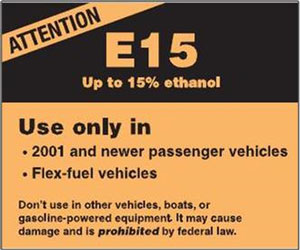
Groups representing small engine, automakers and marine manufacturers announced a formal legal challenge to regulations and labeling proposed for the use of 15% ethanol blends (E15) in older model vehicles.

The Outdoor Power Equipment Institute (OPEI) and other organizations object to the Environmental Protection Agency’s “Regulation to Mitigate Misfueling” rule and labeling proposal meant to address concerns about improper use of E15, calling them “completely inadequate to protect consumers and avoid potential misfueling and damage to millions of legacy products not designed to run on any ethanol fuel higher than E10.”

Officials with the Renewable Fuels Association dismissed the groups’ new litigation, which would prevent EPA from finalizing a consumer label for the proper use of E15 in cars, pickups, and SUVs model year 2001 and newer.

“EPA’s label more than adequately informs consumers as to the proper use of E15,” responded RFA. “Similar labeling, such as for the use of E85 ethanol fuel, have been around for years without incident. In fact, since the adoption of the E85 label, we are not aware of any gas station being found liable for misfueling. EPA’s E15 label is far more descriptive as to the approved uses for E15 and eliminates the guess work for consumers. We believe the American motoring public will be quite capable of determining if E15 is right for their vehicles.”

RFA notes that the groups are already suing EPA over the decision that allows E15 to be used.

Ethanol, Ethanol News, RFA

Biodiesel Tax Incentive Creates Jobs

Cindy Zimmerman

The biodiesel tax incentive is helping to create jobs across the country, according to testimony submitted to the House Ways and Means Committee today by the National Biodiesel Board (NBB).

“While we understand the pressures facing Congress, this is the wrong time to pull support from a growing American industry that is a rare bright spot in this economy,” said Anne Steckel, NBB vice president of federal affairs. “Our industry is having a record year of production, and the tax incentive is a key ingredient in that success. Stripping the incentive away this year would put thousands of jobs in jeopardy.”

Steckel’s written testimony was submitted to the committee for a hearing on energy tax policy and tax reform held today that focused on whether energy policy should be conducted through the tax code, and specifically on proposed tax credits for natural gas under the New Alternative Transportation to Give Americans Solutions (NAT GAS) Act of 2011.

While, the biodiesel industry was not called to testify at the hearing, Steckel’s submitted comments highlighted the biodiesel industry’s rebound this year after the biodiesel tax incentive was reinstated following a one-year lapse in 2010 which caused production to drop dramatically last year as dozens of plants shut down and thousands of people lost jobs.

Since its reinstatement this year, the industry had produced roughly 475 million gallons as of July compared with 315 million gallons in all of 2010. This year’s increased production of at least 800 million gallons will support more than 31,000 jobs while generating at least $3 billion in GDP and $628 million in federal, state and local tax revenues, according to a recent economic study conducted by Cardno-Entrix.

“We believe the U.S. biodiesel industry offers a clear and compelling case that strong domestic energy policy can boost this economy,” she said. “Our production turnaround this year is creating good-paying jobs in nearly every state in the country.”

That claim was highlighted with the re-opening of a southern Minnesota biodiesel plant this week. Minnesota soybean farmer Jim Willers said reinstating the biodiesel tax incentive is one of the best jobs creation programs the government has done lately. “This plant’s put almost 25-30 people back to work, there’s usually 50 trucks that go through here and the spin off effect from this plant creates almost 2,000 jobs,” he said. “Between state and local and federal taxes, it’s way more than the tax credit so your return on investment for the government is just terrific with biodiesel.”

Biodiesel, NBB, REG, Soybeans