

NASCAR has passed the one million mile mark in competition racing on Sunoco Green E15 and issued a report detailing how the 15% ethanol blend performed on the race track this year.
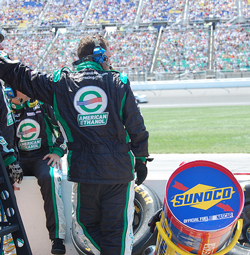 The “One Million Competition Miles on Sunoco Green E15” report, released today in Washington D.C., shows the qualities of E15 as a racing fuel this first year of use in the NASCAR Sprint Cup Series™, NASCAR Nationwide Series™ and NASCAR Camping World Truck Series™. With more than 1.3 million miles accumulated in practice, qualifying and racing laps in NASCAR racing vehicles since the racing season began in February with the Daytona 500, the report details the performance of mid-level ethanol blends.
“Before NASCAR switched its fuel to Sunoco Green E15 at the start of the 2011 racing season, there was extensive analysis and deep consideration about the decision,” said Mike Lynch, Managing Director of Green Innovation for NASCAR. “Successfully transitioning to the new fuel and surpassing a million miles, all on America’s toughest proving ground, is a validation of Sunoco Green E15 as a high-performance racing fuel and is part of our overall effort to go green. NASCAR is proud to use this American-made product because it creates American jobs while also reducing harmful emissions.”
NASCAR’s switch to 15% ethanol fuel came together from a partnership with American Ethanol, established by Growth Energy and the National Corn Growers Association (NCGA).
“It is time we moved forward with E15. This is yet another testament to E15’s value as a fuel. If E15 can fuel the dozens of drivers in dozens of different vehicles every weekend without issue, then it stands to reason that E15 can be used in everyday street cars by everyday Americans,” said Tom Buis, CEO of Growth Energy.
“E15 is performing like champ in the most rigorous driving conditions on the planet and that’s good news for everyone who supports renewable fuels,” said NCGA president Bart Schott.
 At the opening celebration of the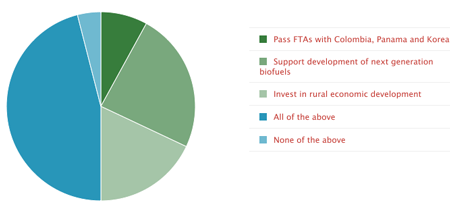

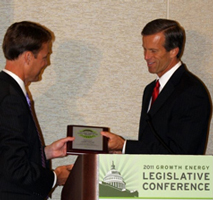 Senators John Thune (R-SD) and Amy Klobuchar were recognized for their support of the ethanol industry today with the “Fueling Growth” award from
  “We are grateful for the leadership and wisdom of these leaders,” said Growth Energy CEO Tom Buis. “This award serves as a reminder of our gratitude, and our continuing efforts to make this country’s national security and economic security stronger through a robust and viable alternative, renewable fuels industry. With their votes and actions in Congress, and their leadership within the administration, these individuals demonstrated loyalty and devotion to the cause of American energy independence.”
 In a letter to the co-chairs of the Joint Select Committee on Deficit Reduction, the so-called “super committee” assigned to find ways to cut the deficit, the
  Molecular biologist Zonglin Lewis Liu with ARS’ National Center for Agricultural Utilization Research in Peoria found a biorefinery yeast that successfully ferments plant sugars from cornstalks, wheat straw, and other rough, fibrous, harvest-time leftovers into cellulosic ethanol. According to Liu, the yeast overcomes some of the troublesome compounds in these materials that are created during dilute acid pre-treatment of the crop leftover. The compounds tend to damage yeast cell walls and membranes, disrupt yeast genetic material such as DNA and RNA, and interfere with yeast enzymes’ fermentation abilities, ultimately reducing potential cellulosic ethanol yields.
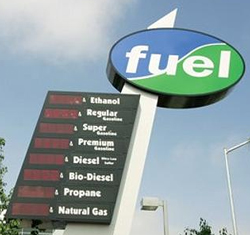 Ethanol, biodiesel, propane, natural gas, electricity – even regular gasoline – consumers should have choices at the pump and a new campaign is urging lawmakers in Washington to make that happen.
 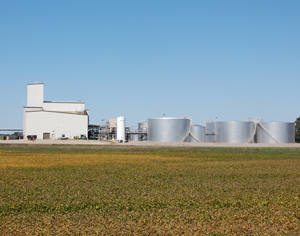 Fields of soybeans surround the newly re-opened
  Hill, pictured here on the left with REG president Dan Oh, says the economic benefits of biodiesel production in a rural community have a multiplier effect. “From the farmer, to the elevator to the tire salesman, to the people buying the biodiesel to blend it, for trucks and everything else, it just helps everybody,” Hill said, adding that it helps all of agriculture, including livestock producers who benefit because it helps reduce the cost of soybean meal.
  Secretary of Agriculture Tom Vilsack addressed members of