ISU Researchers Growing Algae in Poultry Houses

Joanna Schroeder

A research project conducted by several Iowa State University (ISU) researchers is studying the feasibility of growing algae in poultry houses. Poultry manure generates ammonia, a health and safety concern for both animals and workers. Ammonia can burn the eyes, but if released into the atmosphere, could also cause acid rain. But if Honwei Xin, professor of agricultural and biosystems engineering at ISU he will turn a challenge into an opportunity.

Juhyon Kang, graduate research assistant in food science and human nutrition is joining Xin in the research and are working together, according to an article in the Iowa State Daily, to design and develop a bioreactor that will filter  ammonia out of the exhaust air. The gas will then be repurposed to grow algae in a controlled environment.

“We want to improve the environmental stewardship of the poultry operation,” Xin said. “It would be a perfect match if we could remove ammonia from the exhaust air in poultry houses and use it to grow algae.”

Algae can be used to create a myriad of products including biofuel, biojet fuel, biomaterials, biochemicals and animal feed. Algae thrives on gases that for humans, can negatively affect health such as carbon dioxide and ammonia.

Kang said tests have shown that up to 96 percent of the ammonia is removed from the [air] exhaust. She is currently working on scaling up the algal bioreactor ro commercial scale while other team members study optimal algae growth conditions, analyze algae to produce feed and exploring optimum amounts of ammonia concentration for the algae to grow.

Xin added, “Algae can serve as a feedstock for biorenewable energy or [an additive] for animal feed. It’s a win-win situation; you kill two birds with one stone.”

advanced biofuels, Agribusiness, algae, Research

IRFA Elects 2013 Offers & Executive Committee

Joanna Schroeder

The Iowa Renewable Fuels Association (IRFA) announced its new Board of Directors Officers and Executive Committee for 2013, elected during its annual meeting held on December 11, 2012. Each producer member has a seat on the Board and votes on officers. New officers will serve a one year term during the 2013 calendar year.

2013 IRFA Board of Directors Officers:

  • President, Rick Schwarck, Absolute Energy
  • Vice President, Steve Bleyl, Green Plains Renewable Energy
  • Treasurer, Brian Cahill, Southwest Iowa Renewable Energy
  • Secretary, Tom Brooks, Western Dubuque Biodiesel
  • Executive Director, Monte Shaw (non-voting)

The IRFA Executive Committee is comprised of the IRFA Officers and other members as elected by the Board. Elected to join the IRFA Officers on the Executive Committee for 2013 are: Past President Brad Albin, Renewable Energy Group; At-Large Craig Willis, ADM; and At-Large Eamonn Byrne, Plymouth Energy.

“2012 was a challenging year for ethanol and biodiesel in Iowa,” said IRFA Executive Director Monte Shaw. “The next twelve months will greatly influence the future of renewable fuels. Leveling the playing field through the Renewable Fuels Standard (RFS) and empowering consumers through wider availability of E15 and higher biodiesel blends will be vital to the continued success of Iowa’s ethanol and biodiesel producers in the future.”

advanced biofuels, Biodiesel, Ethanol, Iowa RFA, Renewable Energy

World Corn Supply and Demand

Cindy Zimmerman

USDA’s World Agricultural Supply and Demand Estimate (WASDE) out this week left corn stocks unchanged but lowered the season average price estimate by 20 cents to $7.40 per bushel.

USDA maintained corn ending stocks in the U.S. for the marketing year at a tight 647 million bushels, which is about three weeks worth of supply. Globally, USDA slightly lowered the projection for corn ending stocks in the current marketing year to 117.6 million metric tons, which is down 13.4 million from last marketing year. However, global coarse grains production was actually increased 7.9 million metric tons, as China reported a corn crop four percent larger than the November estimate.

“The drought reduced production by four billion bushels from what we thought earlier this year,” said USDA Chief Economist Joe Glauber. “No question that’s rationed demand and we’ve seen a really tight stock situation.”

Glauber says margins for ethanol producers have been very tight this year. “If you look at ethanol production, it’s been below 13 billion gallons on an annualized basis, if you look at weekly production numbers, and that reflects the lower margins for sure,” he said. Corn use for ethanol is forecast at 4.5 billion bushels, 10% lower than last year.

According to the Renewable Fuels Association, the U.S. ethanol industry is projected to use 78.9 million metric tons of grain (net distillers grains) or less than three percent of the world grain supply – the lowest rate in five years. “Further, more grain will be available for non-ethanol use than any other time in history with the single exception of last year,” said RFA Vice President, Research and Analysis Geoff Cooper. “In fact, grain available for non-ethanol use in 2012/13 will be 15% higher than 10 years ago in 2003/04. Meanwhile global population grew 9.8% during this period.”

corn, Ethanol, Ethanol News, RFA, USDA

Expiring Biotech Patents and Agriculture

Melissa Sandfort

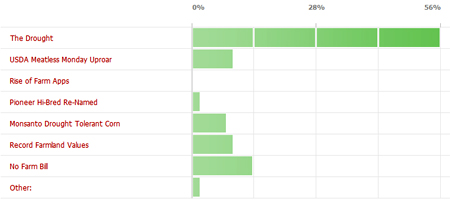
Our latest ZimmPoll asked the question, ” What will expiring biotech patents mean for agriculture?”

Our poll results: fifty-two percent said more options; twenty-one percent said don’t know enough about it; fourteen percent said export concerns; ten percent said nothing and three percent said other.

Learn more about this issue from Cindy’s coverage of last week’s ASTA CSS in Chicago.

Our new ZimmPoll is now live and asks the question, “How do you plan to travel this holiday?” The price of fuel and a plane ticket usually increases around the holiday, so will that change how you travel this year? Or does it really not matter – you’re getting there the quickest way possible! Let us know.

ZimmPoll is sponsored by Rhea+Kaiser, a full-service advertising/public relations agency.

ZimmPoll

Franklin County Wind Farm Powering Local Community

Joanna Schroeder

Here is a story about a new wind farm that is just a stone’s throw away. The Franklin County Wind farm, a subsidiary of Alliant Energy Corporation, has begun operations in Franklin County, Iowa. Consisting of 60 wind turbines, the farm is capable of producing nearly 100 megawatts of wind energy – enough to power close to 25,000 homes.

“We are very happy to have the Franklin County Wind Farm producing electricity,” said Patricia Kampling, chairman, president and CEO of Alliant Energy. “The construction team delivered this project on time and on budget with an exemplary safety record. We are also grateful to the landowners and the community for their strong support on this project.”

Franklin County Wind LLC continues to seek a buyer for the energy produced by the wind farm, but in the meantime it will sell the power it generates into the MISO market.

Alternative energy, Electricity, Energy, Renewable Energy, Wind

Companies Shifting to Clean Energy

Joanna Schroeder

As climate talks begin to wind down in Qatar, a new report, “Power Forward: Why the World’s Largest Companies are Investing in Renewable Energy,” has been released by Calvert Investments, Ceres and World Wildlife Fund. The report concludes that many of the world’s largest companies are not waiting for binding treaties and subsequent polices, rather they are integrating clean energy and lower emissions into their business now.

The report shows that many Fortune 100 companies have set renewable energy commitments, greenhouse gas (GHG) emissions reduction goals, or both. While the movement is strong in the U.S., the trend to sustainability is even stronger internationally.

“The companies that are boldly setting either greenhouse gas or renewable energy goals and making progress on those commitments are demonstrating the business case and real leadership on climate change,” said Marty Spitzer, WWF’s Director of US Climate Policy.  “And, in the process, these companies are changing the game — driving significant renewable energy investment globally and pressing for the right policy and market conditions that will allow companies to do even more.”

The report finds that clean energy practices are becoming standard procedures for some of the largest and most profitable companies in the world. For example, many companies are shifting from purchasing short-term, temporary Renewable Energy Credits (RECs) to longer-term investment strategies like Power Purchase Agreements (PPAs) and on-site projects, indicating a long-term commitment to renewable energy and reaping the benefits of reduced price volatility.

For some companies, there are still key barriers to achieving sustainability goals including: the fact that in some regions renewable energy is not yet at cost-parity with subsidized fossil-based energy; internal competition for capital; and inconsistent policies that send mixed signals to companies and investors in renewable energy projects, particularly instability in renewable energy incentives; and policies that prevent companies from signing green power purchase agreements.

The report also offers several recommendations for U.S. policymakers, including promoting tax credits or other incentives that level the cost playing field for renewable energy, specifically, extending the Production Tax Credit (PTC) for wind energythis year; establishing Renewable Portfolio Standards in states that do not have them; removing policy hurdles in states that prevent companies from contracting to buy the cheapest renewable power available and building on-site renewable power generation; and market-based solutions that put a price on the pollution from conventional energy generation.

Alternative energy, Carbon, Clean Energy, Climate Change, Environment, Renewable Energy, Wind

Driving Forward Speakers Announced

Joanna Schroeder

Speakers for the National Ethanol Conference (NEC): Driving Forward being held Feburary 5-7, 2013 in Las Vegas have been announced. The conference will kick off with the Chairman of the Renewable Fuels Association (RFA) Neill McKinstray, who is the president, Ethanol Group, The Andersons. The line-up will then feature the much anticipated State of the Industry Address from RFA President and CEO Bob Dinneen.

Featured speakers will also include:

  • Brooke Coleman, Executive Director of the Advanced Ethanol Council.
  • Rick Tolman, CEO of the National Corn Growers Association
  • Rob Vierhout, Secretary General, ePURE
  • Scott Turlow, President, Canadian Renewable Fuels Association
  • James Massie, Principal, The Alpine Group
  • Marty Durbin, Executive Vice President, Government Affairs, American Petroleum Institute
  • Shane Karr, Vice President, Federal Government Affairs, Alliance of Automobile Manufacturers
  • Louis Finkel, Executive Vice President, Government Affairs, Grocery Manufacturers Association
  • Linda DiVall, Founder, President and CEO, American Viewpoint
  • Bruce Heine, Director Government Affairs, Magellan Midstream Partners LP
  • Michael Pacheco, Ph.D., Associate Laboratory Director, NREL
  • Scott Zaremba, President, Zarco 66, Inc….and many more.

Click here to see the full line-up and to register. We’ll see you there!

E15, Ethanol, National Ethanol Conference, RFA

Genuine Bio-fuel Expands to the Caribbean

Joanna Schroeder

Genuine Bio-Fuel is expanding to the Caribbean region with the formation of a new subsidiary Caribbean Bio-Fuel (CBF). The company will be based in Puerto Rico and serve Caribbean and South American markets. The company will build a biodiesel plant in the region that will have the capacity to produce nearly 12 million gallons of biodiesel per year. The new 35,000 square foot facility is expected to open in March 2013. Raw materials and feedstocks will be sourced from Puerto Rico and the surrounding islands.

Jeff Longo, executive vice president for Genuine Bio-Fuel said, “This is an exciting time for Genuine Bio-Fuel. This expansion will allows us to be a global competitor in the alternative energy industry, but our mission will ultimately remain the same. With Caribbean Bio-Fuel we strive to build an environmentally responsible facility, create jobs, and help spur economic growth in this region.”

The company will also develop other co-products unique to this region.

advanced biofuels, Biodiesel, Renewable Energy

San Diego Zoo Goes Solar

Joanna Schroeder

The San Diego Zoo has gone solar. It’s Solar-to-EV-project, in partnership with Smart City San Diego, is run by San Diego Gas & Electric (SDGR&E). The solar system is comprised of Kyocera Solar photovoltaic (PV) solar panels. All Kyocera solar panels used in this project were manufactured in the U.S. at the company’s San Diego facility.

“Kyocera is celebrating 41 years in San Diego, and 37 years as a leader in solar energy solutions,” said Steve Hill, president of Kyocera Solar, Inc. “We’re proud to work with other San Diego companies that are equally committed to making sustainable energy a reality, especially at one of the most well-known landmarks in the country.”

Ten solar canopies, designed and installed by Independent Energy Solutions (IES), produce 90 kilowatts (kW) of energy, or enough to power 59 homes, as well as five EV charging stations, including one in a nearby ADA-accessible parking space.

One feature of this system, that varies from most currently operating systems, is that while electric vehicles (EVs) are being charged in the Zoo’s parking lot by the solar power, and then the remaining solar energy goes to the electrical grid, a high-tech battery system stores solar power for future use. Today, most solar systems do not have the ability to store energy for later use.

Using lithium-polymer battery technology, its 100-kW energy storage system is charged by the solar canopies to offset demand on the electrical grid and recharge EVs after sunset. When the battery is full, excess energy generated from sunlight is put into the grid to improve reliability and benefit the surrounding community. The solar canopies also provide shade to approximately 50 cars in the Zoo’s southeast parking area.

Linda Strand, president and CEO of IES added, “This project showcases how energy storage, electric vehicle charging and solar energy can be successfully integrated, providing benefits to the public while remaining environmentally sound.”

Alternative energy, Electric Vehicles, Electricity, Energy, Solar

Book Review – Who Turned Out the Lights?

Joanna Schroeder

Should we be entertained when reading about America’s energy crisis? Dare we be regaled by clever cliches, fun word pairings and sarcasm when learning our basic Energy 101 facts? Yes to infinity. And I experienced just these things when reading “Who Turned Out the Lights?” by Scott Bittle and Jean Johnson. Reading this book  was a guilty pleasure because I enjoyed the lighthearted book just a bit too much when technically the topic of energy, tends to be, well, a bit dull.

The book was a “guided tour” through the country’s energy crisis.  Beginning with reasons why the U.S. needs to get its act together, the book chronicles the country’s failed attempts at energy security and diversity, discussed three flawed ideas that could get the country off track, and laid out 10 facts all people should know about energy. Did you know that one out of four Americans can’t name a fossil fuel? Yikes.

The tour then takes you through a discussion of various types of energy and alternative energy sources. While this section was good, the book was published in 2009 so some of the information was outdated so reader, digest this will a sprinkle of salt. For example, in the section about ethanol (a biofuel that surprisingly the authors don’t hate) they mentioned subsidies and the tariff on Brazilian ethanol (neither of which still exist).

However, there was one element of this section that really stood out. Many argue that the low hanging solution is to improve fuel economy and some go so far to declare that this has been accomplished. While on the outside, yes, this is correct, on the inside, it is not actually the case. As Bittle and Johnson aptly point out, when fuel economy gets better, people drive more. So at the end of the day, actual fuel consumption doesn’t actually go down, it remains virtually the same.

There were other areas this book addressed, and explained well, that other books have not. Read More

Alternative energy, book reviews, Electricity, Energy, Renewable Energy