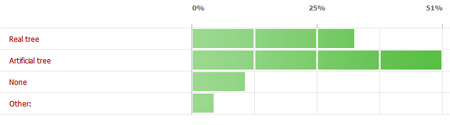
Our latest ZimmPoll asked the question, ”What kind of Christmas tree do you have?”
Our poll results: Fifty-one percent said artificial tree; thirty-three percent said real tree; eleven percent said none and four percent said other. It looks as though the majority of you have allergies to real trees like my family!
Our new ZimmPoll is now live and asks the question, “How would you rate 2012? 1 = Poor, 5 = Excellent” There were a lot of big news items this year: the Olympics; Presidential election; Hurricane Sandy; the death of Whitney Houston; the new iPad and iPhone. But how did the headlines affect your year? Did it make it a stellar year or just a ho-hum kind of year? Let us know, and Happy New Year!
ZimmPoll is sponsored by Rhea+Kaiser, a full-service advertising/public relations agency.
I was recently forwarded an opinion piece on how to promote biofuels and it struck a cord with me. In June 2011, I published an article in Industrial Biotechnology called “Back to basics: Redefining the biotechnology message.” In it, I said the current messages weren’t working – especially when tied to climate change where public opinion is slipping.
The opinion piece, “How to properly promote biofuels,” was authored by Alkol Bioenergy and focused on a new TV advertising campaign running in Brazil. The campaign was developed for UNICA (Brazilian Sugarcane Industry Association) and featured images of ethanol being cool and sexy. The op-ed piece points out that this is very different from what is being done in Europe and the USA.
“Truth is that facts such as job creation, national security, global warming, etc., have never proved their value, as they all depend on a previous knowledge about socioeconomic issues people are unaware of or simply do not care, ignoring instead the real motivations for people using something new,” is written in the piece.
While I agree to some level, I do still feel that job creation and economic security are two reasons that work for some, more specifically those who are well-informed about the issues such as our readers. Where I think the messages still struggle is with the average person, who doesn’t really, truly understand why biofuels, or renewable energy or sustainability in particular, is important.
Let me give you an example of what is happening in China. Several years ago there were articles citing the sale of fake solar panels. But the solar panels were not sold and installed only to discover they never worked; they were never intended to work. They were designed to increase a buyer ‘s social standing in the community who couldn’t afford real solar panels. In China, those who had solar panels on their homes are better respected and maintain a higher social status than those who don’t.
So why aren’t Americans or Europeans, or others in any other country given more respect when they adopt renewable energy or sustainability initiatives? Because in many cases, these early adopters were/are seen as snobs, I am better than you, rather than as leaders of a movement. And this, I think is key. We need to make renewable energy cool and we need to make renewable energy for everyone. And this lies the point of the editorial, where I wholeheartedly agree, biofuels need to be seen as cool, as the UNICA ad portrays. As Gareth Kane wrote in “Green Jujitsu,” we need to make renewable energy and environmental consciousness sexy.
Can you define sustainability? More than likely, but it is also likely that your definition is different than a colleagues, family member or friend. The green movement touts sustainability but how do you actually integrate the idea of sustainability into your business? To answer this question, I turned to the DoShort, “Green Jujitsu,” written by Gareth Kane.
The book focuses on how to help businesses become more sustainable and how to make it stick. The answer? Harness the strengths of your employees rather than focusing on their weaknesses. Kane aptly uses the analogy of the martial art of jujitsu. This concept is focused on using your opponents strength, energy and momentum against them and levering into submission. While Kane doesn’t promote bringing your employees to submission, he does promote the idea of bringing people on board with sustainability initiatives by understanding their strengths and weaknesses.
I often struggle with the way the renewable energy industry promotes itself and have come to believe that the industry is not using the right language and stories to gain public and policy support. In some regard, I feel I’ve found an ally in Kane and his message.
He notes that oftentimes, “The green movement has a well-earned reputation for presenting sustainability as the hair-shirt option….We are bombarded with litanies of how we should be ashamed of ourselves as a species….Hand up who wants a guilt trip? The answer is to make it fun; ditch the hair-shirt and make sustainability sexy.”
In other words, make sustainability attractive, positive and compelling.
While this book hits the mark on guiding a business through the process of engaging employees into sustainability practices that will also help to save money, it is also a good lesson in messaging for the industry. This book should be read by both sustainability leaders and champions, but also by those who are helping the industry to craft its sustainability messages. Green Jujitsu is a “art” the industry could, and should get behind.
Renewable Energy Group (REG) has announced that its REG Newton, LLC loan with AgStar Financial Service, PCA was extended for one additional year. The biodiesel facility entered into this debt agreement with AgStar in conjunction with the related March 2010 acquisition of the assets of Central Iowa Energy, LLC.
“We’re pleased that the lender syndicate saw fit to extend this note in a routine manner,” said REG Chief Financial Officer, Chad Stone.
The new maturity date is March 2014, and all material terms remain the same for the 30 million gallon per year biorefinery.
NextEra Energy Canada has completed its first wind farm in Ontario Canada – Conestogo Wind Energy Centre. The 22.9 megawatt wind project is located in Wellington County, Ontario, and comprised of 10 Siemens wind turbines. The wind farm has the capacity to generate enough energy to power around 5,700 homes per year. All of the power from the project is being sold to the Ontario Power Authority under the Feed-In-Tariff program. Conestogo Wind, LP, an indirect subsidiary of NextEra Energy Canada, owns and operates the project.
“We are pleased to have completed our first wind project in Ontario,” said Mike O’Sullivan, NextEra Energy Resources senior vice president of development. “In addition to generating clean, emission-free energy, this project will have a positive impact on the local economy through the jobs created, taxes paid, lease payments to landowners, and goods and services sourced throughout the region.”
The Conestogo Wind Energy Centre is the first of eight wind projects NextEra Energy Canada plans to bring into service by the end of 2015 in Ontario. Combined, NextEra Energy Canada’s eight Ontario wind projects represent a capital investment in the province of approximately $1.5 billion.
Infinite Enzymes has launched IE-CBHI, a single activity, plant-based cellulase enzyme. The enzyme is available for research and development projects through Sigma-Aldrich Corporation.
The global industrial enzymes market is projected to reach 3.74 billion by 2015, not including many emerging applications in advanced biofuels and biobased products. Enzymes are a critical role in converting cellulose and hemicellulose in biomass to sugars, which becomes the foundation to produce biofuels, biochemicals or biomaterials.
According to Infinite Enzymes, their technology produces enzymes in a lower value part of the corn kernel thereby creating a new sustainable market for corn processing by-products. The company says their technology lowers the cost of sugar production needed for developing low-cost biobased plastics and advanced biofuels.
Recently, Infinite Enzymes received a $450,000 Small Business Innovation Research (SBIR) Phase II grant from the U.S. Department of Agriculture to advance its enzyme development technology.
What do people in the Southeast think about biofuels? Do they support biofuel ventures? Who will grow the biomass? Will those in established industries fight against it? These are just a few of the questions researchers from the University of Georgia and the U.S. Forest Service are asking as part of studies in locations throughout the Southeast suited for biomass development.
The researchers will use a mix of ethnographic methods to help understand public opinion about bioenergy and also to provide policymakers and business owners with the information they need to make sustainable energy production viable throughout communities.
“We’re planning to work on the ground throughout the Southeast,” said Sarah Hitchner, a co-investigator and post-doctoral research associate at UGA’s Center for Integrative Conservation Research. “A lot of people talk about biofuels as being an obvious win-win, but it’s more complicated than that.”
Supported by a grant from the U.S. Department of Agriculture’s National Institute of Food and Agriculture, which funds research projects on sustainable bioenergy through its Agriculture and Food Research Initiative, the research team will begin in Soperton, Georgia-formerly home to Range Fuels and now the Freedom Pines Biorefinery owned by LanzaTech-and then moving on to other areas in Georgia, Alabama, Mississippi, Louisiana, Florida and North Carolina. While visiting local communities, the researchers will participate in the daily activities of community members and conduct in-depth interviews with a variety of stakeholders, such as landowners, industry representatives, potential employees and county commissioners.
“A big part of this kind of research is to listen to as many perspectives as possible,” said Peter Brosius, professor of anthropology in the Franklin College of Arts and Sciences, director of the Center for Integrative Conservation Research and co-investigator in the study. “From there you begin to see patterns emerge.”Read More
The Indiana Soybean Alliance is offering high school teachers free Soy Biodiesel Chemistry Kits. The kits were developed by Purdue University researchers in partnership with education professionals with funding from ISA and the Indiana soybean checkoff organization. Indiana science teachers can receive the kit free as part of ISA’s program.
The kit was first released in 2005 and is now updated with two new lessons along with the most current information about soy biodiesel including how to produce biodiesel and the benefits of its use.
“The kit is an engaging way for high school science classes to apply the basic skills and principles of chemistry,” said Don Wyss, chairman of ISA’s biofuels committee and a farmer from Ossian, Ind. “It is also a great way to introduce soy biodiesel — and renewable fuels in general — to students through hands-on experiments that take complex scientific processes and break them down into easy to understand lessons.”
The free kit includes six lesson plans and hands-on experiments along with the necessary equipment for 10 groups of two students to perform each of the kit’s hands-on exercises and experiments. Lesson topics include the diesel engine and the development of biodiesel, the physical and chemical properties of soybean oil and esters, thin-layer chromatography, determining biodiesel concentrations in diesel, and more.
“The lessons offered in the kit are aligned with the National Science Education Standards, and we think that is an important component to encourage teachers to incorporate these lessons into their classrooms,” added Wyss.
The House and Senate Armed Services Committees finalized the National Defense Authorization Act of 2013 (NDAA) yesterday and today Congress stood behind the military by passing the Act without including controversial proposals that would have banned the Department of Defense from expanding its use of advanced biofuels.
In response to the passage, Jim Greenwood, CEO and president of the Biotechnology Industry Organization (BIO) said, “Military leaders have recognized that building a domestic advanced biofuels industry to produce cost-competitive fuels is a national security priority. They have responded to this need in the same way the United States has responded to similar challenges in the past – by proposing public-private partnerships to produce the needed materials.”
He noted along with other industry leaders that the passage of NDAA will clear the path for the Department of Defense to participate with other federal agencies in partnership with private companies to continue to develop and deploy biofuels for military use.
In a recent report, E2 concluded that more than 14,000 jobs and more than $10 billion in economic activity could be created if the military meets is biofuels goals. The Navy and Air Force have a goal of sourcing 50 percent of their fuel needs from advanced biofuels by 2020.
“Just like it did with industries ranging from aviation to the Internet, the military is leading the country on deploying advanced biofuels,” said Nicole Lederer, co-founder of Environmental Entrepreneurs (E2). “By turning back short-sighted attempts that would have kept the military dependent on a single fuel source – oil – Congress has cleared the way for the Department of Defense to continue to make investments in advanced biofuels that will have positive impacts on the industry and our economy.”


 ZimmPoll is sponsored by Rhea+Kaiser, a full-service advertising/public relations agency.