Methes Energies & BioFuel Aruba Ink Deal

Joanna Schroeder

109752_MethesEnergyMethes Energies Canada, a subsidiary of Methes Engeries International, has signed a Purchase and Cooperation Agreement with BioFuel Aruba of Oranjestad, Aruba to purchase one Denami 600 biodiesel processor. The agreement was signed during the “Europe Meets the Americas” business conference in Aruba earlier this month.

Mr. Abe Dyck a cofounder and shareholder of Methes Energies was in Aruba for the ceremonial signing of the agreement. “I believe the signing of this agreement accomplishes the objective Aruba has of becoming a Green Gateway for companies wanting to deploy their technologies in the region. I see this as the start of a great relationship. I have enjoyed working with Gregory and the staff at Arina (Aruba Investment Agency) and look forward to commissioning the first 600 later this year.”

Screen Shot 2013-05-14 at 12.28.06 PMBioFuel Aruba was the first and is the only biodiesel producer in the country. The company will work with Methes to expand its biodiesel capacity. In addition, BioFuel Aruba has entered into pilot agreements with the Aruba Airports Authority and the public transit company, Arubus BV, to implement a biodiesel blend into their fleets. The two companies will also be working with the Government of Aruba to develop a biofuels mandate to be incorporated into their national energy policy.

“We can’t wait for our first Denami 600 to be delivered. With two pilot projects soon to start with Arubus and the Airport, we are looking forward to a greater demand for biodiesel. Methes’ technology is a great fit and will allow us to add more Denami’s as the demand increases even more here in Aruba and in the surrounding islands,” said BioFuel Aruba President, Gregory Fung.


Alternative energy, Biodiesel, biofuels

New Farm Policy Possible Because of Ethanol

Cindy Zimmerman

As the Senate and House Agriculture Committees begin to mark up a new farm bill this week, big changes are expected in the next farm bill when it comes to farm programs and ethanol is helping to make that happen.

dinneen-wwAt the annual National Association of Farm Broadcasting Washington Watch issues forum on Monday, Renewable Fuels Association president and CEO Bob Dinneen said the dramatic changes in farm programs expected are actually being made possible by the increased use of biofuels that has taken place under the Renewable Fuel Standard (RFS). “It used to be that the price of corn was far less than the cost of production and it was government farm programs that would make up the difference,” said Dinneen. “And one of the things that Congress intended with the value-added ethanol industry was creating a value for farmers that would allow them to reduce farm program costs and it has done exactly that.”

Dinneen said the Senate farm bill proposal, which is being marked up this morning in committee, does include an energy title, the farm bill is not a real focus for them but they do hope that the farm bill will include funds for USDA to support blender pump installation and the development of advanced biofuels.

Interview with Bob Dinneen, Renewable Fuels Association
advanced biofuels, Audio, Ethanol, Ethanol News, farm bill, RFA

Biodiesel Ups Bean Prices Without Raising Food Prices

John Davis

Soybiodiesel-bumper-sticker1Soybean growers are getting more for their beans because of biodiesel, but consumers aren’t being pinched by higher food prices at the grocery stores. According to the United Soybean Board, a new study done for soybean checkoffs in Minnesota, Nebraska and the Dakotas show that biodiesel production has pushed U.S. soy oil prices higher than they were before the green fuel, increasing soy-oil revenues by $15 billion between 2006 and 2012 while pushing up the price of a bushel of soybeans by $0.74 a bushel:

It appears that biodiesel demand also helped offset the effects of a drop in food applications.

As biodiesel production edged upward, the amount of soy oil used in the food industry slid down. Soy oil use for biodiesel increased from 670,000 pounds in 2005 to 4.1 billion pounds for 2012. During that period, U.S. soy oil use in food applications declined by 3.6 billion pounds.

According to one USB farmer-leader, that was no accident.

“When trans-fat labeling decreased the use of soy oil for food applications, specifically cooking oils, it created a huge drag on the soy-oil price due to surplus,” said Lewis Bainbridge, United Soybean Board (USB) secretary and a soybean farmer from Ethan, S.D. “We generated a huge stockpile, and that’s when the demand for biodiesel started, which helped decrease the glut of soy oil.”

Meanwhile, all those soybeans processed for biodiesel production are also being turned into more soy meal, lowering the cost of feed poultry and livestock farmers. The study says biodiesel production lowers soy meal prices by as much as $25 per ton.

Biodiesel, Soybeans, USB

U of Wyoming Inks Deal to Get Into Algae Biz

John Davis

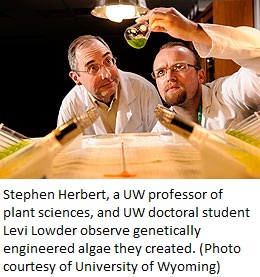
plantomics1The University of Wyoming has signed a deal that gets it into the algal biomass industry. The school agreed to give PlanktOMICS Algae Bioservices, run by a pair of university researchers, space and support to research how to develop patent-pending processes in exchange for a cut of the profits down the road:

PlanktOMICS principal partners Stephen Herbert, a UW professor of plant sciences, and Levi Lowder, a UW doctoral candidate in molecular and cellular life sciences, will focus on serving small companies that need to solve problems relative to their algae needs.

PlanktOMICS provides advanced phenotype analysis (testing biological traits) and screening services, custom algal vector design and construction, algal transformation and gene-expression analysis, according to its website.

“We’re here to solve problems for other companies that want to produce algae at large scales,” says Herbert, who serves as the company’s CEO. “We see our role as building up research capacity of these small companies that don’t have enough capacity for research.”

“Our services are tailored to companies that want to outsource their biological studies or biological research,” adds Lowder, who is PlanktOMICS’ chief technology officer. “We don’t really produce the end products. We do the biology. You have to know how to grow algae. That’s where we come in, to figure out how to farm algae on a large scale (for other companies).”

PlanktOMICS is working on technologies to control unwanted algae and other microbes in algae ponds, just like corn and soybean farmers control weeds, as well as technology to lower the cost of harvesting of algal biomass, among others. Last year, Lowder’s team won the university’s John P. Ellbogen $30K Entrepreneurship Competition, getting $12,500 and one year of free rent to further develop the company at the Wyoming Technology Business Center (WTBC), a business incubator at the school. Herbert and Lowder say they already have two clients lined up, one in the algal nutritional supplement business for more than 30 years. The developments could ultimately lead to algae-biodiesel projects.

algae, biomass, Research, University

DOE Student Clean Energy Winners Announced

Joanna Schroeder

The U.S. Department of Energy has announced six regional winners of its National Clean Energy Business Plan Competition. The competition is for university teams across the country to create new businesses and commercialize promising energy technologies developed at U.S. universities and the National Laboratories. Regional US DOE logofinalists include: Northwestern University, North Carolina A&T University, Purdue University, Brigham Young University, University of Arkansas, and University of California-Berkeley. The teams will compete in the national competition in Washington, D.C., on June 11th and 12th, 2013.

“The National Clean Energy Business Plan Competition allows the best and brightest to use their entrepreneurial skills to tackle the energy challenges our Nation continues to face,” said Acting Energy Secretary Daniel Poneman. “These innovative business strategies can expand the use of clean energy technologies and compete on a global market.”

According to DOE, the national competition aims to promote entrepreneurship in clean energy technologies that will boost American competitiveness, bring cutting-edge clean energy solutions to the market, and strengthen economic prosperity. Six regional organizations have received a total of $2 million over three years to host the competitions, including $100,000 in annual prizes for each regional competition’s winning team. At the National Competition, regional finalists will compete for cash prizes, and unique technical, design, public relations, and legal assistance to help commercialize their technology.

Clean Energy

Florida Governor Urged to Veto Anti-Ethanol Bill

Cindy Zimmerman

In the wake of a bill passed by the Florida Legislation to repeal a law calling for the use of 10% ethanol blends in the state, automotive technician and talk show host Bobby Likis had an op-ed in the Pensacola News Journal over the weekend calling on the governor to veto the bill.

likis-studio“What could be more devastating than ditching 35 years of progress? If the Renewable Fuel Standard (RFS) is repealed, we will haplessly relinquish the fast track to the future while fellow states and countries worldwide embrace strategic biofuels production and use,” wrote Likis.

Who among us foolishly says, “We don’t care about what ‘they’ are doing. We care about Florida?” Well, we’d better care. Because of “them,” more efficient, better-mpg engines, cleaner air, national security and lots of dollars — in Florida — are at stake.

So whose agenda is behind repealing the RFS anyway? Can’t be those who have the economics of the state at heart or interest in lower emissions, lower gas prices and optimized engine performance. All these are attributes of the renewable fuel, ethanol.

And yet, the Florida Legislature would put all of this in our rear view mirror.

Governor Scott, now is the time for one good man to come to the aid of his state—by vetoing HB4001/SB320.

Florida’s Renewable Fuel Standard Act, which requires that all gasoline sold in Florida contain 9-10 percent ethanol, or other alternative fuel, by volume has been in effect for five years. The legislature passed a bill to repeal the act last month but it has not yet been signed by the governor.

Ethanol, Ethanol News

Ethanol Policy Update to Kick Off Discussions at FEW

John Davis

FEWroundtableLooks like the discussions are going to kick off right at the upcoming International Fuel Ethanol Workshop & Expo (FEW), June 10-13, 2013, in St. Louis, Mo. One of the first sessions will be the Association Roundtable: Mid-Year U.S. Ethanol Policy Update, featuring moderator Tom Bryan, President, BBI International; Bob Dinneen, President & CEO, Renewable Fuels Association; Tom Buis, CEO, Growth Energy; and Brian Jennings, Executive Vice President, American Coalition for Ethanol, set for Tuesday, June 11 at 9 am:

Join the top executive officers of the Renewable Fuels Association, Growth Energy and the American Coalition for Ethanol for a vital summer policy update on safeguarding RFS2, correcting misinformation about RINs, building the market for E15 and mid-level blends and maintaining our national commitment to commercializing advanced and cellulosic ethanol.

Still plenty of time to make your reservation for the event. Click here for more information.

ACE, conferences, FEW, Growth Energy, RFA

RFA Announces New Communications Director

Cindy Zimmerman

RFA-logo-13The Renewable Fuels Association (RFA) today announced that Dawn Schueller Moore has joined the staff as Communications Director. Moore served as Press Secretary to U.S. Senator Herb Kohl of Wisconsin for nearly three years and has publicized issues and events ranging from agriculture, rural development, Supreme Court Justices Sotomayor and Kagan’s nomination hearings and Senator Kohl’s “No Oil Producing & Exporting Cartels Act” antitrust legislation to help decrease the cost of gasoline.

rfa-dawn“I’ve seen firsthand the positive impact ethanol has had in my home state and I know all too well the fight that ethanol has ahead of it in Congress as oil interests bear down to desperately protect their monopoly,” Moore said. “I’m anxious to put my press and social media skills to work telling the amazing story of this industry and the Renewable Fuel Standard.”

“Dawn is a great addition to our team. With her Midwestern roots and Washington political experience, she has rural America in her blood and politically savvy instincts,” said RFA CEO Bob Dinneen. “Besides her valuable Senate experience, she is high energy and enthusiastic about the value-proposition that U.S. ethanol brings to agriculture, economic development, and our country as a stronger, more energy independent nation.”

Moore rounds out RFA’s communications team led by Christina Martin, Executive Vice President. Moore will be the point person for day-to-day press activities including media inquiries, interviews, and press conferences. She will be actively participating in social media. Look for Dawn Moore on Twitter at @RFADawn.

Ethanol, Ethanol News, RFA

Farm Broadcasters in Nation’s Capitol

Cindy Zimmerman

NAFB Washington WatchIt’s time for National Association of Farm Broadcasting members to gather in Washington, DC for their annual Washington Watch program.

Activities this afternoon with the Issues Forum, sponsored by the Renewable Fuels Association. Among the topics sure to be discussed will be what a new farm bill may hold for renewable energy and the latest on attacks to the Renewable Fuel Standard (RFS).

Tomorrow morning the farm broadcasters meet up at USDA and will be speaking with a number of department heads including Secretary of Agriculture Tom Vilsack. It looks like Wednesday morning will be all about the Farm Bill with input from various members of the Senate and House where their versions of the new legislation are going through mark ups this week.

Ethanol, Ethanol News, farm bill, RFA, RFS

RINs Could Be Key to Aviation Biofuels Viability

John Davis

epa-logoThe Environmental Protection Agency’s (EPA) decision that makes aviation biofuel, better known as biojet, eligible for Renewable Identification Numbers (RINs) could make those green fuels viable for the aviation industry. This piece from Platts says the aviation industry could qualify for D4 biodiesel, D5 advanced biofuel or D7 cellulosic diesel RINs, despite jet fuel being exempt from RINs obligations.

“The availability of RINs is a critical bridge to commercial viability,” Nancy Young, vice president of environmental affairs for US airline trade group Airlines for America, said in a recent interview.

“It means there is an economic value assigned to the renewable content in jet fuel that can help the producer of that fuel get closer to the price of traditional jet fuel,” Young said…

But with supplies of biojet still extremely limited, most industry goals are still modest. Airplane manufacturer Boeing, for instance, wants biojet to account for 1% of the industry’s 600 million gallons/year of jet fuel consumption by 2015.

The aviation industry, biofuels producers and the federal government have been investing in research to bring down the cost of making biojet, as well as financing more refineries.

Brooke Coleman, executive director of the Advanced Ethanol Council, said RINs are key to that.

“What the RIN value does is it creates an incentive to buy and trade this fuel,” he said. “The whole reason we need the RFS is because we can show up with a cheaper better fuel, but it doesn’t necessarily get it into the marketplace because it’s so vertically integrated. RINs make sure the renewable fuel is used in an economically efficient way.”

The article goes on to say that the increasing costs of biodiesel RINs could end up causing trouble for biojet.

aviation biofuels, biofuels, biojet fuel, RINS