RFA E-15 Ad

UK Seeks “Best” Biofuel

Joanna Schroeder

According to an article in The Guardian, the United Kingdom (UK) is willing to pay for the best biofuels. The UK government is hosting a competition to come up with the most garbageviable demonstration plants for biofuels made from waste organic materials, such as wood waste or straw.

Many groups, especially environmental groups, have begun to lobby in favor of “better biofuels” or ones they consider to be both better for the environment or for society. Within this context, groups are opposed to first generation biofuels– or those that can be used for “food-” aka the food versus fuel debate. In light of this trend, focus has shifted to biofuels made from other feedstocks, especially waste materials – things that would end up in landfills.

Attempts to manufacture biofuels from waste have been going on since the late 1960s; however, until now, research has been limited to the lab have have not met with great success. Yet growing concerns about the environment has brought more attention to the transportation sector and a resurgence in waste-to-energy technology has evolved. Today, the industry is beginning to see some success at demonstration level.

In the UK, Ministers believe that research has now reached a stage where advanced biofuels are commercially possible. The department for transport said indications from the biofuels industry have demonstrated there are potential projects with a modicum of interest. The Ministers believe there will be several “high quality” bids for the 25m on offer, which must be matched by private sector investment.

Norman Baker, the Liberal Democrat transport minister, told the Guardian, “It’s hugely important that we decarbonise transport. We have been up hill and down dale on biofuels in the past few years. What we need to do is distinguish between good biofuels and bad biofuels, and this competition will produce good biofuels.”

The first step of the prize will involve a feasibility study detailing the design of the competition and the criteria that needs to be met by any bidder. This stage is expected to take four or five months, after which bids will be accepted. A winner could be announced within a year, but the process could take longer depending on the bids received. The prize will accept a bid for a project using any methodology or feedstock as long as they can be proved to produce carbon savings over conventional fuels and come from feedstocks that are environmentally sustainable.


 

advanced biofuels, International, Waste-to-Energy

IRFA Unveils E85 Wholesale Price Listing Service

Joanna Schroeder

The Iowa Renewable Fuels Association (IRFA) has launched an E85 Wholesale Price Listing Service. The IRFA lists E85 prices from wholesale distributors with the intent of increasing transparency in the marketplace, allowing retailers to review supply options in one location.

“The goal of our E85 wholesale price listing program is to assist retailers in providing their consumers with the lowest-cost E85 available,” said IRFA Executive Director Monte Shaw. “This is good for the Renewable Fuels Standard (RFS), good for consumers, and great for Iowa. Many of these suppliers pass the RIN savings to the consumer, which is making for some very attractive E85 prices. In fact, several E85 suppliers this week have E85 a dollar or more below the average price for regular unleaded gasoline.”

IRFA E85 Price IndexThe IRFA will publish Thursday’s E85 price every Friday. E85 suppliers wishing to have their price posted should contact T.J. Page with the IRFA at 515-252-6249 or tpage@IowaRFA.org. To be eligible for listing, the supplier’s price must: be publicly posted elsewhere; be available to any retailer or supplier; not be restricted by gallonage caps.  E85 is defined in state law as a blend of between 70 and 85 percent ethanol with gasoline.

biofuels, E85, Ethanol, Iowa RFA

BioEnergy Bytes

Joanna Schroeder

  • BioEnergyBytesDFHow does regulatory and legislative behavior affect RIN values? Is it possible to predict price fluctuations in the current environment? These questions and more will be asked and answered by Tristan Brown, lecturer at Iowa State University and a regular contributor to Seeking Alpha, during the RIN Academy on August 26, in Des Moines, Iowa. Brown co-authored the book, Why are We Producing Biofuels among other publications. Registration is still open.
  • Registration is now open for the 5th Annual Renewable Energy Technology Conference & Exhibition (RETECH) being held in Washington, D.C. September 9-11th. More information on the agenda, speakers and more can be found on the RETECH website.
  • Emery Law Firm, located in Taos, New Mexico, has completed a 4.0kw Grid Tied Photovoltaic Carport Canopy at its offices. The solar system will both provide shade as well as an electric vehicle charging station for its Chevy Volts. Sol Luna Solar was selected to design and install the system.
  • Dominic DiCicco, who is the Principal Environmental Engineer for the automobile manufacturer, will be speaking at ACE Ethanol Conference August 27-28, 2013 in Des Moines, Iowa. DiCicco has worked at Ford Motor Company for over twenty years. During that time he has helped implement Ford’s strategic product plans as well as work on improving fuel quality and regulations, requiring interaction with the Environmental Protection Agency (EPA), the California Air Resources Board (CARB), and other governmental agencies around the world.
Bioenergy Bytes

IBM Launches Wind & Solar Forecasting

Joanna Schroeder

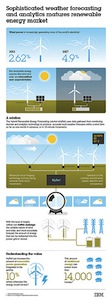
IBM has announced the launch of an advanced power and weather modeling technology that will help utilities increase the reliability of renewable energy resources. According the company, the solution, “Hybrid Renewable Energy Forecasting” (HyRef) combines weather predictions and analytics to accurately forecast the availability of wind power and solar energy. This will enable utilities to integrate more renewable energy into the power grid.

IBM HyRefIBM says HyRef uses weather modeling capabilities, advanced cloud imaging technology and sky-facing cameras to track cloud movements, while sensors on the turbines monitor wind speed, temperature and direction. When combined with analytics technology, the data-assimilation based solution can produce accurate local weather forecasts within a wind farm as far as one month in advance, or in 15-minute increments.

“Utilities around the world are employing a host of strategies to integrate new renewable energy resources into their operating systems in order to reach a baseline goal of a 25 percent renewable energy mix globally by 2025,” said Vice Admiral Dennis McGinn, President and CEO of the American Council On Renewable Energy (ACORE). “The weather modeling and forecasting data generated from HyRef will significantly improve this process and in turn, put us one step closer to maximizing the full potential of renewable resources.”

By utilizing local weather forecasts, according to IBM, HyRef can predict the performance of each individual wind turbine and estimate the amount of generated renewable energy. This level of insight will enable utilities to better manage the variable nature of wind and solar, and more accurately forecast the amount of power that can be redirected into the power grid or stored. It will also allow energy organizations to easily integrate other conventional sources such as coal and natural gas.

HyRef represents advancements in weather modeling technology, stemming from other game-changing innovations such as Deep Thunder. Developed by IBM, Deep Thunder provides high-resolution, micro-forecasts for weather in a region – ranging from a metropolitan area up to an entire state – with calculations as fine as every square kilometer. When coupled with business data, it can help businesses and governments tailor services, change routes and deploy equipment-to minimize the effects of major weather events.

Electricity, Energy, Solar, Utilities, Wind

Record Corn Crop Forecast

Cindy Zimmerman

Despite a wet spring causing a challenging start to the season, the 2013 corn crop is still looking to break new ground this year, according to the latest USDA production estimate out today.

corn-fieldCorn production is forecast at 13.8 billion bushels, up 28 percent from 2012. If realized, this will be a new record production for the United States. Based on conditions as of August 1, yields are expected to average 154.4 bushels per acre, up 31.0 bushels from 2012. If realized, this will be the highest average yield since 2009. Area harvested for grain is forecast at 89.1 million acres, unchanged from the June forecast but up 2 percent from 2012.

Renewable Fuels Association (RFA) CEO Bob Dinneen says the average yield, which would be the third-highest yield on record, is significant considering farmers had one of the slowest, wettest planting seasons on record. “After the disappointment of last year’s drought-stricken crop, farmers have responded by producing what is likely to be the largest crop of all time,” said RFA President and CEO Bob Dinneen. “By rapidly adopting new seed and equipment technologies over the past decade, this country’s corn growers have distinguished themselves as the most productive in the world.”

Brian Jennings, Executive Vice President for the American Coalition for Ethanol (ACE), says the quick recovery from last year’s devastating drought shows that the Renewable Fuel Standard is able to work as intended. “The RFS provides an economic incentive for scientists and farmers to innovate and sustainably deliver more corn, enabling the total U.S. corn supply to reach 14.5 billion bushels this year and making room in the market for adequate and affordable food, feed, and fuel,” Jennings said. “Since the RFS was originally enacted in 2005, these advancements have driven U.S. farmers to produce around 20 bushels more corn per acre than before.”

On a global scale, USDA is forecasting that grain production worldwide will hit 2.43 billion metric tons in 2013, up eight percent from last year and a new record.

ACE, corn, Ethanol, Ethanol News, Government, RFA, USDA

Spanish Biodiesel Plant to Refit for Waste Oils

John Davis

BDIlogoA biodiesel plant in Spain is being refitted to take more feedstocks to include waste oils, such as used restaurant grease and animal fats. BDI-BioEnergy International AG announced it will retrofit the 31,000-ton-per-year Stocks del valles biodiesel plant:

The existing customer Stocks del valles commissioned BDI with the implementation of the RetroFit-program, which takes place in this particular case by the installation of a new type of pre-esterification. Based on this, the flexibility of the feedstock of the entire BioDiesel-plant will increase significantly while maintaining the strict biodiesel quality regulations (EN 14214).

“We are very pleased to support our customer with a long-term business-relationship, to optimize his existing BioDiesel-plant to the state of the art Multi-Feedstock BioDiesel-technique. This is another proof that our RetroFit-technology is increasingly in demand for international biodiesel plants. In addition, it provides an efficient way for biodiesel producers to increase the profitability of their existing plants with the experience and the technology of BDI.”, says Dr Edgar Ahn – CSO and member of the Management Board.

BDI says this new system allows for a high percentage degradation products in the oil, especially free fatty acids, FFA.

Biodiesel, International

Invasive Species Could Become Biofuel

John Davis

arsgrouseUSDA researchers are looking at being able to turn some invasive trees into biofuel. This story from the Agricultural Research Service says they are looking at harvesting native juniper and pinyon trees that have extended out of their natural ranges for biomass. The plan not only produces renewable energy, but it also restores rangeland for livestock and protects critical sagebrush habitat for the western sage grouse and other animals.

In Burns, Ore., research leader Tony Svejcar and others will inventory trees available for harvest and biofuel production. This information can also be used to determine optimal locations for restoring wildlife habitat and locations where harvests could adversely impact existing wildlife. Svejcar works at the ARS Range and Meadow Forage Management Research Unit in Burns.

The scientists will also focus on devising plans for harvesting the trees in a sustainable manner. ARS research leader Fred Pierson plans to conduct experimental juniper harvests on a variety of sites in Idaho to observe how the removal affects erosion, and will use the information to model the environmental impacts of large-scale tree harvests. Pierson, who works at the ARS Northwest Watershed Research Center in Boise, Idaho, will also be monitoring how juniper removal affects large-scale water cycles.

The article also credits David Goodrich, a hydraulic engineer at the ARS Southwest Watershed Research Center in Tucson, Ariz., for his estimates of watershed-level rainfall runoff and erosion to help guide tree harvesting decisions.

More is available in the July 2013 issue of Agricultural Research magazine.

biofuels, biomass

Real Goods Solar to Purchase Mercury Energy

Joanna Schroeder

Real Goods Solar, has signed a definitive agreement to acquire Mercury Energy, Inc. d/b/a Mercury Solar Systems in a merger transaction. Based in Port Chester, New York, Mercury Solar Systems is one of the region’s top solar companies.

Real_Goods_Solar_LogoReal Goods Solar will issue 7.9 million shares of its class A common stock, subject to certain adjustments based on closing working capital and the price of the class A common stock, as the consideration for the acquisition of Mercury. The transaction is subject to the approval of the shareholders of each of Real Goods Solar and Mercury. A representative of Mercury’s current board will be nominated to join Real Goods Solar’s board of directors.

“This transaction brings together two of the country’s highly respected and experienced solar companies, creating a very strong and talented team to increase our market reach and our overall depth and breadth of capabilities,” said Kam Mofid, CEO of Real Goods Solar. “This acquisition significantly expands our presence as a major solar solutions provider in key solar markets across the East Coast. As an added benefit, it also strengthens our balance sheet with additional working capital that we expect to use to further accelerate growth in key markets across the country.”

Mercury Solar Systems logoMercury Energy was formed in 2008. The company has installed more than 50 megawatts of solar projects that have cumulatively generated over $250 million in revenues, including $35 million in 2012. Mercury’s assets include approximately $10 million of cash, and it has no debt. After the transaction closes, the cash balance will be available to Real Goods Solar for general corporate purposes and to accelerate the growth of the combined business. Upon closing, Mercury will bring more than 50 employees to Real Goods Solar.

Haines added, “Mercury’s years of industry experience in designing and installing solar systems, including nearly 2,000 solar installations of varying complexity and size for commercial, residential and utility customers, is highly complementary to the business of Real Goods Solar. As we join forces with Real Goods Solar, our combined size, scale, and financial resources will enable us to increase not only our customer acquisition and project development capabilities, but to do so while bringing to our customers more comprehensive end-to-end solutions, including attractive project finance options.”

Electricity, Energy, Solar

Praj Cellulosic Plant Breaks Ground

Joanna Schroeder

Praj Industries is set to be the first company in South Asia to produce bioethanol. The company has broken ground on its integrated 2nd Generation (2G) Cellulosic ethanol plant. Praj’s Executive Chairman Mr. Pramod Chaudhari, was at the groundbreaking ceremony at Shirala in Sangli District in Maharashtra (India) along with Chairman of Viraj Alcohols & Allied Industries Limited (VAAIL), Mr. Mansinghrao Naik.

The 2G Cellulosic ethanol demo plant will operate on different varieties of biomasss with a capacity of 100 dry tonnes of biomass per day, which includes agricultural wastes such as corn stover, cobs and bagasse. The demo plant will enable Praj to consolidate its 6 years of R&D efforts, starting with laboratory trials to pilot scale trials. The same plant will also enable Praj to develop various biochemicals and bioproducts.

The demo plant will seek to demonstrate various technical parameters including optimization of water and energy integration and its impact on the capex and opex. The plant will also develop the entire value chain including biomass handling and biomass composition and its impact on the operations. Praj expects the project cost to be in the region of US$ 25 million (Rs. 145-150 crore).

For this project, Praj will associate with VAAIL, an existing ethanol producer located in Western Maharashtra and a long term client of Praj. VAAIL will provide the land and allied services for the smooth operation of the project.

Commenting on the ground-breaking, Chaudhari said, “Ground breaking of 2G Cellulosic ethanol plant is a giant leap in biotechnology and towards a more sustainable world. The greenhouse gas savings from cellulosic ethanol is greater than those from 1st Generation crop-based biofuels as well as fossil-based fuel and hence this project will play a vital role in reducing carbon footprints.  The project site at Shirala gives us a locational advantage in terms of sourcing of biomass, utilities and manpower. We are delighted to work with VAAIL who has been our long term client.”

Naik, added, “Viraj has more than a decade’s experience in operating ethanol plants based on both, molasses as well as grains. Praj has supplied both these plant. It gives me great pride to be associated with Praj as it will give us the opportunity of participating in a path- breaking project.”

advanced biofuels, Cellulosic, Ethanol

Amyris Signs $60M Funding Agreement

Joanna Schroeder

Amyris, Inc. has announced they have entered into an agreement for the sale of convertible notes in a private placement for up to $60 million in cash proceeds.

Amyris-logoUnder the terms of the agreement, one of Amyris’s largest stockholders, Temasek, agreed to purchase $35 million of the notes in an initial tranche and, at Amyris’s election, up to $25 million in a second tranche. Both tranches are subject to Amyris’s satisfaction of closing conditions, including stockholder approval of the transaction at an upcoming special meeting of stockholders.

“This financing agreement is an affirmation of our largest stockholders’ continued support for our strategy. This funding will provide us with financial flexibility to help us achieve our business objectives,” said John Melo, Amyris President & CEO.

“Our progress to date developing and manufacturing molecules developed under our proprietary synthetic biology platform, including ramp up of our new industrial fermentation facility for the production of farnesene in Brazil, continues to demonstrate our leadership in the sector,” Melo concluded.

advanced biofuels, aviation biofuels, biochemicals