New E15 Stations Give Dakota Drivers More Choice

John Davis

RFA-logo-13Six new E15 stations will give North Dakota drivers more choices at the pump. The Renewable Fuels Association welcomed the move at the six Petro Serve USA locations in Bismarck, Mandan, West Fargo, and Fargo, as North Dakota becomes the ninth state to offer E15 to consumers with vehicles 2001 and newer.

“We are committed to offering our customers choice at the pump,” says Kent Satrang, CEO of Petro Serve USA. “Ethanol blends are the perfect partnership between North Dakota’s corn fields and oil fields. E15 provides a very cost-effective option for our consumers.”

E15 is EPA tested and approved for all vehicles 2001 and newer. It has been offered for over 14 months and has been driven over 40 million miles. E15 is shown to save drivers an average of 10-15 cents per gallon compared to gasoline without ethanol. With the addition of the six North Dakota Petro Serve USA locations, E15 is now available in more than 40 stations in nine states.

“North Dakota drivers now have additional, cost-saving options at the pump,” said Robert White, Renewable Fuels Association’s director of market development. “A recent Fuels America poll showed that 82% of Americans want E15 to be available at the gas station. It is tremendous to see stations in state after state begin to offer E15 and I hope this trend will continue in North Dakota as other stations see the success of the six Petro Serve USA stations. The spread of E15 is only beginning and I am proud that North Dakota is helping lead the way in E15 implementation.”

E15 is a natural fit for the state, as the North Dakota Ethanol Council points out ethanol plants in the state contribute approximately $640 million/year to the economy, and they directly create nearly 200 in-state jobs and indirectly support 10,000 more. Plus, ethanol is made from local grain and creates a high protein feedstock, dried distiller grains (DDGS) for local farms.

E15, Ethanol, Ethanol News, News, RFA

Wine Chemicals Uncork Biodiesel Potential

John Davis

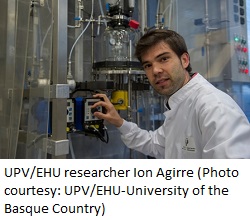
IonAgirre1Chemicals found in wine could help uncork the potential in biodiesel. Researchers at the UPV/EHU-University of the Basque Country in Spain are looking into how acetals, chemical compounds found in many wines, can improve biodiesel’s properties.

From the point of view of chemistry, acetals are obtained through the reaction of an alcohol and an aldehyde. They are generated naturally in fermentation processes. For example, in many wines like port, acetals are the indicators of quality because of the tremendously special, sweet smell they give the wine. When the liquid is poured from glasses into the fuel tank, the acetals improve the properties of the biodiesel when they mix with it: combustion is more effective and, what is more, it is less polluting because engine performance is increased. It is vitally important to come up with a method to obtain acetals easily and cheaply, as a litre of biodiesel may have an acetal content of about 15%.

It is easy to produce acetals in a laboratory, but designing an industrial-scale process is quite another matter, according to the UPV/EHU researcher Ion Agirre. He is trying to make this process possible with the help of his colleagues in the SUPREN group. He has experimented with the alcohol that is the by-product of sugar-rich plants (sugar cane, beetroot, etc.) and also with glycerol, both of which are alcohols of renewable origin. Glycerol is also an alcohol and is a by-product obtained from the reaction to produce the biodiesel. It is used, above all, in cosmetic creams and other products, but it is difficult to channel all the glycerol generated in biodiesel production to this use. That is why it would be advantageous to validate this compound in acetal production.

The researchers found that glycerol-based acetals transmit better properties to the biodiesel compared to alcohols such as ethanol or butanol. They hope to translate this knowledge to a commercial scale.

Biodiesel, International

DF Cast: Ethanol Battles for Info & Against the Gov’t

John Davis

Understanding what the auto industry wants and needs… and how ethanol can meet that… all while battling Big Oil and even the government… that’s the daunting task the ethanol industry has been facing for some time.

ACE13-uniteandignite-vandergriendIn this edition of the Domestic Fuel Cast, we talk with Dave Vander Griend, the co-founder and president of one of the world’s largest ethanol plant engineering and construction firms, ICM. He talks about how first the ethanol industry needed to identify what the auto industry needed and then what the refineries were producing, a first on both counts for the ethanol industry. He says once his industry was able to see what the car makers wanted, it was easier to figure out how to counter some of the arguments Big Oil has been making against ethanol.

Meanwhile, the Urban Air Initiative, a group that looks to reduce the threat to public health posed by petroleum-based fuels, issued a white paper, dispelling Big Oil’s myths and countering what the group characterizes as an erroneous report from the U.S. Environmental Protection Agency (EPA) that would hurt ethanol.

It’s a fascinating conversation, and you can hear more of it in this Domestic Fuel Cast: Domestic Fuel Cast - Dave Vander Griend, ICM and Urban Air Initiative

You can also subscribe to the DomesticFuel Cast here.

Audio, blends, Domestic Fuel Cast, E15, E85, Environment, Ethanol, Ethanol News, Government, News, Oil, RFS

Importance of Argentine Soy Complex

Cindy Zimmerman

ifaj13-foropaisForo PAIS – Productores Agro Industriales de Soja – was born in 2011 with the purpose of promoting the Argentine soy agro-industry and we learned more about it during the IFAJ 2013 Congress.

Foro PAIS Communications and Institutional Relations Director Dr. Adrián Figueroa says soybean production is a huge industry for Argentina. “Soybean production in Argentina in the last ten years has permitted this country to be the first exporter in biodiesel, soybean meal and soybean oil,” he told us.

One of the main reasons for this is Argentina’s large and technologically advanced crushing facilities near to the ports and production areas. “We have huge plants that can produce almost 20,000 tons per day,” he said. “All the arable land is close to the industry sector so in terms of transportation, the cost is so low.”

Listen to my conversation with Dr. Figueroa here: Interview with Adrián Figueroa, Foro PAIS

2013 IFAJ Congress Photo Album

Audio, Biodiesel, International, Processing, Production, Soybeans

BASF to Acquire Verenium

Cindy Zimmerman

BASF BASF Corporation has entered into an agreement to acquire biotechnology company Verenium Corporation.

The agreement, in which BASF will purchase all of the outstanding shares of Verenium’s common stock for US$4.00 per share, has been unanimously approved by both Verenium’s and BASF’s Boards of Directors. Based on all outstanding shares and including all net financial liabilities, the enterprise value would be approximately US$62 million. Verenium is based in San Diego, California, and generated sales of US$57 million in 2012. The acquisition is expected to close in the fourth quarter of this year.

VereniumVerenium Corporation is focused on the development and commercialization of high-performance enzymes for a number of applications, including biofuels production. According to a BASF press release, the company believes that combining “Verenium’s scientific and technological excellence with BASF’s enzyme activities and its global access into all relevant markets will strengthen BASF’s footprint in the strategic enzyme growth market.”

advanced biofuels, BASF, biofuels

Propel, Solazyme Seen as Future of Algae Biodiesel

John Davis

SZ_Propel_1_webA couple of companies familiar to Domestic Fuel readers are being mentioned as the future of algae-based biodiesel. This article from the Voice of America (VOA) talks about how the partnership between renewable fuel marketer Propel Fuels and algae-biodiesel maker Solazyme, both based in Northern California, is advancing the role algae-based biodiesel is having.

“It all starts in the lab where what we do is we grow a proprietary strain of algae that are actually optimized to produce an oil that is a perfect oil, an algae oil, to make into fuel,” [Bob Ames, Solazyme’s vice president in charge of fuels] said.

To test its marketability, Propel installed algae-based fuel pumps at four of its seven stations in the San Francisco Bay area. It was the first time Solazyne’s new biodiesel was offered to the public. The companies were pleased to see a 35 percent increase in biodiesel sales over the month-long test-run.

“Basically, it was offered at exactly the same price as the competing fuel, and what consumers told us by buying more of it is that they were willing to buy it because of the better environmental benefits,” Ames said.

The article goes on to talk about the economies of scale algae-based biodiesel must reach to be profitable. The companies seem to be on the right track, as Solazyme has a plant in Illinois and another smaller one in California (plus a third even larger plant to be opened in Brazil) that are producing large quantities of algae oil, while Propel seems to have the best means of marketing this particular niche of the green fuel.

algae, Biodiesel

Analysis: Biodiesel Still Profitable Despite Price Drop

John Davis

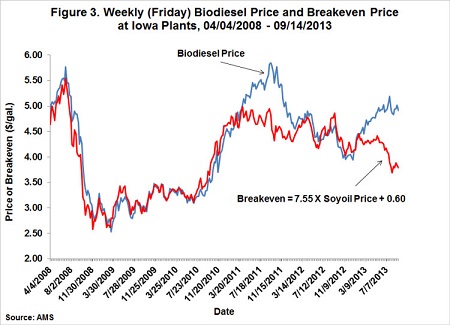
Biodiesel producers remain profitable despite a recent drop in prices for the green fuel. An analysis from Scott Irwin and Darrel Good with the University of Illinois shows that several factors, including an uncertain future of federal tax credits and a drop in soybean oil prices.

There are likely two explanations for the current spike [in profits]. First, diesel blenders once again are motivated to incentivize an increase in the production of biodiesel during 2013 to take advantage of the blenders tax credit that was reinstated for this year only. It is uncertain whether it will be extended for 2014. Second, the biodiesel mandate under the RFS was expanded by the EPA from 1 billion gallons in 2012 to 1.28 billion gallons in 2013 and there may be a need for additional production above the mandate in 2013 in order to meet parts of the advanced and renewable mandates.
fig3

Figure 3 … helps to explain why biodiesel production profits have only dropped slightly since mid-July in the face of falling biodiesel prices. The sharp drop in soybean oil prices has more than offset the decline in biodiesel prices, thus propping up margins.

The analysis goes on to say that the biodiesel market is playing a big role in Renewable Identification Number (RIN) prices, as blenders have bid up the price of biodiesel since the beginning of this year compared to soybean oil prices.

Biodiesel, Research

U of Cali Riverside Installs EV Charging Stations

Joanna Schroeder

evchargerThe University of California, Riverside has installed eight electric vehicle charging stations as part of the College of Engineering – Center for Environmental Research and Technology’s (CE-CERT) “New Grid” project. The new charging units have “level one” and “level two” charging capability and are located in parking lots 1, 6, 15 and 30. Four additional “level two” chargers are located at the CE-CERT parking lot at 1084 Columbia Avenue in Riverside. The on-campus units are overseen by the UCR Office of Transportation and Parking Services and are part of the Chargepoint network.

According to Irma Henderson, alternative transportation program manager in Transportation and Parking Services, drivers will need to have a valid parking permit to use the space, though any permit that is valid for that time of day will be allowed, regardless of the lot that the stations are in.

“For example, the station in Lot 1 is located in the red spaces, but a person with a blue permit can park there as long as they are participating in an active charging session,” Henderson said.

The cost to charge a vehicle will be $1 per hour for the first four hours, then $3 per hour thereafter.

Henderson said that UCR-affiliated individuals will be able to enter a special code into the system that will provide a $1 per hour discount at the campus charging stations, making the service free for the first four hours.

The “New Grid” project is a two-year smart grid deployment supported by the South Coast Air Quality Management District. The project involves a number of public and private partners and will include, solar arrays, advanced battery storage, vehicle charging stations, an electric trolley, and a grid management system to utilize renewable energy to charge electric vehicles efficiently. As part of the program, 13 additional charging stations are being installed throughout the City of Riverside.

Alternative Vehicles, Electric Vehicles

Feds Go After Biodisel Owner for Securities Fraud

John Davis

SEClogoOn the heels of yesterday’s story about the federal government going after a Renewable Identification Number (RIN) defrauder, it looks like the Securities and Exchange Commission is now going after a biodiesel company owner for a different crime. Biodiesel Magazine reports Paul Marshall, Executive Director of FOGFuels Inc., has been charged with breaking federal securities laws for misappropriating client funds.

According to the commission’s complaint, since at least 2011, Marshall, an investment adviser representative of the Bridge Entities, misappropriated at least $2 million from advisory clients. In its complaint, the commission alleges that Marshall instructed clients, some of whom were elderly, to transfer funds to bank accounts under his control for purported investment in various securities, including mutual funds. Instead, Marshall used those client funds to pay personal expenses, including luxury vacations and private school tuition for his children. The complaint further alleges that Marshall concealed his fraud by providing advisory clients with fabricated account statements.

The charges also say that Marshall misappropriated $100,000 from an advisory client who invested in FOGFuels.

A federal judge froze the assets of Marshall, the Bridge Entities and FOGFuels and is preventing them from destroying documents. A hearing is scheduled for today.

Biodiesel

Biodiesel Bumps Up Soybean Demand, Value

John Davis

USBlogoThe longtime and still primary feedstock for biodiesel has received a bump up in its demand and value. Figures from the United Soybean Board show that in order to meet this year’s federal requirement of 1.28 billion gallons of the green fuel this year, it will take 9 billion pounds of vegetable oils and animal fats, with a majority, at least 4.8 billion pounds, coming from soybean oil. That equals out to 430 million bushels of American soybeans.

“There’s value for soybean farmers from the growing market use of soybean oil for biodiesel,” says Gregg Fujan, a USB director and soybean farmer from Weston, Neb. “It expands the market for our soybeans, which also increases the price we receive.”

According to research commissioned by soybean farmers in Minnesota, Nebraska, North Dakota and South Dakota through their state soy checkoff boards, biodiesel contributed to a $15 billion increase in soybean-oil revenues between 2006 and 2012. Over that time period, this raised the price of soybeans by 74 cents per bushel.

Biodiesel already qualifies as the Nation’s first EPA-approved Advanced Biofuel. Guess that makes soybeans the first advanced feedstock.

Biodiesel, Soybeans, USB