RFA E-15 Ad

WEC Issues 10-Point Action Plan for Sustainable Future

Joanna Schroeder

The World Energy Council (WEC) has issued a 10-point action plan for how governments, industry, and key decision-makers should refocus their efforts and resources to achieve real progress in resolving the energy trilemma. The World Energy Congress is taking place 2013TrilemmaCoverThumbnail-209x300in Daegu, Korea this week. The report, “World Energy Trilemma: Time to get real – the agenda for change,” provides a detailed guide to creating a global policy framework that addresses the energy trilemma: energy security, energy equity, and environmental sustainability.
The WEC said the report is the culmination of the findings of a two-year World Energy Council study, “World Energy Trilemma,” conducted with Oliver Wyman, the management consulting firm. Recommendations from the past two years of study were the result of interviews with over 100 energy leaders in 41 countries, including chief executives, ministers, and heads of development banks.

“Governments face a daunting challenge to deliver secure, affordable and environmentally sustainable energy services,” said Joan MacNaughton, executive chair of the WEC’s World Energy Trilemma studies. “How well they meet it has a fundamental bearing on the social and economic prospects of their countries. Over the last two years our World Energy Trilemma study has identified what governments and energy leaders believe is needed to balance the energy trilemma.”
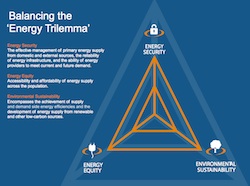
WEC Balancing Energy TrilemmaMacNaughton noted that while leaders say they are ready to act now, they acknowledge the need for more guidance and support. “Our analysis provides the basis for countries to assess their political and institutional risk, and our new ‘Agenda for Change’ report describes how they can mitigate such risk and unlock the investment to deliver the required energy infrastructure. This subject will be the core of discussions between government and business leaders at the World Energy Congress,” added MacNaughton.

The WEC’s 10-point Agenda for Change action plan includes:
Action 1: Connect the energy trilemma to the broader national agenda.
Action 2: Provide leadership to build consensus – nationally and globally.
Action 3: Improve policymaker dialogue.
Action 4: Increase engagement with the financial community.
Action 5: Minimise policy and regulatory risk and ensure optimal risk allocation.
Action 6: Adopt market-based approaches to carbon pricing to drive investments.
Action 7: Design transparent, flexible and dynamic pricing frameworks.
Action 8: Drive (green) trade liberalisation.
Action 9: Meet the need for more research, development & demonstration (RD&D).
Action 10: Encourage joint pre-commercial industry initiatives, including early large-scale demonstration and deployment.

According to the report, addressing strong demand growth, widening access to the 1.2 billion people currently not served by energy grids, and balancing the upgrade of aging infrastructure with environmentally progressive systems requires investment and coordination on an unprecedented scale. However, the impact of shale gas discoveries in more than 40 countries, cost breakthroughs in certain renewable technologies, and increasing the efficiency of transport, construction and household energy use could enable communities to live and work within a widely more sustainable energy landscape.


Alternative energy, conferences, International

NY-Sun Initiative Features New Solar Project

Joanna Schroeder

The largest solar project to date has gone online under the New York Governor Andrew M. Cuomo’s NY-Sun initiative. Owens Corning, the New York State Energy Research and Development Authority (NYSERDA) and Constellation have completed a 2.7 megawatt solar project at Owens Corning’s thermal and acoustical insulation plant.

The solar installation was designed to supply approximately 6 percent of the plant’s annual electricity needs. Constellation financed, built, owns and maintains the solar power system. Electricity generated by the system is purchased by Owens Corning under a 20-year power purchase agreement with Constellation.

Owens Corning solar projectFrank O’Brien-Bernini, vice president and chief sustainability officer for Owens Corning, said, “Owens Corning is committed to helping solve the world’s most pressing energy and climate challenges, and we are constantly seeking solutions that will materially contribute. This solar project represents our continuing efforts to implement programs that advance our 2020 Environmental Footprint Goals, and we are proud to be part of a project that helps protect New York State’s environment.”

The solar power system is comprised of approximately 9,000 ground-mounted, photovoltaic panels located on more than nine acres. The system is expected to generate approximately 3.3 million kilowatt-hours of electricity per year (based on first year production).

“Nearly two years after Governor Cuomo first announced the NY-Sun initiative, the Owens Corning large-scale solar project is a great example of how public-private partnerships are changing the landscape of New York’s clean-energy economy,” said John B. Rhodes, president and CEO for NYSERDA. “We applaud Owens Corning and Constellation on this NY-Sun milestone achievement. This project is a testament not only to the state’s investment in expanding its renewable energy portfolio, but also to its commitment in providing cleaner, more affordable energy for New Yorkers.”

New York State Senator Neil D. Breslin added, “Clean, renewable energy is good for the environment and good for New York businesses. I congratulate Owens Corning, NYSERDA and Constellation on the completion of this project. Through the NY-Sun initiative we will continue to create clean energy jobs and a more sustainable future for our state.”

Alternative energy, Electricity, Solar

Proponents Wonder Why Can’t Biodiesel Fulfill RFS

John Davis

epa-logoA hat tip to my friend Jessica Robinson over at the National Biodiesel Board for pointing out this great article from Biofuels Digest. As the U.S. Environmental Protection Agency (EPA) has proposed lower targets for the 2014 Renewable Fuel Standard, proponents of biodiesel are wondering why their green fuel is targeted a 20 percent reduction.

Let’s review the background on biodiesel and renewable diesel. There’s no blend wall in sight, production volumes have been growing fast, prices have been relatively stable, and because it provides a market for soybean oil, it reduces prices for ranchers and poultry farmers who use the soybean meal as animal feed.

Here are answers to your questions regarding biomass-based diesel and the proposed 2014 and 2015 standards.

Q: What is EPA’s stated method and target?

A: In the draft EPA document that is floating around the industry — which the Digest has reviewed — the EPA writes that it aims to “Base advanced volume on availability of advanced biofuels but considering the blendwall” by [setting} the advanced volume at the sum of the cellulosic standard, the BBD standard and all available volumes of non-ethanol advanced.” EPA adds that it intends to “Maintain biomass-based diesel std at 1.28 Bgal; since BBD is nested within the advanced biofuel standard, any excess volumes above 1.28 bill gal can compete with other advanced biofuels. There is limited availability of other advanced biofuels, which generates opportunities for biodiesel production above 1.28 bill gal to help meet the advanced biofuel standard.”Read More

Biodiesel, Environment, Government

Ethanol Safety Seminar Planned in Tacoma

Joanna Schroeder

Ethanol Safety SeminarThe Renewable Fuels Association (RFA) and the Burlington Northern Santa Fe (BNSF) Railway will co-host a free Ethanol Safety Seminar on October 23 and 24, 2013 at the Tacoma Fire Department Training Center in Tacoma, Washington. Sessions will run from 9 a.m. to 2 p.m. Registration is limited to the first 60 people per session. Lunch will be provided. Certificates of attendance will be awarded to attendees at the completion of the course.

This course was developed to give first responders, hazmat teams, and safety personnel an in-depth look at proper training techniques needed when responding to an ethanol-related emergency. A majority of this training is based on the “Complete Training Guide to Ethanol Emergency Response,” a training package created by the Ethanol Emergency Response Coalition (EERC) that has been distributed throughout the United States and to several countries worldwide.

“These training opportunities allow community responders to become more knowledgeable and better prepared to respond safely and effectively to incidents involving ethanol,” said Patrick Brady, assistant director of hazardous materials at BNSF Railway. “We feel it is important to bring in leaders in the hazmat emergency response field to share the best practices for responding to ethanol incidents with responders in communities that we serve.”

The Ethanol Safety Seminar focuses on numerous important areas of ethanol safety including an introduction to ethanol and ethanol-blended fuels, chemical and physical characteristics of ethanol and hydrocarbon fuels, transportation and transfer of ethanol-blended fuels, storage and dispensing locations, firefighting foam principles and ethanol-blended fuel, health and safety considerations for ethanol-blended fuel emergencies and tank farm and bulk storage fire incidents.

biofuels, Education, Ethanol, RFS

BioEnergy Bytes

Joanna Schroeder

  • BioEnergyBytesDFHuaneng Power International, Inc. has announced that the Distributed Energy Project for Guangxi Huaneng Guilin World Tourist City and Huaneng Hunan Guidong Hankou Wind Farm Project, both of which are wholly owned by the Company, had obtained approvals from the Development and Reform Commission of Guangxi Zhuang Autonomous Region and the Development and Reform Commission of Hunan Province, respectively.
  • Enerkem Inc., a waste-to-biofuels and renewable chemicals company, is proud to announce that it earned the top ranking by Lux Research for near-term growth opportunity among 415 companies, and was named a 2013 Global Cleantech 100 company by the Cleantech Group.
  • The NUNA 7 team of Delft’s University has won the World Championships of Solar Racing in Australia. With the very latest in solar and electronic technology, amongst the brand new, very efficient Filter Inductors of ISE Magnetics, the NUNA 7 crossed the line to claim the title with an average speed of 90 km/h for the 3,000 km journey.
  • The Canadian Wind Energy Association (CanWEA) has revealed the three winners of its second annual Power of Wind blog contest. The first-prize winner is Gautham Krishnaraj, a B.Sc. student at McGill University studying Microbiology and Immunology. The second-prize winner is Laurence Dupuis, Laurence is currently studying Film Production at The Mel Hoppenheim School of Cinema of Concordia University in Montreal, Quebec. The third-prize winner is Daniel Bryce, who is working on a master’s degree in Planning at Dalhousie University in Nova Scotia.
Bioenergy Bytes

Cavitation Tech Deal Good for Brazil Biodiesel

John Davis

CTi Nano Reactor1Cavitation Technologies Inc.’s (CTi) first Nano Reactor system sales deal could be a positive development for biodiesel in Brazil. CTi’s strategic business partner and licensee of the company’s vegetable oil refining technology, Desmet Ballestra Group (“Desmet”), entered into a sales agreement with a soybean oil refinery in Brazil, using CTi’s Nano Neutralization(R) Reactor System that processes approximately 500 tons of soybean oil daily. This company news release says the system could be completed and ready to go by the end of June 2014.

With multiple sales in Argentina and Ecuador, this Brazilian installation marks CTi’s sixth in South America. This region has enormous sales potential in edible oil processing and refining and is a major target for the company. President Igor Gorodnitsky explains, “I can’t fully emphasize the importance of finalizing this installation in Brazil. In the edible oil processing and refining industry, Brazil is one of the largest markets in the world and we appreciate all that Desmet has done to complete this agreement.”

Mr. Gorodnitsky added, “Brazil is also one of the largest biodiesel producing countries and a world leader in bio fuel development. With our recently patented technology on processing and producing biodiesel, CTi is continuously on the lookout for additional new opportunities to implement our systems across these sectors. Brazil provides enormous potential for us moving forward.”

CTi touts its patented NanoReactor technology as significantly cutting producers’ processing costs and environmental impacts, as well as increasing the yield.

Biodiesel, International, Soybeans

EC&R Climate Dedicates Two Solar Projects

Joanna Schroeder

Congressman Ron BarberE.ON Climate & Renewables (EC&R) has dedicated two solar photovoltaic (PV) projects in the Tucson, Arizona area with a combined total of 15 megawatts (MW) of solar capacity. Both projects have long-term power purchase agreements (PPAs) with Tucson Electric Power (TEP). According to Dr. Christophe Jurczak, CEO of E.ON Climate & Renewables Global Solar, these two projects are among the most technologically advanced solar PV projects in the world.

“These are our maiden solar facilities in the U.S. and signal E.ON’s commitment to solar development in the U.S. market,” said Steve Trenholm, Chairman E.ON North America.

In a statement, Congressman Ron Barber of Arizona praised the economic development opportunities that solar power brings to Arizona and the local community. “Solar-generating capacity in the United States continues to grow each year. I am proud that Arizona is a solar leader with nearly 10,000 people employed in my state’s rapidly growing solar industry.”

The first of the two projects, a 5 MW project called Tech Park Solar (TPS), was developed in collaboration with the University of Arizona Science and Technology Park (UA Tech Park) and TEP. The project started generating power in December 2012. The second, 10MW, project, Valencia Solar, came online in June 2013.

“We’ve been consistently impressed by E.ON. The company offers innovative tracking technologies and their employees possess strong expertise in renewable energy. E.ON is easy to work with and we would be pleased to work with them again,” said Carmine Tilghman, TEP’s Director of Renewable Energy.

During the ceremony, E.ON donated $10,000 to Casa de los Ninos, a local non-profit organization dedicated to preventing and treating child abuse and neglect in Tucson.

Alternative energy, Energy, Solar

Energy-Efficiency Standards Could Save Consumers $$

Joanna Schroeder

According to a new report, Energy Efficiency Performance Standards: The Cornerstone of Consumer-Friendly Energy Policy, consumers could save nearly $1,000 on annual household energy costs if energy-efficient performance standards were more prevalent and understood.

The Consumer Federation of America (CFA) report also finds a broad consensus among a variety of independent policy evaluations that energy-efficiency performance standards, iStock_000019192538XSmallwhen effectively implemented, are the ideal tool for delivering these savings. Currently, proceedings affecting almost two-dozen new energy performance standards are pending at the federal and state levels for a broad spectrum of products.

“Some analysts doubt the money-saving potential of energy efficiency standards because they assume that energy markets work perfectly and automatically push consumers toward money-saving, energy-efficient options. But that’s not how the real world works,” said Mark Cooper, Director of Research for CFA.

“Hundreds of empirical case studies we reviewed show that barriers and imperfections in energy markets create an efficiency gap—the difference between our actual level of energy consumption and the optimal level of energy consumption,” Cooper continued. “The studies show the barriers affect both the supply-side and the demand-side of markets for residential and commercial/industrial products. More importantly, evaluations of policies over the past decade indicate that those barriers can be brought down by well-designed energy-efficiency performance standards, like fuel economy standards for cars and trucks or standards for air conditioners.”

The report bases its conclusions on an extensive review of studies done by academics, think tanks, private-sector firms, and government agencies, drawing on literature by experts in several fields, including economics, energy efficiency, and technology innovation and diffusion. In addition to examining recent studies that directly address the efficiency gap and performance standards directly, the CFA study draws insights from empirical studies of two closely related fields, the innovation diffusion literature and climate change. The report will provide the analytic basis for evaluating specific standards that are currently going through regulatory review including household appliances, light duty vehicles, and heavy duty trucks.

“Critics of performance standards, whether they are efficiency gap deniers or cost-benefit naysayers, have either ignored the mountain of evidence that shows the benefits of standards far outweigh the costs, or use flawed data and misspecified models to reach unsupported and misleading conclusions. Our economic analysis confirms the pocketbook savings and our survey results show that consumers understand the benefits of these programs,” Cooper said. “Well-crafted, long-term, energy efficiency performance standards give consumers and businesses extra cash through significant energy savings.”

energy efficiency, Legislation

Cellulosic Byproduct Increases Ethanol Yield

Joanna Schroeder

jin_yongsu1-bScientists from the University of Illinois have reported that they have engineered yeast to consume acetic acid, a previously unwanted byproduct of the process of converting plant leaves, stems and other tissues into biofuels. This innovation increases ethanol yield from lignocellulosic sources (aka second generation feedstocks) by nearly 10 percent. According to researchers, the new advance will streamline the fermentation process and will simplify plant breeding and pretreatment of the cellulose. The results were published in Nature Communications.

Lignocellulose is the fibrous material that makes up the structural tissues of plants. It is one of the most abundant raw materials on the planet and, because it is rich in carbon it is an attractive source of renewable biomass for biofuels production.

The researchers explain that the yeast Saccharomyces cerevisiae is good at fermenting simple sugars (such as those found in corn kernels and sugarcane) to produce ethanol. But coaxing the yeast to feast on plant stems and leaves is not so easy. Doing it on an industrial scale requires a number of costly steps, one of which involves breaking down hemicellulose, a key component of lignocellulose.

“If we decompose hemicellulose, we obtain xylose and acetic acid,” said University of Illinois food science and human nutrition professor Yong-Su Jin, who led the research with principal investigator Jamie Cate, of the University of California at Berkeley and the Lawrence Berkeley National Laboratory. Jin and Cate are affiliates of the Energy Biosciences Institute (EBI), which funded the research. Jin is an affiliate of the Institute for Genomic Biology at the U of I.

“Xylose is a sugar; we can engineer yeast to ferment xylose,” Jin said. “However, acetic acid is a toxic compound that kills yeast. That is one of the biggest problems in cellulosic ethanol production.”Read More

advanced biofuels, Cellulosic, Ethanol, Research

WW2 Air Raid Bunker Converted to “Energy Bunker”

Joanna Schroeder

A former air raid bunker has been transformed into an “Energy Bunker” in the district of Wilhelmsburg, located in Hamburg, Germany. The project was part of the 2013 International Building Exhibition Hamburg (IBA) that kicked off this week. The massive building had been derelict for several decades but is now the host of a regenerative power plant supplying the surrounding community with green energy.

Former WW2 Air Raid Bunker Converted Into an "Energy Bunker" in Hamburg, GermanyThe project is part of the “Renewable Wilhelmsburg” climate protection scheme, which aims to provide the 50,000 Wilhelmsburg residents with CO2-neutral electricity by 2025 and with climate-neutral heating by 2050.

The surrounding neighborhood’s household energy is generated by a combination of energy sources: besides solar energy and biogas, the bunker also uses wood chips and waste heat from a nearby industrial plant, supplying heating energy to local households. What might be the project’s most innovative feature is its large-scale buffer storage facility with its 2 million litre capacity that integrates different eco-friendly heat and power units. The Energy Bunker also feeds the renewable power generated by its solar panels into Hamburg’s electricity grid, thereby supplying 3,000 households with heat and 1,000 households with electricity.

Another landmark project of the climate protection scheme is the “Energy Hill”, a former toxic landfill site that has been transformed into a renewable energy hill that, using solar energy and wind power, supplies 4,000 households with electricity.

Other pioneering projects include the “Energy Network Wilhelmsburg Central,” which integrates energy-generating facilities from various buildings into one large “virtual” power plant, and the BIQ House, which is setting new standards as the world’s first building to have a bioreactor façade. Microalgae are cultivated in the glass elements that make up the BIQ House’s “bio skin”. The house is part of the IBA “Building Exhibition within the Building Exhibition” project, which gives us a glimpse into urban life in the future.

Alternative energy, biogas, energy efficiency, International, Solar, Wind