Hydro-PV Hybrid Project in China Connects to Grid

Joanna Schroeder

What is believed to be the world’s largest hydro and PV hybrid project has been connected to the grid and is now supplying power from the Longyangxia Dam in Qinghai Province, China. Yingli Green Energy Holding Company, who supplied 15 MW YGE series photovoltaic (PV) modules for the project congratulated the project team for its successful efforts.

Longyangxia DamWith a total capacity of 320 MW, the project began construction in March 2013 and started grid connection and commissioning last week. During its 25 years lifetime, the hyrdo-solar project is expected to deliver 498 million kWh of electricity per year to the grid.

“We feel delighted about the successful grid connection of world’s largest hydro and PV hybrid project,” said Liansheng Miao, Chairman and Chief Executive Officer of Yingli Green Energy. “In addition to this hydro and PV hybrid project, the company has also been acting proactively in integrating PV with architecture, agricultural, and other fields. For example, the Power Valley International Hotel – world’s first five star hotel with BIPV application applied our curtain wall Series PV modules, integrating solar power generation into the overall design and making the building more environmental friendly.”

Miao added, “The Company also focuses on the innovative applications of PV modules with traditional agriculture, promoting the development of eco-agriculture. Besides, we installed more than 20 MW PV modules on our factories, parking lots, and other facilities, which will provide approximate 23 million kWh solar electricity per year for the company’s production and operation. This will help the company to reduce CO2 emission and increase renewable energy consumption.”

Alternative energy, Electricity, Hydro, International, Solar

U.S. Solar Energy Industry Breaks Records

Joanna Schroeder

Solar Report Figure1.1_0GTM Research and the Solar Energy Industries Association (SEIA) have released the “U.S. Solar Market Insight: 3rd Quarter 2013,” the definitive analysis of solar power markets in the U.S., with strategic state-specific data for 28 U.S. states and the District of Columbia.

According to the report, the U.S. installed 930 megawatts (MW) of photovoltaics (PV) in Q3 2013 is up 20 percent over Q2 2013 and 35 percent over Q3 2012. This represents the second largest quarter in the history of the U.S. solar market and the largest quarter ever for residential PV installations. The report finds that even more importantly, 2013 is likely to be the first time in more than 15 years that the U.S. installs more solar capacity than world leader Germany, according to GTM Research forecasts.

“Without a doubt, 2013 will go down as a record-shattering year for the U.S. solar industry,” said Rhone Resch, SEIA president and CEO. “We’ve now joined Germany, China and Japan as worldwide leaders when it comes to the installation of new solar capacity. This unprecedented growth is helping to create thousands of American jobs, save money for U.S. consumers, and reduce pollution nationwide. When it comes to preparing for America’s future, clean, dependable and affordable solar energy has become the ‘Little Engine That Could,’ defying expectations and powering economic growth – and, frankly, we’re just scratching the surface of our industry’s enormous potential.”

Solar Report Figure2.1_4The report finds that the residential market continues its rapid growth. Through Q3, residential PV installations were up 45 percent year-over-year, driven largely by increasingly attractive economics and by fair net metering policies. The non-residential (commercial) market has seen the most difficulty this year with installations forecasted to stay flat over last year. The utility market continues its consistently strong installation numbers and is forecasted to exceed 1 gigawatt (GW) of installations in the fourth quarter, including Abengoa’s Solana, the world’s largest parabolic trough concentrating solar power (CSP) plant with a 6-hour thermal energy storage system. This will be the first time any individual market segment has hit that mark.

“Solar is the second-largest source of new electricity capacity in the U.S. this year, trailing only natural gas,” said Shayle Kann, vice president of research at GTM. “As solar continues its march toward ubiquity, the market will require continued innovation, efficiency improvement and regulatory clarity. But already the groundwork has been laid for a mainstream solar future.”

Alternative energy, Electricity, Research, Solar

BioEnergy Bytes

Joanna Schroeder

  • BioEnergyBytesDFRyan Lamke has joined Growth Energy as the new Communications Manager and will be responsible for strategic planning, grassroots communications, as well as managing and coordinating social and traditional media efforts to expand Growth Energy’s public relations, legislative affairs and membership agendas. Courtney Henderson has joined as the new Communications Assistant and will be responsible for monitoring media coverage of the biofuels industry, as well as expanding Growth Energy’s digital presence through various social media platforms.
  • The Iowa Renewable Fuels Association (IRFA) has announced its Board of Directors, Officers and Executive Committee for 2014, elected at its Dec. 12, 2013 annual meeting. Each producer member has a seat on the Board and votes on officers. New officers will serve a one-year term during the 2014 calendar year. 2014 IRFA Board of Directors Officers: President, Steve Bleyl, Green Plains Renewable Energy; Vice President, Brian Cahill, Southwest Iowa Renewable Energy; Treasurer Tom Brooks, Western Dubuque Biodiesel; Secretary Eamonn Byrne, Plymouth Energy; and Executive Director Monte Shaw (non-voting). The IRFA Executive Committee is comprised of the IRFA Officers and other members as elected by the Board. Elected to join the IRFA Officers on the Executive Committee for 2014 are: Past President Rick Schwarck, Absolute Energy; At-Large Brad Albin, Renewable Energy Group; and At-Large Craig Willis, ADM.
  • EPA has issued its annual report that tracks the average fuel economy of vehicles sold in the United States. The report shows that model year 2012 vehicles achieved an all-time high fuel economy of 23.6 miles per gallon (mpg). This represents a 1.2 mpg increase over the previous year, making it the second largest annual increase in the last 30 years. Fuel economy has now increased in seven of the last eight years.
  • Earlier this week energy ministers blocked an attempt by the UK to undermine the 20% renewable energy target for 2020 by having advanced biofuels count double. This would have brought the 20% target for 2020 down to 19.6% if adopted, putting at risk the confidence of companies which have invested in renewables based on a binding target of 20%.
Bioenergy Bytes

USDA, DOE Fund $8M for Bioenergy Feedstocks

Joanna Schroeder

The U.S. Departments of Agriculture (USDA) and Energy (DOE) today announced $8 million in research grants to develop non-food feedstocks that can be used for bioenergy. USDA said the grants are part of a broader effort by the Obama administration to develop domestic renewable energy and advanced biofuels, providing a more secure future for America’s energy needs and enhancing rural economies.

USDA DOE Biomass Programs“Today’s investments are a critical piece of President Obama’s strategy to create a clean source of energy and advance the sustainable use of natural resources,” said Agriculture Secretary Tom Vilsack. “Innovative research plays a vital role in boosting rural economies and creating jobs in rural America, and the benefits this type of research may offer is another pressing reason we need a new Food, Farm and Jobs bill passed.”

Overall, the USDA and DOE projects are designed to improve biomass to be grown for biofuels including selected trees and grasses-by increasing their yield, quality and ability to adapt to extreme environments. Researchers will rely on the most advanced techniques of modern genomics to develop breeding and other strategies to improve the crops. The research will be conducted on switchgrass, poplar and pine, among other plants.

The potential benefits of this research range from decreasing oil imports to increasing options for American farmers. Because these non-food crops will be optimized to tolerate conditions such as drought and poor soils, they can be grown on marginal lands unsuitable for food crops, thereby avoiding competition with food production. Farmers will have the option to grow bioenergy crops in addition to other existing crop choices.

Fiscal Year 2013 awardees include:

USDA-NIFA-funded

  • University of Florida, Gainesville, Fla., $1,000,000
  • Oregon State University, Corvallis, Ore., $1,000,000

DOE-funded

  • Colorado State University, Ft. Collins, Colo., $1,385,763
  • University of Georgia, Athens, Ga., $1,314,235
  • University of Illinois, Urbana, Ill., $998,564
  • Purdue University, West Lafayette, Ind., $863,576
  • University of North Carolina, Chapel Hill, N.C., $1,543,490
advanced biofuels, biomass, Research

Florida Company Starts Trials on Jatropha Biodiesel

John Davis

afaFlorida-based Alternative Fuels Americas, Inc. has started trial production runs of its Jatropha-based biodiesel. This company news release says it will be run in three phases, using feedstock from its Costa Rican plantation for the first phase.

“As with every endeavor we undertake, we are testing our assumptions and capabilities before we engage in larger scale activity. This is a major milestone for us and we need to be certain that we not only produce quality biodiesel, but also that we do so within the cost structures we have imposed,” stated AFAI CEO Craig Frank. “These 3 phases of trials will allow us to pinpoint issues, make the appropriate adjustments, and finalize processes that will ensure the sustainable and profitable production of biodiesel. This is yet one more step on our path to value creation.”

“AFAI marked the completion of our trials this past spring”, continued Mr. Frank. “During this R&D period we created and set up for implementation a wide range of operational activities, including Project Jetropha, our wild feedstock program, the signing of offtake agreements and additional projects in development. We are pleased that since we have initiated our active strategy we are moving rapidly toward growth. It is our intent to continue on this path”.

Alternative Fuels Americas takes a cradle-to-grave approach to its biodiesel process, growing the feedstock, crushing the seeds into oil, turning that oil into biodiesel and finally selling it on the market.

Biodiesel

Miraculous Keynote Announced for Biodiesel Conf.

John Davis

craigBacks against the wall, facing what seems like impossible odds … there’s a lot of parallels between what the biodiesel industry is facing these days with possible cuts to its share of the Renewable Fuel Standard (RFS) and what the 1980 U.S. hockey team faced more than two decades ago, as the team got ready to face the mighty Soviet Union. But miracles do happen, and that squad took home gold that year, beating those stacked odds. The U.S. biodiesel industry has its own hill to climb, so it seems rather appropriate that for the coming National Biodiesel Conference, the National Biodiesel Board (NBB) has announced Olympic gold medalist Jim Craig, goalie for the 1980 USA “Miracle on Ice” Hockey Team, will deliver the keynote address.

He is best remembered for his outstanding goaltending when the U.S. team beat the heavily favored Russians and went on to win the Olympic gold medal in what’s been labeled the greatest sports moment of the 20th Century.

Craig’s message comes at an appropriate time, with many people in the biodiesel industry facing adversity due to uncertainty over the federal Renewable Fuel Standard. Craig’s story shows a come-from-behind victory is never completely out of reach!

NBBconflogo2014-1Craig is currently president of Gold Medal Strategies, a motivational speaking and sales training company. During the past 30 years, he has inspired and provided strategic direction for more than 500 organizations and some of the world’s most recognized brands. Craig’s latest business book, Gold Medal Strategies, Business Lessons from America’s Miracle Team, was published in 2011.

The folks from NBB also remind you that the 2014 conference comes two weeks earlier than previous years, running Jan. 20-23, 2014 so you need to hurry up and get your reservation in for THE biodiesel event of the year before prices go up on Jan. 3.

Biodiesel, Biodiesel Conference, NBB

IRFA to Host Renewable Fuels Forum

Joanna Schroeder

Senate-Tom-HarkinThe Iowa Renewable Fuels Association (IRFA) is hosting a renewable fuels forum for Iowa’s leading Republicans seeking the GOP nomination to run for U.S. Senate in 2014. The seat is currently held by U.S. Senator Tom Harkin who is set to retire after his current term ends. The forum will be held at the Western Iowa Tech Community College Cherokee Campus Auditorium on Thursday, December 19, 2013 from 2:00 to 4:00 p.m. and is free and open to the public.

“Over ten thousand Iowa households work directly for or are invested in Iowa’s renewable fuels industry and they want to know where the candidates stand,” said IRFA President Rick Schwarck. “Iowa is the nation’s number one renewable fuels state, and, at this forum, leading republican candidates will have the chance to speak directly on important issues like the federal Renewable Fuel Standard (RFS), E15, and biodiesel that are vital to Iowa jobs and Iowa’s economic future.”

The IRFA Renewable Fuels Forum will be held at the Western Iowa Tech Community College Cherokee Campus Auditorium located at 220 Victory Drive in Cherokee, Iowa. The candidates invited to participate are Sam Clovis, state Senator Joni Ernst, Mark Jacobs, Matt Whitaker, and David Young.

Biodiesel, biofuels, Ethanol, Iowa RFA, RFS

Anti Corn Ethanol Legislation Sparks Outrage

Joanna Schroeder

SenatorTomCoburnPhoto APSenators Dianne Feinstein (D-CA) and Tom Coburn (R-OK) have introduced legislation to curb corn-ethanol use and production. The Corn Ethanol Mandate Elimination Act of 2013 eliminates the corn ethanol mandate within the Renewable Fuel Standard (RFS), an energy policy that mandates the use of 36 billion gallons of biofuel in America’s fuel supply by 2022.

“I am pleased to join Senator Coburn and others on a bill to eliminate the federal corn ethanol mandate from the Renewable Fuel Standard, while maintaining provisions designed to grow the low-carbon biofuel industry,” said Senator Feinstein. Under the corn ethanol mandate in the RFS, roughly 44 percent of U.S. corn is diverted from food to fuel, pushing up the cost of food and animal feed and damaging the environment. Oil companies are also unable to blend more corn ethanol into gasoline without causing problems for automobiles, boats and other vehicles. I strongly support requiring a shift to low-carbon advanced biofuel, including biodiesel, cellulosic ethanol and other revolutionary fuels. But a corn ethanol mandate is simply bad policy.”

The ethanol industry was outraged at the proposed legislation and is fighting back. “This legislation is incredibly shortsighted as it will eviscerate the RFS – the most successful energy policy enacted in the last 40 years,” responded Tom Buis CEO of Growth Energy to the proposed bill. “It will continue to keep us addicted to foreign oil and more than anything, it seems like this legislation is appeasing the wishes of Big Oil and Big Food.”

Buis continued, “Additionally, this legislation is based on false, misleading information. To blame ethanol for an increase in the price of food may make for good rhetoric, but it is completely devoid of any facts to back it up. Corn ethanol is not the cause of high prices; it is the price of oil. Even the World Bank  outlined how crude oil prices are responsible for 50 percent of the increase in food prices since 2004. Countess studies have shown that record-high oil prices, Wall Street speculators and the high costs of manufacturing, packaging and transportation are the true culprits driving up food prices.

“Furthermore, the authors of this legislation fail to understand the actual process of how ethanol is produced. Only the starch is removed, while all of the valuable components – the fiber, oil and protein is returned to the food chain in the form of a high protein animal feed,” added Buis.

Bob Dinneen, President and CEO of the Renewable Fuels Association (RFA), responded by saying, “This is monumentally stupid. This legislation ought to be entitled ‘The Oil Monopoly Protection Act of 2013.’ This bill would deprive Americans of cost-saving, renewable fuel choice. It would set this country back in its quest to gain energy independence and further damage the environment by increasing the need for fracking, tar sands, and off-shore drilling.”Read More

biofuels, corn, Ethanol, Fuels America, Growth Energy, RFA, RFS

BioEnergy Bytes

Joanna Schroeder

  • BioEnergyBytesDFGov. Terry Branstad and Lt. Gov. Kim Reynolds have joined Sens. Charles Grassley and Tom Harkin, Congressmen Tom Latham, Steve King, Dave Loebsack and Bruce Braley, and Iowa Secretary of Agriculture Bill Northey in sending a letter expressing strong opposition to the EPA’s proposal that would negatively lower levels in the Renewable Fuel Standard (RFS) to President Barack Obama, EPA Administrator Gina McCarthy and U.S. Department of Agriculture Sec. Tom Vilsack. The Iowa elected leaders also urged the federal government to host a hearing in Iowa to hear directly from Iowans on the EPA’s proposal, which would have a harmful effect on the agriculture, agri-business and biofuels industries in Iowa.
  • Highwater Ethanol, LLC, of Lamberton, Minnesota has joined the Renewable Fuels Association (RFA). Highwater Ethanol began operation in 2009 employing over 30 local residents. It has a nameplate capacity of 50 million gallons of ethanol a year and produces 160,000 tons of dried distillers grains with solubles (DDGS), some of which goes back to local farmers as wetcake.
  • Genscape’s is hosting a webinar on December 18, 2013: The New RFS2 Heating Oil Rule… Demystified. The second in the RIN Webinar Series, Susan Olson and Larry Schafer will discuss the additional downstream use eligibility for certain RFS2 fuels, the impacts this will have on fuel producers and the oil market, and the requirements that must be followed for renewable fuel oil.
  • A new partnership between U.S. Bank and Boston Community Capital, Inc. (BCC) will boost development of clean renewable energy in the Boston area, while allowing nine nonprofits and affordable housing communities to reduce their energy costs. Together, U.S. Bank and BCC affiliate BCC Solar Energy Advantage will finance the installation and operation of solar photovoltaic (PV) systems at 225 Centre in Jamaica Plain; the Boys and Girls Club of Greater New Bedford; Cass House in Roxbury Hills; the Jefferson Housing Development and the Lincoln Way Housing Development in Cambridge; Mill Street in Gardner; The Homes at Old Colony in South Boston; and The Greater Boston Food Bank. Solar installations are taking place now through 2014.
Bioenergy Bytes

More Households Could Use EVs

Joanna Schroeder

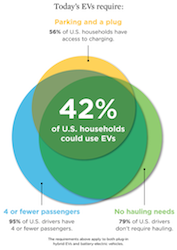
Todays EVs surveyAccording to a national survey released by the Union of Concerned Scientists (UCS) and Consumers Union, four out of 10 households could use an electric vehicle (EV) with little or no change to their driving habits and vehicle needs,

While less than 1 percent of the country are driving electric vehicles (EVs) today, the survey found that 42 percent of respondents with cars, equivalent to 45 million households when applied nationally, meet the basic criteria for using plug-in hybrid electric vehicles, such as the Chevy Volt. More than half of those households are also able to use a battery-electric vehicle (BEV), such as the Nissan LEAF.

“Consumers who might be shopping for a new vehicle this holiday season may be surprised to learn that an electric vehicle could be a good fit for their household,” said Josh Goldman, policy analyst for the UCS Clean Vehicles Program. “Drivers may have preconceptions about whether electric vehicles can meet their driving needs and habits, and this survey shows that for many, they can.”

Alternative Vehicles, Electric Vehicles