ACE Conference 2026

Marshall County Wind Farm Begins Construction

Joanna Schroeder

Laurel MorningMarshall Wind Energy LLC, a wholly-owned subsidiary of RPM Access LLC, has begun construction of its 74 MW wind farm in Marshall County near Beattie, Kansas. The company executed a high voltage transmission interconnection agreement with Westar Energy and Southwest Power Pool in mid-2011. Under the terms of this arrangement, the two companies are coordinating their efforts to pursue all design, engineering and construction activities related to the Westar 115kV Marshall County Wind Farm Switching Station and the Marshall Energy Rock Substation. Energization is scheduled for August 2014 with wind farm commercial operations expected by year end 2014.

A contract has also been signed with Mortenson Construction to provide balance-of-plant design and construction management activities. Marshall Wind has established a local business office in Beattie. An on-site construction management office and equipment have been mobilized to support construction of access roads to wind turbine locations along with substation site grading and foundation work activities that are now underway.

Renewable energy generated by the project will be purchased by multiple entities via long-term contracts. In September, Marshall Wind signed a 20-year power purchase agreement (PPA) for 20 MW with the Missouri Joint Municipal Electric Utility Commission (MJMEUC). The project will qualify for current renewable production tax credits (PTCs). Located within the Southwest Power Pool market region, Marshall Wind in 2014 is ideally positioned to offer for sale under long-term contract(s) the remaining available capacity.

The project is anticipated to create more than 150 jobs during the construction phase and approximately four permanent positions. The wind farm will also benefit the community by strengthening the local economy and providing a steady flow of revenue to Marshall County.

Alternative energy, Electricity, Wind

Tips from Patriot’s Dave Gerhart on Improving Efficiency

Joanna Schroeder

When you want to learn about ethanol, you go to an industry veteran and I did just that when I spoke with Patriot Renewable Fuels Plant Manager Dave Gerhart who began his career in the early 80s at is what is now known as Nebraska-based Chief Ethanol Fuels. At the time, they were the largest dry mill ethanol plant in the United States. Back then corn was less than $2 a bushel so the ethanol plant was something the local community supported to help the local farmer.

Patriot Plant Manager Dave GerhartFrom there, Gerhart changed gears slightly and joined the ICM team where he worked with them on their first 5 design and build ethanol plants. This was in the early 2000s before the major industry boom. Next he began the plant manager at Kaapa Ethanol and today he has brought his 30 years of experience to Patriot to help them grow.

One of Gerhart’s areas of expertise is his ability to identify things in the plant that can be modified to help improve efficiency – a key factor in increasing profitability. I asked him for those that are newbies to the industry, some areas plant managers can’t look at to increase efficiency.

“One you would look at your energy balance and see where you could actually put variable frequency drives rather than an automatic control valve. So that would reduce electricity,” explained Gerhart. “If you can reduce water usage, this helps you out in the energy balance as well. There is different trains of thoughts on fermentation and what you can do there. Sometimes people take the path of least resistance and in doing so they short circuit the energy efficiency they can actually get out of there plant.”

I asked Gerhart what he would really like consumers to know about biofuels. “Hopefully they all realize that ethanol is probably the cleanest thing they can put into your gas tank,” said Gerhart. “Gasoline is not. Alcohol is very safe. It’s homegrown. It’s renewable. It’s not something that we have to go foreign to get.”

I also asked him why consumers needed to care about the Renewable Fuel Standard (RFs). They need to care because ethanol has such an impact on middle America,” said Gerhart. “We’ve done so much to build up the farm incomes and the trucking industry and the fuel distribution. So every plant no matter where it’s at has an economic impact, at a minimum of 70 miles around it.”

Gerhart added, “This needs to stay.”

Listen to my interview with Dave Gerhart here: Tips from Patriot's Dave Gerhart on Improving Efficiency

Check out the Patriot Renewable Fuels photo album.

Audio, biofuels, corn, Ethanol, Patriot Renewable Fuels, RFS

Abundant Corn Harvest Increases Ethanol Production

Joanna Schroeder

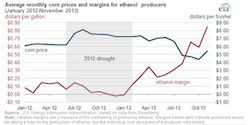
According to a recent Today in Energy published by the U.S. Energy Information Administration (EIA), expectations of a record corn harvest in 2013 have helped lower corn prices and improve ethanol production margins. This has also increased ethanol production and supply.

It was just last year that the 2012 corn harvest faced some of the most severe and far-reaching drought since the 1950s. Final productions for the year were 10.8 billion bushel. This fall however, brought a 30 percent increase over 2012, even those much of the U.S. still experienced drought. Many key growing areas, despite the dry weather, had ample rains at just the right time.

Ave Monthly Corn Prices and Margins for EthanolAs the EIA explains the ethanol margin is the difference between the market price of ethanol and its cost of production adjusted by the value of co-products. It is also a measure of the profitability of producing ethanol. Between October 2012 and January 2013, the ethanol margin for producers was close to zero. The recent reduction in corn prices had a major impact on the profitability of ethanol production, because purchased corn is by far the largest cost incurred by ethanol producers. On average, one bushel of corn can be used to produce 2.8 gallons of ethanol.

Between January and November 2013, corn prices fell from about $7.50 per bushel to below $4.50 per bushel. A $3 reduction in the price of a bushel of corn translates into a roughly $1.08 reduction in the cost of ethanol production. While ethanol prices have also declined, ethanol producer margins have risen above $0.50 per gallon in recent months.

As a result, reports EIA, improved margins have incentivized greater levels of ethanol production, with output recovering to pre-drought levels. At the same time, lower prices have made ethanol more economically attractive for refinery blending, and output of ethanol-blended gasoline has risen. Net use of ethanol by refiners and blenders reached an all-time high of 884,000 barrels per day in August 2013.

biofuels, corn, Ethanol

BioEnergy Bytes

Joanna Schroeder

  • BioEnergyBytesDFIowa Senator Mark Jacobs and Sam Clovis who are running for the Congressional seat that is open with Senator Tom Harkin retiring, are both confirmed for the Iowa Renewable Fuels Association’s renewable fuels forum. This free event is open to the public and taking place on Thursday, December 19, 2013 from 2:00 to 4:00 pm CST at the Western Iowa Tech Community College Cherokee Campus Auditorium.
  • Consumers Energy has selected 31 solar powered projects offered by businesses, homeowners and nonprofit groups across Michigan’s Lower Peninsula to supply renewable energy to customers. The suppliers were chosen as part of the company’s Experimental Advanced Renewable Program (EARP). The program provides for the long-term purchase of renewable energy generated by solar energy systems owned by electric customers.
  • Unirac, Inc., a Hilti Group Company and provider of high quality, competitive PV mounting solutions in North America, has been selected by Green Light Plaster City Solar and ZGlobal, Inc. to provide a 1 MW Ground Mount Tracker (GMT) at the United States Gypsum’s (USG) manufacturing facility in Plaster City, CA. The project broke ground late in November and is scheduled to be completed in January 2014.
  • E.ON Climate & Renewables North America (EC&R) has announced it has secured institutional equity financing for approximately $96.2 million and a commitment to fund further capital contributions from JPM Capital Corporation (J.P. Morgan) in exchange for a partial interest in EC&R’s Panther Creek I&II Wind Farm (Panther Creek). Panther Creek is part of a billion-plus-dollar investment EC&R has made in the Big Spring, Texas area since 2006. The projects are located in Howard, Sterling and Glasscock Counties, Texas. Panther Creek’s 172 GE 1.5 megawatt turbines generate enough energy to power approximately 77,000 homes.
Bioenergy Bytes

OSU Spinoff NuScale Goes Nuclear

Joanna Schroeder

Oregon State University (OSU) spinoff NuScale Power has been awarded up to $226 million in funding from the U.S. Department of Energy (DOE). The company is developing a new form of nuclear power and is a spinoff company based on the pioneering research of OSU professor Jose Reyes. Today Reyes has become one of the international leaders in the creation of small “modular” nuclear reactors.

According to NuScale, this technology holds enormous promise for developing nuclear power with small reactors that can minimize investment costs, improve safety, be grouped as needed for power demands and produce energy without greenhouse gas emissions. The technology also provides opportunities for OSU nuclear engineering students who are learning about these newest concepts in nuclear power.

nuscale-vertical“This is a wonderful reflection of the value that OSU faculty can bring to our global economy,” said Rick Spinrad, vice president for research at OSU. “The research conducted by Professor Reyes, colleagues and students at OSU has been a fundamental component of the innovation at NuScale.”

NuScale said it is bringing closer to reality a nuclear concept that could revolutionize nuclear energy. The Obama administration has cited nuclear power as one part of its blueprint to rebuild the American economy while helping to address important environmental issues.

“OSU has made a strong effort to build powerful partnerships between our research enterprise and the private sector,” said OSU President Edward J. Ray. “The DOE support for NuScale is a vote of confidence in the strategy of building these meaningful relationships, and they are only going to pick up speed with our newest initiative, the OSU Advantage.”

News of the NuScale grant award was welcomed by members of Oregon’s Congressional delegation. “Oregon State University deserves a lot of credit for helping to develop a promising new technology that the Energy Department clearly thinks holds a lot of potential,” said Sen. Ron Wyden, chairman of the U.S. Senate Energy and Natural Resources Committee. “Today’s award shows that investing in strong public universities leads to innovative technologies to address critical issues, like the need for low-carbon sources of energy, while creating private sector jobs.”

OSU officials say the development of new technologies such as those launched from NuScale could have significant implications for future energy supplies. “The nation’s investment in the research of small-scale nuclear devices is a significant step toward a diverse and secure energy portfolio,” said Sandra Woods, dean of the College of Engineering at OSU. “Collaborative research is actively continuing between engineers and scientists at Oregon State and NuScale, and we’re proud and grateful for the role Oregon State plays in assisting them in developing cleaner and safer ways to produce energy.

Energy, Nuclear Energy, Research

A Q&A with JatroDiesel

Joanna Schroeder

JatroDiesel’s technology has been selected by Patriot Renewable Fuels for its 4-5 million biodiesel facility under construction next to its ethanol plant in Annawan, Illinois. The biodiesel plant, when it goes into operation in September 2014 will use the corn oil produced during the ethanol process for its primary feedstock. To learn more about the multi-feedstock biodiesel technology, I spoke with Raj Mosali, CEO of Jatro Diesel.

Jatro Biodiesel TeamHow did you get into the biodiesel industry?
“I would say it was serendipity,” said Mosali. We wanted to do something in the industry. We began developing the technology in the garage. The first iteration was a bad system that could only use soy. Today, they have developed the technology for a fully continuous plant that produces biodiesel from multi-feedstocks.

What types of technologies did you develop?
We have two types of technologies, answered Mosali. One is traditional (catalysts, acid and methanol) and one is super critical methanol-based technologies that is being used for Patriot’s biodiesel facility. When using super critical technology, they are eliminating the use of both catalysts and acid in the process. They achieve the same results by using temperature and pressure. Also with super critical technology the glycerin produced is 95 percent pure or higher and this brings in additional revenue.

Are issues surrounding free fatty acids (FFA) a thing of the past?
Masali said that super critical processing can utilize any feedstock up to 100 percent FFA. Due to this ability, there is no restriction on what the technology can do and no restrictions on what kinds of feedstocks they can use as well as no restrictions on what kinds of FFA’s they come in with. In addition, there is about 5 percent of FFAs that until now no one can use, but this technology can such as yellow grease.

JatroDiesel logoWhy it is a good idea to co-locate the biodiesel facility next to an ethanol plant?
It is a huge, huge advantage whenever you vertically integrate a biodiesel plant with the source of the feedstock, explained Mosali. The savings come from the trucking and other economics that typically go into transporting the feedstock. He believes pretty soon most ethanol plants will follow the lead of what Patriot is doing.

What type of project is best suited for your technology?
Mosali said that the best type of project for their technology is a greenfield project because of all the elements needed for this technology, but it’s not out of the question to convert a shuttered biodiesel plant to use their technology.

Listen to my full interview with Raj Mosali here: A Q&A with JatroDiesel

Check out the Patriot Renewable Fuels photo album.

Audio, Biodiesel, biofuels, Patriot Renewable Fuels

Toyota Racing Biodiesel SUV in Dakar Rally

John Davis

toyotadakar1Toyota will race a biodiesel-powered SUV in the 2014 Dakar Rally. This story in the Japan Times says Toyota Auto Body Co. team will run a Toyota Land Cruiser 200 in the roughly 5,500-km off-road race through Argentina, Bolivia and Chile next month.

The Land Cruiser will run on biodiesel made from used cooking oil, emitting 60 percent less carbon dioxide than regular diesel.

“I want to compete on the world stage in a Japanese car and with Japanese technology,” driver Jun Mitsuhashi said Wednesday at an event in Toyota, Aichi Prefecture, to announce the team’s entry in the race.

The annual rally, started in 1978, is open to amateurs with an off-road racing license as well as professional teams. It formerly ran from Paris to Dakar, Senegal, but has been held in South America since 2009.

Biodiesel, International

DSM Produces Cellulosic Ethanol at Industrial Level

John Davis

dsmlogoRoyal DSM, partnering with Denmark-based DONG Energy shows it is possible to produce cellulosic ethanol from wheat straw at an industrial level. This DSM news release says not only did the companies produce the cellulosic ethanol, but they showed a 40 percent increase in ethanol yield per ton of straw.

The demonstration took place in DONG Energy’s Inbicon demonstration plant in Kalundborg (Denmark), the longest running demonstration facility for cellulosic bio-ethanol production in the world…

In this demonstration, DSM has successfully established a supply chain framework for C5/C6 dry yeast and shown its ability to produce and transport this advanced yeast for use on an industrial scale.

Jan Larsen, head of R&D Inbicon, said: “In this test the mixed fermentation of C6 and C5 sugars has been proven on a 270,000 liter industrial scale with a similar yield as obtained on a 1 liter laboratory scale. This is an impressive scale-up and it improves the possibilities of deployment of the Inbicon technology in combination with advanced yeast from DSM.”

Christian Koolloos, Business Manager Bio-ethanol at DSM, said: “With the supply of yeast product to Inbicon, DSM has demonstrated that it has established the required supply chain framework. Inbicon and DSM have collaborated to make cellulosic bio-ethanol production through fermentation of C5 sugars a reality. The successful supply and application of DSM’s cellulosic yeast product is a milestone in the commercial roll-out of DSM’s cellulosic fermentation technology.”

DSM’s bioenergy work includes an operation in Elgin, Ill., as well as activities in São Paulo, Brazil and Delft in the Netherlands.

Cellulosic, Ethanol, Ethanol News

Annawan Mayor Kennard B Franks Applauds Patriot

Joanna Schroeder

Annawan Mayor Kennard B Franks applauds Patriot Renewable Fuels for how much their ethanol plant (and soon to be biodiesel facility) has done for the local community. “Patriot has helped us immensely,” said Mayor Franks.

He noted that they knew they were in a great spot on Interstate 80 along with the railroad routes and two natural gas pipelines running east and south of town. Yet they didn’t have the money to build the infrastructure needed to prepare the area for an ethanol plant. Enter @Patriot Fuels (Patriot Renewable Fuels). With the taxes that Patriot paid, Annawan was able to do $12 million in infrastructure and equipment upgrades without raising tax rates.

Annawan Mayor Kennard B FranksMayor Franks said that for many small communities across the country, they can’t afford to make the appropriate updates but when an ethanol plant comes to town, these improvements are made. Not only that, but local businesses see a boost and in the case of Annawan, population 986, their school system was saved in part because the state of Illinois has not been able to keep up with payments. In addition a new bank came to town and their local hotel has seen a significant increase in business as have the local restaurants. And the local Shell station added a truck stop to cater to all the trucks delivering corn and picking up ethanol and by products at the plant.

But maybe most important, said Mayor Franks, they have helped to develop 600 acres along the Interstate that is ready for business. He thinks two perfect businesses would be a tilapia fish farm where the fish could eat distillers grains produced at the plant, and a greenhouse where the CO2 from the plant would be used to as nutrients for the vegetables in the greenhouse.

I asked Mayor Franks what would happen if worst case scenario next year I drove down Patriot Way and Patriot Renewable Fuels was not operating because the Renewable Fuel Standard (RFS) has been crippled by the effort of Big Oil. It would have a tremendous impact on the city said Mayor Franks.

“Between 2000 and 2012 total sales increased in Annawan 123 percent when during that same time period the Illinois retail sales increased by 24 percent,” explained Mayor Franks. “Those numbers would probably reverse.” He added that the town would survive but it would no longer be the town that people wanted to live in as it is today.

I also asked Mayor Franks what the EPA and the Obama Administration and America needed to know about the RFS. “I guess what they need to know is that they should increase the mandate to 20 percent rather than decreasing it,” answered Mayor Franks. “Plus they don’t know the economic impact not just here in Annawan but all over Illinois and Iowa and Nebraska. If all these ethanol plants went away, what the impact would have on the farmers. I just don’t think people realize that a big impact that would be if it happened.”

Listen to my interview with Mayor Kennard B. Franks here and learn about the benefits of Patriot to the community and the negative ripple effect that would tear through the town and throughout the country if the RFS goes away: Annawan Mayor Kennard B Franks Applauds Patriot

Check out the Patriot Renewable Fuels photo album.

Audio, biofuels, Ethanol, Patriot Renewable Fuels, RFS

DOE Announces $150M in Clean Energy Tax Credits

Joanna Schroeder

The U.S. Department of Energy (DOE) has announced $150 million in clean energy tax credits to build U.S. capabilities in clean energy manufacturing. The credits will go towards investments in domestic manufacturing equipment by 12 businesses. Through the Advanced Energy Manufacturing Tax Credit program (48C Program), DOE says these awards will help create thousands of jobs across the country and increase U.S. competitiveness in the global clean energy market.

DOE Energy Secretary Ernest MonizU.S. Secretary of Energy Ernest Moniz announced the 48C Program awards during the Energy Department’s American Energy and Manufacturing Competitiveness Summit, jointly sponsored by the Council on Competitiveness. As part of the Department’s broader Clean Energy Manufacturing Initiative, this summit brings together industry, government, academia and the Department’s national laboratories to address national challenges in manufacturing and energy.

“Cost-effective, efficient manufacturing plays a critical role in continuing U.S. leadership in clean energy innovation, and the tax credits announced today will help reduce carbon pollution from our vehicles and buildings; create new jobs and supply more clean energy projects in the United States and abroad with equipment made in America,” said Energy Secretary Ernest Moniz.

The Departments of Energy and the Treasury worked in partnership to develop, launch, and award the funds for this program. The Advanced Energy Manufacturing Tax Credit authorized Treasury to provide developers with an investment tax credit of 30 percent for the manufacture of particular types of energy equipment. Funded at $2.3 billion, the tax credit was made available to 183 domestic clean energy manufacturing facilities during Phase I of the program. Today’s awards, or Phase II, were launched to utilize $150 million in tax credits that were not used by the previous awardees and support projects that must be placed in service by 2017.

Today’s awards include domestic manufacturing of a wide range of renewable energy and energy efficiency products – from hydropower and wind energy to smart grid technologies to fuel efficient vehicles – and will support thousands of new manufacturing jobs in nine states and dozens of supply chains throughout the United States.

Clean Energy, Geothermal, Hydro, Renewable Energy, Solar, Wind