Global Demand for Transportation Biofuels To Grow

Joanna Schroeder

According to a new report from Navigant Research, global demand for biofuels used for road transportation will grow from 32.4 billion gallons in 2013 to 51.1 billion gallons by 2022.

The report, “Biofuels for Transportation Markets,” analyzes the emerging markets and future growth opportunities for biofuels, including ethanol, biodiesel, and drop-in biofuels. The report provides an analysis of the major demand drivers and market challenges related traffic-jam in U.Sto biofuels technologies. The report also examines the key technologies associated with biofuels, as well as the competitive landscape.

“Developed nations in Europe and North America are beginning to see declines in liquid fuels consumption from the road transportation sector, due to increased vehicle fuel efficiency and growing interest in alternative fuel vehicles,” said Scott Shepard, research analyst with Navigant Research.

“The continued growth of conventional biofuels relies either on policies increasing biofuel blend requirements, or on growing vehicle markets in the Asia Pacific region. Meanwhile, advances in biofuels derived from non-food feedstocks, and biofuels that require no changes to infrastructure or vehicles, promise to significantly alter the petroleum industry landscape,” added Shepard.

According to the report, petroleum consumption by the road transportation sector in the United States is expected to peak in 2016, according to the report, as biofuels grow to account for 8.7 percent of demand. Major stakeholders, including the airline industry and the U.S. Department of Defense, stand to benefit greatly from advances in drop-in biofuels and will continue to spur development of the technology, driving the price per gallon down to competitive levels.

advanced biofuels, biofuels, Research

50,000 Wind Advocates Call for PTC Extension

Joanna Schroeder

The Production Tax Credit (PT) that provides tax incentives for the wind energy industry expired on December 31, 2013. Although there has been talk of tax reform, that would include a new formula for clean energy tax incentives, more than 50,000 citizens are urging Senator Ron Wyden (D-OR) to making a renewing the PTC one of his biggest priorities. Sen. Wyden will be taking over as new chair of the Senate Finance Committee.

wind energy in U.SThe petition was started by Iowa State Senator and Climate Parents member Rob Hogg and is set to be delivered to Sen. Wyden’s offices in Washington, D.C. and Oregon this week.

Last month, Sen. Wyden stated he was “not going to sit idly by while plans for renewable energy development are sacrificed on the altar of inaction.”

Supporters of the PTC point to the lobbying efforts of industry figures, such as the Koch brothers, as the explanation behind its initial expiration. According to a Huffington Post article, the Koch brothers have “enlisted their extensive network of think tanks, advocacy groups, and friends on Capitol Hill to spearhead a campaign to pull the plug on the PTC.”

According to Sen. Hogg, there is growing momentum across the country for an extension of the wind tax credit. An example of this momentum is unanimous approval of a resolution calling on Congress to extend the PTC by a bipartisan coalition of Iowa state senators. “We must support wind power and renewable energy,” said Hogg. “Our children and our grandchildren are counting on Congress to act.”

Hogg explains that despite oppositional efforts, the PTC still enables wind energy to compete with highly subsidized fossil fuel industries, attracts investors for new wind projects, fosters innovation and employs tens of thousands of Americans in the clean energy economy. “Wind power currently provides 25% of Iowa’s electricity generation and has increased nationally by 30% per year over the past five years. The wind power tax credit made this possible,” said Hogg.

Climate Parents Director and Co-Founder Lisa Hoyos said that the decision on whether to extend the wind PTC is a crucial test for Congress that will our children will grow up in. “We have the technology to shift to 100% clean energy. What we’re lacking is the political commitment from Congress to support the investments in renewable energy that will protect our kids’ from the climate impacts already harming communities. Senator Wyden’s leadership on this issue is critical right now.”

“When it comes down to it, Congress has a choice. Are they with the Koch brothers, or with our kids?” said Hoyos. “People across the country have joined this call to action, because we know future generations need us to rapidly deploy kid-safe, climate-safe energy, and stop investing in the dirty energy fueling climate change.”

Alternative energy, Legislation, Wind

DF Cast: Hearing in the Heartland Talks EPA & RFS

John Davis

Unable to get the Environmental Protection Agency (EPA) to come to the heart of where biodiesel and ethanol are produced, leaders in the Midwest decided to hold their own “field hearing” to let the Obama Administration know they are unhappy with what proposed cuts to the Renewable Fuel Standard (RFS). The comment period for this proposal has recently ended, but now comes the possible months-long decision process by the EPA.

In this edition of the Domestic Fuel Cast, we listen in on some of what was said at Iowa Gov. Terry Branstad’s “Hearing in the Heartland,” a gathering of politicians, biodiesel and ethanol advocates, energy experts, and those who will be affected if this proposal to cut the amount of ethanol and biodiesel to be blended into the Nation’s fuel supply comes to fruition.

You can hear more of what was said during the hearing in the Heartland it in the latest Domestic Fuel Cast: Domestic Fuel Cast - Hearing in the Heartland

You can also subscribe to the DomesticFuel Cast here.

Audio, Biodiesel, Domestic Fuel Cast, EPA, Ethanol, Government, RFS

Distilers Grains Exports Record High in 2013

Cindy Zimmerman

Patriot Renewable Fuels DDGsU.S. exports of the ethanol co-product distillers grains set a new record last year and exports of ethanol were lower but still strong.

According to the latest government statistics, exports of distillers dried grains with solubles (DDGS) totaled a record 9.7 million metric tons (mmt) last year, up 31% from 2012 and well above the previous record of 9.0 mmt set in 2010. China was the leading destination for U.S. distillers grains, taking 46% of the total, with Mexico and Canada a distant second and third.

ethanol-tankerU.S. exports of ethanol totaled 621.5 million gallons in 2013, down from the previous year but still the third-highest annual total on record. Canada was by far the leading export market for the year, receiving 52% of the total. The Philippines ranked second, followed by Brazil, the United Arab Emirates, and Mexico. Meanwhile, U.S. ethanol imports were down 27% from 2012, making the United States a net exporter of 226.3 mg in 2013, roughly a 24% increase over 2012 net exports.

“U.S. produced ethanol is the world’s lowest cost liquid transportation fuel. As such, we anticipate that export opportunities will continue to grow as countries across the globe recognize the air quality, high octane and superior performance of renewable ethanol,” said Bob Dinneen, President and CEO of the Renewable Fuels Association.

Distillers Grains, Ethanol, Ethanol News, Exports, RFA

Both Farm Bill and RFS Important

Cindy Zimmerman

Signing the new farm bill into law on Friday, President Obama commented that the legislation “supports businesses working to develop cutting edge biofuels” which have the “potential to create jobs and reduce our dependence on foreign oil.” The president also announced a new “Made in Rural America” export and investment initiative “to help more rural businesses expand and hire and sell more products.”

RFA-logo-13In response, Renewable Fuels Association (RFA) president Bob Dinneen noted the great economic benefit biofuels production has brought to rural America. “Under the Renewable Fuel Standard, the U.S. ethanol industry created and supported over 386,000 jobs in the past year,” said Dinneen. “To build on the success of the Farm Bill, we call on President Obama and the Environmental Protection Agency to protect the RFS and restore the 2014 conventional ethanol requirement to its statutory level.”

During a press call about the benefits of the farm bill for bioenergy, Matt Carr with the Biotechnology Industry Organization (BIO), also pointed out the importance of the RFS. “The Renewable Fuel Standard is really the fundamental policy foundation for the growth of the advanced biofuels industry,” said Carr, noting that BIO submitted comments to EPA regarding the proposal to lower the volume requirements under the law. “That proposal puts at serious risk the investment (our members) have made in advanced biofuels projects.”

“We like to say that the farm bill policy as well as the tax code work hand in hand with the RFS to help accelerate the adoption and deployment of advanced biofuels,” Carr added.

advanced biofuels, BIO, Ethanol, Ethanol News, farm bill, RFA, RFS

Farm Bill Biofuel Benefits

Cindy Zimmerman

BIOlogoJust as President Obama was preparing to sign the Agricultural Act of 2014 into law today, the Biotechnology Industry Organization (BIO) held a media conference to highlight how expansion of the new farm bill’s energy programs to include renewable chemical technologies can help advanced biofuel producers.

“Renewable chemicals are now defined in the farm bill, an important and long overdue change,” said Matt Carr, BIO Industrial and Environmental Director about that inclusion in the Biorefinery Assistance Program and Biomass Research and Development Program, which had been primarily for advanced biofuel projects.

dsm-welshOne of the participants in the call was Hugh Welsh, President of DSM North America, the Netherlands-based company that partnered with POET two years ago on cellulosic ethanol production. “We’ve made significant investments in the United States over the past three years,” said Welsh. “Some of that, in excess of $150 million, has been directly into the biofuels base and we’re encouraged by the inclusion of biochemicals in the farm bill.”

While DSM used its own funds for investment rather than taking advantage of the program, Welsh says it will help others. “We see the loan guarantee program now extended to biochemicals as something that offers greater opportunity for the development of this technology going forward,” in licensing the technology to others and “ultimately creating a true biorefinery.”

Welsh noted that the two technologies will work together. “We’re looking to grow both the advanced biofuels business and the biochemistry business,” he said.

Also participating in the call were Agriculture Energy Coalition co-director Lloyd Ritter, and Renmatix Senior VP Mark Schweiker.

Listen to or download the call here: BIO farm bill call

advanced biofuels, Audio, BIO, biochemicals, Cellulosic, Ethanol, Ethanol News

President Signs Farm Bill

Cindy Zimmerman

President Barack Obama traveled to Michigan State University to sign the Agricultural Act of 2014 at the alma mater of Senate Agriculture Committee chair Debbie Stabenow (D-MI).

fb-signing“Despite its name, the farm bill is not just about helping farmers,” President Obama told the small crowd invited for the signing. “Secretary Vilsack calls it a jobs bill, an innovation bill, an infrastructure bill, a research bill, a conservation bill. It’s like a Swiss Army knife.”

The president also gave a shout out to biofuels production in Michigan in his address prior to the bill signing. “I just got a tour of a facility where you’re working with local businesses to produce renewable fuels,” said Obama. “This bill supports businesses working to develop cutting edge biofuels, like some of the work being done here at Michigan State.”

Listen to the president’s speech here: President Obama farm bill signing

What do you think of the new farm bill? Which part is most important to you? Tell us in this week’s ZimmPoll.

Audio, biofuels, Ethanol, Ethanol News, farm bill, Government

DOE Awards $3M for Geothermal Development

Joanna Schroeder

Screen Shot 2014-02-05 at 12.28.17 PMThe U.S. Department of Energy (DOE) has announced $3 million to spur geothermal energy development using play fairway analysis. This technique identifies prospective geothermal resources in areas with no obvious surface expression by mapping the most favorable intersections of heat, permeability, and fluid. The technique is commonly used in oil and gas exploration but has of yet, has not been widely used in the geothermal industry. By improving success rates for exploration drilling, this data-mapping tool could help attract investment in geothermal energy projects and significantly lower the costs of geothermal energy.

The U.S. Geological Survey estimates that 30 gigawatts of undiscovered hydrothermal energy potential exist untapped beneath the Earth’s surface – nearly 10 times the current installed capacity of geothermal energy in the United States. One of the keys to tapping this clean resource is reducing the cost and risk of locating it. Play fairway analysis projects could unlock significant geothermal energy resources and accelerate industry-wide adoption of this tool, by quantifying and reducing the risk of exploratory drilling,

The DOE will support one-year collaborative research and development projects, especially in new, unexplored areas, that adapt play fairway analysis to geothermal exploration. These projects selected will focus on using existing geologic and geophysical data to develop maps that identify areas with a higher probability of containing a geothermal resource. The research also seeks to develop a methodology for exploration of geothermal resources in a particular region, or play.

Alternative energy, Geothermal

BioEnergy Bytes

Joanna Schroeder

  • BioEnergyBytesDFRGS Energy and Altus Power America Management have formed a new joint venture, RGS Energy Asset Management LLC. The purpose of the joint venture is to develop, finance and manage up to $150 million of commercial solar projects.
  • SolarCity is expanding to Delaware and the Eastern Shore of Maryland to make it possible for many area homeowners and businesses to install solar panels for free and pay less for solar electricity than they pay for utility power. SolarCity opened a new, 9,600 square-foot operations center in Seaford, Del., this week.
  • The U.S. Department of Energy is hosting a Webinar, “Incorporating Solar in Green Power Offers from Coast to Coast,” on Febraury 25, 2014 from 3:00 pm–4:00 p.m. EST. The webinar will discuss how utility green pricing programs and other voluntary green power offers have incorporated solar into their product mix. Leslie Brown will discuss how Silicon Valley Power in CA, has developed a product with 20% solar from CA. Jay Carlis will share how Community Energy has been engaged with developing solar, buying and selling solar renewable energy certificates, and supplying solar to voluntary program.
  • According to a recent report, “Energy Harvesting,” from Navigant Research, worldwide revenue from energy harvesting systems will grow from $283 million in 2014 to nearly $375 million in 2020. Energy harvesting systems convert ambient energy to useable electrical energy and offer an attractive alternative to battery power for portable devices. Using a variety of energy sources including electromagnetic radiation, thermal energy, kinetic energy, and mechanical energy, energy harvesting technology is already powering a range of consumer products, such as laptops and mobile phones.
Bioenergy Bytes

Primus Green’s STG Technology Awarded Patent

Joanna Schroeder

Primus Green Energy has been awarded a patent by the U.S. Patent and Trademark Office for its STG+ liquid fuel synthesis technology. The company says its STG+ produces high quality, cost-effective, drop-in liquid transportation fuels such as gasoline, diesel and jet fuel directly from syngas derived from natural gas and other carbon-rich feedstocks in a single-loop process.

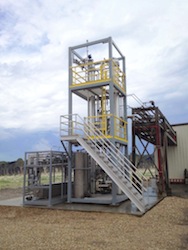
STG+ represents a cost breakthrough for the GTL industry, says the company, as it demonstrates compelling economics at scales of less than 6,000 barrels per day. The patented process is far simpler and more efficient than existing GTL technologies as it Primus STG and reactorstransforms syngas to liquid fuels with only one condensation step and also recycles untransformed gases. These efficiencies result in a high-yield process – STG+ can convert one MMBtu of natural gas into more than five gallons of 90+-octane, drop-in gasoline.

“STG+ is a new, proprietary thermochemical GTL process that fundamentally transforms the efficiency and economics of liquid fuel synthesis technologies,” said Robert Johnsen, CEO of Primus Green Energy. “The allowance of this patent application validates the novelty of the technology we have developed and proven at scale in our research facilities and commercial demonstration plant here in Hillsborough. Further, it greatly strengthens our intellectual property portfolio, an important step as we look toward construction of our first commercial GTL plant.”

In October 2013, Primus successfully commissioned its 100,000 gallon-per-year natural gas-to-gasoline demonstration plant. A recently concluded independent engineers report found that both catalyst performance and STG+ system economics exceeded expectations during demonstration plant operation. The company is now working toward construction of its first commercial plant, which is expected to produce 27.8 million gallons per year of drop-in gasoline from natural gas. The company expects to break ground on the plant in 2014.

advanced biofuels, Biodiesel, biojet fuel, Natural Gas