EPA Chief Discusses RFS With Ag Journalists

Cindy Zimmerman

epa-mccarthyEnvironmental Protection Agency Administrator Gina McCarthy spoke to the North American Agricultural Journalists meeting in Washington DC on Monday and expressed confidence that the final rule for the Renewable Fuel Standard (RFS) will be different than the proposed rule that reduces volume requirements for biofuels in 2014.

According to Agri-Pulse McCarthy said EPA is in the process of reviewing more than 200,000 comments on the RFS proposal and plans to issue a final rule in late spring or early summer.

She stressed that EPA has to make sure the final rule is implementable. “And that means taking into realities of the fuel market. One of those realities is the fuel blend wall.”

Agri-Pulse reports that McCarthy expects the final rule will “almost certainly” be different than the one that was proposed. “Gasoline demand had an impact in the proposal and it will also be reflected in the final rule,” she said.

She also said that EPA expects legal challenges to any RFS standards. “We need to be able to justify it in court,” McCarthy said. With current the current infrastructure, the industry this year would not be able to “get anywhere near” the levels required in the original RFS. “But we think that the industry is stepping up to that challenge,” she said. “We’re going to try to work toward these goals the best we can, but we need to be realistic.”

Read the entire article from Agri-Pulse here.

EPA, Ethanol, Ethanol News, Government

North Dakota Canola for Aviation Biodiesel Explored

John Davis

CanolaCanola from North Dakota farmers could be the next source for biodiesel for aircraft. This story from the Billings (MT) Gazette says researchers in the northern plains have been exploring the oilseed’s possibility to fill aviation fuel tanks since 2011.

The Northern Great Plains Research Laboratory in Mandan is one of eight locations testing different plant products for biofuels. The focus here has been on oilseeds such as canola, rapeseed camelina and mustard — “all crops that grow well in wheat-producing areas,” soil scientist Dave Archer said.

The scientists at Great Plains have just finished their first year of field trials and are waiting for the second round of fall-planted canola to come up, Archer said.

The oilseed varieties are being judged on their economic and environmental impacts, he said. Researchers are trying to find varieties not used for food that fit into existing crop rotations and that improve soil quality…

“It will certainly help the state,” said Barry Coleman, executive director of the Northern Canola Growers.

Coleman said canola is used for biodiesel production in Velva. If the crop could be used as a jet fuel as well, he said, it would gain popularity among farmers.

About 1.8 gallons of biodiesel are already made from canola each year.

Biodiesel

Biodiesel Board Joins EPA, DOJ Against Big Oil

John Davis

scalesofjustice1While the basketball national championship might have been decided on the court, it could be the courts that decide the future of advanced biofuels in this country. The National Biodiesel Board (NBB) joined forces with the Environmental Protection Agency (EPA) and Department of Justice to fight an attempt to dismantle the Renewable Fuel Standard (NBB).

In the current case, Monroe Energy, joined by the American Petroleum Institute and other groups, is challenging the EPA’s handling of the 2013 volume requirements. Among the arguments supporting the EPA’s position, NBB points out that that the petroleum industry’s challenge makes no argument that insufficient volumes of renewable fuels were available in 2013 and fundamentally misinterprets the EPA’s authority to waive volume requirements under the law. NBB maintains that the EPA’s 2013 standards achieved the directives of Congress.

“The renewable fuels industry is united in supporting the RFS to promote production of clean, alternative fuels,” said Anne Steckel, NBB’s vice president of federal affairs. “As the leading producer of Advanced Biofuels in the nation, the biodiesel industry has demonstrated that the Advanced Biofuel standard is working. The simple fact is that we have met or exceeded the Advanced standard in each year of the program, including in 2013 when the RFS delivered more than 3.3 billion RIN-equivalent gallons of Advanced fuels, made up mostly of biodiesel and renewable diesel.”

“Big Oil likes to say the RFS isn’t working, but what’s really broken is the decades-long stranglehold the petroleum industry has on our fuel supplies,” Steckel added.

The U.S. Court of Appeals for the District of Columbia is hearing the case, and NBB says the decision will have tremendous implications for the future of advanced biofuels and affirm the EPA’s obligation to maintain the statutory volumes.

Biodiesel, NBB

BioEnergy Bytes

Joanna Schroeder

  • BioEnergyBytesDFThe Grain Processing Corporation (GPC) has become a member of the Renewable Fuels Association (RFA).
  • It’s not too late to register for the Emerging Issues Forum, hosted by the Nebraska Ethanol Board, taking place in Omaha, Nebraska April 10-11, 2014. Registrants have a chance to win a flex-fuel vehicle. Click here to register and see the full agenda.
  • Genomatica has been named a winner of the 2014 Bloomberg New Energy Pioneers Award for developing process technologies to produce widely-used chemicals from alternative feedstocks rather than petroleum. Genomatica’s processes are designed to produce the exact same chemicals while delivering better economics and a smaller environmental footprint.
  • Lignol Energy Corporation has announced the signing of a formal Memorandum of Understanding between M Energy Co., Ltd. and LEC establishing the framework by which the two companies will work together to restart LEC’s 140 million litre per year biodiesel plant and incorporate M Energy’s proprietary pre-treatment technology. The Parties have been in discussions regarding an investment structure which, if successful, would provide sufficient capital for the Darwin project and an opportunity for M Energy to become an equity partner in the project.
Bioenergy Bytes

Broward County Schools Convert to Propane

Joanna Schroeder

Broward County Public Schools, the nation’s sixth largest school district, has purchased 98 propane autogas fueled school buses. The purchase supports the top 10 school district’s environmental stewardship program, “Learn Green. Live Green.” This is the nation’s largest single order of autogas fueled buses by a school district.

“We’ll be using these buses for our high mileage routes due to the substantial cost and maintenance savings with clean and safe autogas,” said Pat Snell, director of student transportation and fleet services for Broward County Public Schools. “Some of the savings will be funneled directly back into the classroom.”

schoolbusesSnell anticipates the county will see a six-month return on investment for the additional cost of the alternative fuel buses. According to Snell, the county will lock in an autogas fuel price at substantially less than their diesel cost. Historically, autogas costs about 50 percent less than diesel per gallon and reduces maintenance costs due to its clean-burning properties.

According to Snell, each bus will travel about 17,000 miles per year and each bus will displace about 40,000 gallons of diesel and emit 150,000 fewer pounds of carbon dioxide over their lifetime.

“School districts are eager for cleaner, lower emissions solutions that also work with their budgets. The Blue Bird Propane-Powered Vision and Micro Bird meet these needs with lower fuel and maintenance costs, decreased noise and environmental benefits,” said Phil Horlock, president and CEO of Blue Bird Corporation. “We applaud Broward County Public Schools for their forward-thinking leadership in the state of Florida.”

The purchase qualifies Broward County Public Schools to apply for funding through a state rebate program. The Florida incentive waives state taxes for gaseous alternative fuels, which include propane autogas and natural gas.

The school district purchased the buses from Florida Transportation Systems, the authorized Blue Bird dealer in Florida. The Blue Bird Propane-Powered Visions, each equipped with a ROUSH CleanTech fuel system, include a 100-gallon extended range tank that provides a 93-usable gallon capacity. Delivery begins in May for operation for the 2014-2015 school year.

Alternative energy, Propane

Alaska Air Includes Biofuels in Sustainability Plan

John Davis

alaskairAlaska Air Group announced some aggressive sustainability goals for 2020, and part of that includes aviation biofuels. This company news release says the goals and how to get there are outlined in a new report from the airline.

“We believe running our business sustainably—with an eye on the long run—is simply the right thing to do,” CEO Brad Tilden said. “By integrating sustainable practices and policies into our business, we’re making Alaska, and all of the people and communities we work with, stronger and healthier over time.”

Air Group signed an off-take agreement with Hawaii BioEnergy to buy sustainable aviation biofuels from the Hawaiian Islands beginning in 2018. The airline has set a goal of using sustainable biofuels at one or more of its airports by 2020.

Other sustainability measures being implemented by the airline include flying more efficiently to reduce overall fuel use.

biofuels

Minnesota Biodiesel Mandate Faces Uncertain Future

John Davis

mnstatelegis1A delay in Minnesota’s biodiesel mandate could have a ripple effect for more targets in the law’s future. This article in the Mankato Free Press says nearly three years ago, state regulators delayed implementing a B10 mandate scheduled for 2012. Now that officials in Minnesota believe they’re ready for the higher blend, it’s running dangerously close to another target, B20, scheduled for 2015.

That deadline would be extended by three years, to 2018, under a bill from North Mankato Rep. Clark Johnson.

The basic problem with the 2015 deadline is similar to the reasons for the earlier delays: The state just isn’t ready, he said.

The state’s soybean farmers association, Mankato-based Minnesota Soybean, supports the bill, said Mike Youngerberg, its senior director of field services. Another version of the bill, opposed by the association, would have delayed the 10 percent transition and eliminate the 20 percent move entirely. But it failed to pass a Senate committee last month.

Johnson’s bill, too, has an uncertain future — it didn’t pass through its House committees before a March 21 deadline — but he believes it can still pass this year.

Johnson’s bill would also change the summer mandate months from April – October to September. Another provision would allow companies that build generators to test them without biodiesel.

Biodiesel, Government

Oil-Induced Rail Chaos Driving Up Gas Prices

Joanna Schroeder

The railroad industry is America is struggling to keep up with demand and according the Bob Dinneen, president and CEO of the Renewable Fuels Association (RFA), this is negatively affecting deliveries of ethanol and biofuel co-products. In a letter to Ed Hamberger, president and CEO of the Association of American Railroads (AAR), Dinneen sent a list of questions that address the “abject failure of the rail system to adequately address the needs of all of its customers.”

According to Dinneen, U.S. ethanol is the lowest price liquid transportation in the world, saving American consumers between $0.50 and $1.50 per gallon. He writes, “Over the past several weRail car getting filled with ethanol at Patriot Renewable Fuels biorefineryeks, however, the sheer chaos that is today’s rail system is denying consumers that price relief by driving up the transportation cost for and impacting the supply of ethanol and other commodities. Nothing has changed with regard to ethanol production costs or efficiencies. The only change has been abject failure of the rail system to adequately address the needs of all its customers. The U.S. economy is suffering as a consequence.”
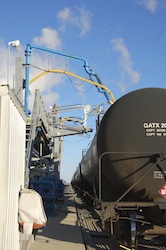
Dinneen says the letter spells out in clear detail the limiting impact the rail situation is having on the ethanol industry. He writes, “In response to increasing demand, the ethanol industry was producing at an average rate of 949,000 barrels per day (bpd) in December 2013. But disarray on the rail system in the first quarter of 2014 has forced ethanol producers to significantly curtail output. By the first week of March 2014, ethanol output had fallen to 869,000 bpd, as producers were forced to slow down. Onsite storage tanks were brimming full and, in many cases, the railcars and/or locomotives needed to ship ethanol were simply not available. As a result, ethanol stocks in key regions have been depleted and prices have increased. All of this is due to the turmoil on the rails—dislocated railcars and locomotives, increased terminal dwell times, slower train speeds, an insufficient number of crews, and a shortage of spare railcars and locomotives.”

The railroad industry has blamed the winter weather as the major problem but Dinneen says this is simply an excuse. “The railroads have attributed this lackluster performance and inefficiency to winter weather. But they seem to have forgotten that winter comes every year!… Indeed, a more plausible explanation for the severity of the current epidemic is the explosive growth in railcar shipments of Bakken and Canadian crude oil.”

Dinneen continues, “The surge in crude oil production from fracking has reshuffled the existing fleet of railcars and locomotives, pressured lease rates, changed normal rail traffic patterns, and generally exerted significant stress on the rail system. According to AAR, crude oil shipments have increased from 9,344 carloads in 2008 to 434,032 carloads in 2013. In addition, AAR data show rail shipments of industrial sand nearly tripled between 2008 and 2013, stating, ‘…frac sand is almost certainly the primary driver behind the increased industrial sand movements on railroads over the past few years.’ It seems absurd to suggest, as some have, that the efficiency of the rail system has been unaffected by the 4545% increase in crude oil shipments and the 170% increase in sand shipments since 2008.”

Click here to view the list of questions and the full letter.

biofuels, Distribution, Ethanol, RFA

Extenders Package Picks up Wind

Cindy Zimmerman

After quite a bit of back and forth, the Senate Finance Committee finally included wind energy in the renewable energy Production Tax Credit (PTC) and Investment Tax Credit (ITC) tax extenders package out of committee this week.

AWEA1“We’re grateful to all the supporters of renewable energy on the Senate Finance Committee,” said Tom Kiernan, CEO of the American Wind Energy Association. “This provides a critical signal for our industry, which has created up to 85,000 jobs and has a bright future ahead, as we grow from 4 percent of the U.S. power grid to an expected 20 percent and beyond, so long as we have a predictable business climate.”

The PTC and the alternate Investment Tax Credit were added overnight to a modified “Chairman’s mark,” after an earlier draft released Monday left them and several other provisions for further negotiation.

They prevailed on a critical 18-6 vote during the committee markup late Thursday morning, on a motion by Sen. Pat Toomey (R-PA) to strip them out. Five Republicans joined the committee’s Democrats in voting down that amendment: Sens. Chuck Grassley (R-IA), John Thune (R-SD), Rob Portman (R-OH), Mike Crapo (R-ID), and John Cornyn (R-TX).

Government, Wind

ACE: Blend Wall Cost Reporting Wrong

Joanna Schroeder

Several recent media reports have reported that the “blend wall” cost refiners nearly $1.35 billion last year. The blend wall is the amount of ethanol that can be blended into the fuel supply. Today is this considered “E10” and for the most part this has been achieved. The next step to hurdle the so called blend wall is to either increase the amount of ethanol Screen Shot 2014-04-04 at 10.59.49 AMblended into the fuel supply, such as E15 which is a voluntary blend (retailers can choose to blend E15 and consumers can choose to purchase E15) or to promote mid-level or higher blends of ethanol such as E85, which can be used in flex-fuel vehicles.

In response to these reports, Ron Lamberty, senior vice president for the American Coalition for Ethanol (ACE) called them “incomplete and misleading”. A recent Reuters article said that was the amount nine companies paid for Renewable Identification Number (RINs), which are credits refiners provide to EPA to prove they bought the amount of renewable fuels required by law. RINs are free to refiners who blend biofuels, while refiners who choose not to blend biofuels can buy RINs from companies that blend more than the law requires.

“Those refiners made a business decision to purchase credits instead of ethanol. Reports aren’t honest if they fail to point out that those nine refiners paid $1.35 billion dollars to other refiners for those companies’ excess RINs.” said Lamberty. “The “blend wall” provided $1.35 billion dollars of income to some refiners, which reduced their cost of fuel.”

Lamberty said ACE would like to see more RINs generated by retailers, since they generally use the additional funds to reduce prices at the pumps. “Unfortunately, at the same time oil companies are complaining about RINs and the “blend wall,” they enforce policies that won’t allow their branded marketers to sell E15 and higher ethanol blends,” Lamberty said. “Station owners who offer E15, E85, and other blends generally sell about 20% ethanol overall, making more RINs available. And when they sell RINs, they pass most of the value of those RINs on to customers in the form of lower pump prices.”

ACE, biofuels, Ethanol, RINS