
 Renewable energy provider Wheelabrator Technologies will provide live online video coverage of its annual youth environmental summit taking place May 5-8, 2014 in Sunrise, Florida. In all, 150 students from 15 schools in the Northeast, Mid-Atlantic and Florida will gather to present their projects to a panel of Wheelabrator employees, educators and environmental experts. A first for the Symposium series, each team presentation will be made available online, enabling schools, family members,friends, and community and business leaders to watch the presentations unfold live Tuesday, May 6. Interested spectators can view the school presentations by logging on to Wheelabrator’s website.
- The American Solar Energy Society (ASES) is accepting nominations for six awards that honors persons making significant contributions to the field of solar, renewable energy and the Society. Award nominees must be a member of ASES and nominations are due May 16, 2014. ASES is also accepting nominations for new Fellows of the Society. Click here for more information on the awards and to submit a nomination.
- Admirals Bank, a leading provider of residential solar and renewable energy lending, has worked with Heatspring Learning Institute to bring an interactive, online training course to residential solar installers across the United States. The online training course, titled Solar Loans vs PPAs: How to Use Simple Solar Loans to Sell More Residential Solar, runs from May 5, 2014 through May 23, 2014. This 3-week online training course was developed by Admirals Bank to provide solar installers and other industry professionals with a comprehensive understanding of how to use residential solar financing to increase sales and home solar installations.
- International renewable energy consultancy Natural Power has further strengthened its services in North America by appointing wind technical professional, Scott McDonald. Formerly of AWS Scientific (AWS Truepower), PPM Atlantic Renewable, Iberdrola Renewables and Ogin, Inc. McDonald joins Natural Power as Head of Energy Assessments in North America.

California Celebrates Geothermal Awareness Day
Today is Geothermal Awareness Day in California and the geothermal industry is participating with several activities throughout the state including Sacramento, the state’s capitol. On this day, the Geothermal Energy Association (GEA) is making a call for people to submit entries for the GEA Honors awards program, which recognizes the contributions made by companies and individuals in the past year that have advanced technology, business and environmental sustainability through the field of geothermal energy.
“There is a growing need to educate Californians about the benefits of geothermal energy, and Geothermal Awareness Day is a great opportunity to make progress on understanding geothermal power,” said Karl Gawell, GEA’s executive director. “May 5 is Geothermal Awareness Day in Sacramento, and GEA is making key information available at its website free to the public to encourage Californians to learn more about the benefits of geothermal to the state.”
Free reports of interest that are available to the public include:
- Report on the State of Geothermal In California, April 2012
- The Values of Geothermal Energy: A Discussion of the Benefits Geothermal Power Provides to the Future US Power System, October 2013 (published jointly with the Geothermal Resources Council);
- Geothermal Energy and Greenhouse Gas Emissions, November 2012
- Geothermal Basics
“It’s amazing to see the success being achieved in the geothermal sector, from cutting edge technology that are bring projects online to valuable research that are bringing us closer to a sustainable future. GEA Honors offers a moment to pause and celebrate the positive developments in the geothermal energy industry,” said GEA Executive Director Karl Gawell.
The deadline for GEA Honors submissions is July 7. Winners of GEA Honors will be announced on August 5 at the National Geothermal Summit at the Grand Sierra Resort & Casino in Reno, Neveda. Click here to view all the categories and to submit a nomination.
NE Energy Event Features Biodiesel Heating Oil
 Attendees of a recent energy, petroleum and HVAC (heating, ventilation, and air conditioning) industry tradeshow in the Northeast U.S. got to hear a lot more about biodiesel used as heating oil, better known as Bioheat. The National Biodiesel Board helped feature the green heating fuel at the Atlantic Region Energy Expo, considered the most significant energy event in that area.
“Our partnership with AREE reflects the successful partnership of the oil heat and biodiesel industries,” explained Paul Nazzaro, Petroleum Liasion for the National Biodiesel Board. “The collaboration between these groups has fueled Bioheat® fuel’s success and provided expanded options for oilheat consumers and new opportunities for small business throughout the Northeast.”
“As the biodiesel industry has grown to more than a billion gallons each of the last three years it has begun to penetrate markets beyond just on-road diesel use,” said Bob Metz, South Dakota Soybean Research and Promotion Council. “Bioheat® fuel is a tremendous opportunity to improve the air quality in home heating with a renewable product. Supporting AREE with the Bioheat® partnership is a great way to take that message direct to the industry.”
Bioheat certainly isn’t a new feature, as experts have been involved with biodiesel blends in heating oil for nearly 20 years. This is the third year that the Atlantic Region Energy Expo and Bioheat have hosted the AREE event.
Biodiesel, Renewable Diesel Imports Hit Record
The U.S. is importing more biodiesel and renewable diesel than ever before. This report from the Energy Information Agency (EIA) says in 2013, the U.S. imported 525 million gallons of the green fuels, compared to just 61 million gallons in 2012.

The strongest driver of the resurgence in U.S. biomass-based diesel demand was the increasing Renewable Fuel Standard (RFS) target. Both biodiesel and renewable diesel qualify for the biomass-based diesel and advanced biofuel targets, as well as the overall RFS target. The total RFS target increased from 15.20 billion gallons in 2012 to 16.55 billion gallons in 2013. The biomass-based diesel and advanced biofuels targets increased from 1.00 billion gallons to 1.28 billion gallons, and from 2.00 billion gallons to 2.75 billion gallons, respectively. Biomass-based diesel fuels have higher energy content compared with ethanol, and thus generate more Renewable Identification Number (RIN) credits per gallon of fuel produced. In addition, renewable diesel meets the same American Society for Testing and Materials (ASTM) standards as petroleum diesel, and is thus not subject to the blending limits imposed on biodiesel.
The report says that domestic production could only partially offset increased U.S. biodiesel consumption. In addition, during the last four months of 2013, Argentine biodiesel was locked out of Europe in that continuing trade dispute, making the South Americans’ fuel available for U.S. consumption.
Ag Subcommittee Hears Pros and Cons of RFS
 The food versus fuel debate arose once again in front of Congress. At last week’s U.S. House Ag Subcommittee hearing in Washington, D.C., opponents and proponents of the Renewable Fuels Standard presented their arguments on the RFS and its impact on the livestock industry.
One of the biggest opponents of the RFS is the poultry industry. Their members argued that ethanol has forced up feed prices that keeps them from expanding operations and fulfilling consumers’ needs to have a cheaper alternative to beef and pork, calling the RFS “broken beyond repair.” But the chief economist at the U.S. Department of Agriculture, Dr. Joseph Glauber, said while ethanol initially did have an impact much bigger factors forced up the price of feed.
“Certainly, the ramp up [in ethanol production] we saw from 2005 to 2010 had a big impact on corn prices, but we also saw a big increase in energy prices, so it’s not the only thing going on,” he told the committee.
In fact, during that same ramp-up period, petroleum prices shot up to record levels, and RFS proponent, Roger Johnson, President of the National Farmers Union, said the agriculture industry should be united for renewable fuels.
“The World Bank found that crude oil is the number one determinant of global food prices. We should reduce our dependance on oil consumption in order to be more food secure, and biofuel production is an excellent way to do that,” adding that pitting the biofuels industry against the livestock growers is counter-productive.
The bottom line, according to Glauber, is that biofuels are important, and they’re here to stay.
“Corn-based ethanol is a vibrant industry and is competitively priced against gasoline, and producers will continue to produce ethanol from corn as long as profit margins are there. And profit margins have been there.”
2012 Ag Census Includes Renewable Energy
 The 2012 Census of Agriculture shows a doubling of on-farm renewable energy production since 2007.
According to the census data released by USDA today, there were 57,299 farms that produced on-farm renewable energy in 2012, more than double the 23,451 in 2007. By far the biggest was solar panels, used on over 36,000 farms. Geoexchange systems and wind turbines each were used on more than 9,000 farms.
For renewable fuels, biodiesel was produced on 4,099 farms and ethanol on 2,397. Small hydro systems were used on about 1300 farms and methane digesters on 537.
The census reveals there are now 3.28 million farmers operating 2.1 million farms on 914.5 million acres of farmland across the United States. Those numbers are all lower than 2007 when the census reported 3.18 million farmers, 2.2 million farms and 922 million acres. The top 5 states for agricultural sales were California ($42.6 billion); Iowa ($30.8 billion); Texas ($25.4 billion); Nebraska ($23.1 billion); and Minnesota ($21.3 billion). Corn and soybean acres topped 50 percent of all harvested acres for the first time.
Census data is available from USDA online and a recording of the webcast release of the census data is here: USDA Releases 2012 Census Data
Results in on 2014 Corn Planting
 Our latest ZimmPoll asked the question, “Is corn planting underway in your area?”
I don’t believe I’m overstating when I say we are all seeing a late spring. After an unusually cold winter, it’s not surprising that it lingered longer then welcome. Our poll held true to this with few in the full swing of planting. Most have just started or are waiting for the ground to cooperate.
Our poll results:
- Full swing – 12%
- Not yet – 20%
- Just started -33%
- Ground not ready – 33%
- Other – 2%
Our new ZimmPoll is now live and asks the question, “What is the MOST important part of sustainability?”
Sustainability is the number one buzzword for all industries these days, especially agriculture, but the definition of the word varies. In general, it means the ability of a process or action to continue indefinitely without draining significant resources. Those resources can include everything from soil and water to inputs and labor. What do you think is most important to the long term sustainability of global agriculture?
Farmers Co-op Breaks Ground on Renewable Fuels Station
Farmers Cooperative Company has broken ground on the future site of its new Mount Ayr, Iowa renewable fuels retail location. The station will offer consumers higher blends of ethanol and biodiesel including ethanol blends E10, E15 as a registered fuel, E30 and E85, as well as biodiesel blends B10, B20 and B99 for jobbers and special use customers.
 “The price of [E10] in Iowa is 17-30 cents below gasoline, so the savings is even greater with higher ethanol blends,” Iowa Governor Terry Branstad told the audience at the groundbreaking ceremony. “I’ve told the EPA, if E15 is offered to give consumers a choice, they will choose cheaper renewable fuels.”
Iowa Secretary of Agriculture Bill Northey told attendees, “For this project, we have a great partnership with [Iowa State University] who will be conducting a study to find out why motorists choose the fuels they do. This is a great opportunity to convince others to make the same type of investment.”
Farmers Cooperative Company was selected to receive $125,000 in funding for the new site from Iowa Governor Terry Branstad’s “Fueling Our Future” program, administered by the Iowa Department of Transportation (IDOT) and the Iowa Department of Agriculture and Land Stewardship (IDALS). In addition, Farmers Cooperative will receive $100,000 in funding from the Iowa Renewable Fuels Infrastructure Program. Construction will begin later this year.
“We congratulate Farmers Cooperative Company on this great event to celebrate the groundbreaking on a true renewable fuels retail location that will provide consumers with greater access to clean, locally-produced ethanol and biodiesel,” added Iowa Renewable Fuels Association Managing Director Lucy Norton. “With the help of Gov. Branstad’s ‘Fueling Our Future’ program and the Iowa Renewable Fuels Infrastructure Program, Iowans will continue to benefit from fuel choice at locations like this one.”
Strata Solar Completes Nine Solar Projects in NC
Strata Solar, has installed nine utility-scale solar projects across North Carolina (NC) using more than $100 million of tax-equity financing provided by a subsidiary of Wells Fargo & Company. When combined, the projects produce enough electricity to power 5,000 homes and were in part made possible by a 35 percent North Carolina Renewable Energy Tax Credit. The power will be purchased by NC utility Progress Energy Carolinas.
 “We are very proud of our ability to invest and build in North Carolina’s rural communities. These projects bring jobs, significant local spend, and an increase in the tax base without the requirement of county dollars which is typical of development projects,” said Markus Wilhelm, Strata Solar’s CEO. “On a number of occasions we’ve witnessed these projects having an impact on attracting additional investors who are looking for business-friendly environments.”
The three largest projects – Bladenboro, Wagstaff and Nash 58 – all exceed six MWs in capacity and provide a significant boost to the local tax base without requiring additional county expenditures on sewer, roads or any other infrastructure.
“As a leading provider of capital in renewable energy and cleantech across the U.S., Wells Fargo is excited to participate in the rapid expansion of solar in the Southeast,” said Barry Neal, Head of Wells Fargo’s Environmental Finance Group. “We are proud to partner with top-tier developers like Strata who share in our commitment to support communities and deploy clean energy.”
Companies Need to Step Up Sustainability Efforts
According to a recent report, while there are pockets of sustainability leadership in the U.S. business community, much more needs to be done. The Ceres and Sustainalytics study found that most companies are merely taking small, incremental steps to address sustainability issues that could impact not only their bottom line, but also the economy and planet.
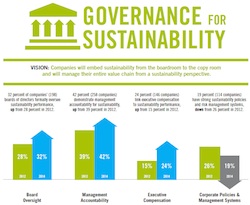 “Given the acceleration of environmental and social challenges globally – floods, droughts, and workplace tragedies – most U.S. corporations are not keeping pace with the level of change,” said Mindy Lubber, president of the sustainability advocacy group, Ceres. “Those that step up to the challenge will be best positioned to thrive in the rapidly changing, resource-constrained 21st century economy.”
The report assesses the sustainability performance of 613 of the largest publicly traded companies in the U.S. and covers nearly 80 percent of the total market capitalization of all public companies in the country. It tracks corporate performance against 20 key metrics essential for any sustainable corporation to follow, including governance, disclosure, greenhouse gas emissions reductions and labor standards. It identifies sustainability trends across eight key sectors, highlighting industry best practices and which companies are leading among their peers. It also provides aggregate data and online scorecards for companies on each performance area. Key findings include:
- While many companies are taking action to reduce GHG emissions, few have set time-bound targets. More than two-thirds of the companies evaluated (438) have activities in place aimed at reducing GHG emissions, but only 35 percent (212) have established time-bound targets for reducing GHG emissions. In terms of renewable energy, 37 percent of companies have implemented a program, while only six percent have quantitative targets to increase renewable energy sourcing.
- More companies are setting clear sustainability standards for suppliers. Fifty-eight percent of companies (353) have supplier codes of conduct that address human rights in supply chains, compared to 43 percent in 2012. However, only a third (205 companies) have some activities in place to engage suppliers on sustainability performance issues, up from 27 percent in 2012.
- A growing number of companies are incorporating sustainability performance into executive compensation packages. Twenty-four percent of companies (147) link executive compensation to sustainability performance – up from 15 percent in 2012.
The metrics used in this report were first spelled out in the Ceres Roadmap for Sustainability, which has been used by dozens of leading companies since 2010 to incorporate sustainability into their business planning and corporate accountability infrastructure.
“The findings of this report should inspire companies to examine their own progress and identify where they stand on the path to sustainability,” said Michael Jantzi, CEO and Founder of Sustainalytics. “This is about more than how companies stack up against their peers – it’s about how innovation is driving performance from the corporate boardroom throughout the entire supply chain.”