New BioJet Program Collaboration in Mexico

Joanna Schroeder

The Mexico’s Sector Fund for Energy Sustainability (SENER-CONACYT) is supporting a new biojet collaboration with Boeing, Aeromexico and Mexico’s Airports and Auxiliary Services (ASA). The goal of the program is to advance research and development of sustainable aviation biofuel in Mexico. The Mexican government and participating institutions will fund the effort for four years, aiming to develop a self-sustaining business model. Research will be conducted on biomass sourcing, fuel production, sustainability and lifecycle assessment, and aviation biofuel market development.

boeing_logoThe project will be coordinated through the Mexican Bioenergy Innovation Center and will support Mexico’s aviation sector as well as help meet the country’s environmental and economic goals.  Executives at Boeing, Aeromexico, ASA and the Potosinian Institute of Scientific and Technological Research (IPICYT) formalized the initiative at a ceremony in Mexico City. In total, there are 17 organizations throughout the world participating in the program.

“To support customers and the aviation industry’s long-term growth, Boeing is proud to partner with Aeromexico and many key stakeholders to move Mexico’s sustainable aviation biofuel industry forward,” said Marc Allen, president, Boeing International. “Sustainable jet fuel will play a critical role in reducing aviation’s carbon emissions and will bring a new and innovative industry to Mexico.”

Aviation biofuel feedstocks will be sourced from Mexico and are expected to include jatropha, salt-tolerant Salicornia and sewage sludge. The initiative’s projects are expected to meet sustainability criteria established by the Roundtable on Sustainable Biomaterials.

“The success of these efforts would not be possible without the team work of Airports and Auxiliary Services (ASA) and our strategic partner Boeing,” said Sergio Allard, Chief of People & Industries Affairs Officer, Aeromexico. In Aeromexico, we recognize that conducting a sustainable operation is an everyday commitment. We are ready to assume the challenge and break the myth that you cannot be socially and environmentally responsible and competitive at the same time.”


aviation biofuels, biojet fuel

Senate Holds #RFS Oversight Hearing

Joanna Schroeder

The U.S. Senate Committee on Environment and Public Works held an oversight hearing on the Renewable Fuel Standard (#RFS). The legislation has been under fire for several years and there are currently several lawsuits surrounding the program: the biofuels industry is suing because the required volumes (RVOs) for 2014, 2015 and 2016 are below what the legislation requires, and Big Oil is suing to reduce RVOs claiming there is not enough advanced gallons in the marketplace. In response to the hearing several ethanol associations stressed the importance of the benefits of the RFS to America.

ace“While we appreciate that the Administration improved the final Renewable Fuel Standard blending targets for 2016 compared to the purposed rule, regrettably, the methodology used to waive volumes for 2016 protects the old way of doing business by obstructing consumer access to cleaner fuels, stifling competition in the marketplace, and undermining innovation,” said Brian Jennings, the Executive Vice President of the American Coalition for Ethanol (ACE). “ACE members have made significant biofuel production advancements because of the RFS and we know that further innovation is within reach if federal policy continues to reward a competitive marketplace. ACE is strongly committed to ensuring consumers have access to high octane, low carbon, affordable blends of ethanol and we will explore all options at our disposal to achieve that goal with this Administration and the next.”

growth-energy-logo1Tom Buis, co-chair of Growth Energy stated, “Homegrown ethanol and the RFS are major wins for the American people. Biofuels, such as ethanol, are a 21st century fuel for 21st century vehicles. It is our only alternative to oil, and the RFS is the most effective policy in reducing cancer-causing chemicals and the toxic emissions that come from oil’s monopoly on our motor fuel supply. The RFS supports consumer choice, creates hundreds of thousands of jobs across America, strengthens our energy security and slashes climate change causing emissions.

“Policies like the RFS improve America’s climate, national security, rural economy and consumer choice. Repealing or changing the RFS would turn back the clock and undermine the progress we’ve made toward increasing America’s energy independence and cleaning our air and environment.”

ACE, biofuels, Ethanol, Growth Energy, RFS

Cellulosic Ethanol Prices Hinges on Feedstocks

Joanna Schroeder

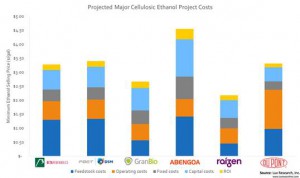
A new study from Lux Research finds innovation is still needed to make advanced biofuels competitive. The report cites six cellulosic ethanol facilities online and finds Raizen has the lowest projected minimum ethanol selling price of $2.17 per gallon. Abengoa’s $500 million Hugoton plant has the highest price of $4.55 with feedstock cost as the most critical variable. (It should be noted the study was conducted before the Hugoton plant was taken offline due to Abengoa’s financial troubles.)

“Improving feedstock aggregationlux research cellulosic ethanol price per gallon and lowering feedstock cost is critical in cellulosic ethanol achieving cost parity, as feedstock cost can impact total cost by 40%,” said Yuan-Sheng Yu, Lux Research Analyst and lead author of the report titled, “Uncovering the Cost of Cellulosic Ethanol Production.”

Lux Research built a comprehensive cost model based on six cellulosic feedstocks and three pre-treatment technologies. Among their findings:

  • Feedstock cost is a key differentiator. Two companies with the lowest projected minimum ethanol selling price – GranBio and Raizen – both utilize the cheapest cellulosic feedstocks. Sugarcane straw and sugarcane bagasse cost $40 and $38 per dry metric ton (MT), respectively, compared with corn stover ($90) used by Abengoa and POET-DSM and wheat straw ($75) used by Beta Renewables.
  • Bigger is far from better. Abengoa’s Hugoton facility cost $500 million but despite getting economic credits for a 21 MW on-site generation unit, it is projected to have the highest projected selling price for ethanol of $4.55 per gallon.
  • DuPont creates new economics. Even without electricity credits, DuPont has a projected selling price of $3.31 per gallon, similar to Beta Renewables and POET-DSM, at its 30 MGY plant. It uses improved feedstock aggregation processes, reducing corn stover from $90 per dry MT to $52 per day MT.

Yuan-Sheng Yu added, “Improvements in pre-treatment yield, enzyme performance and price, and fermentation efficiency potentially reduce costs by up to 16%.”

advanced biofuels, Cellulosic, Ethanol, Research

Do Farm Show Impact Farmers’ Buying Decisions?

Jamie Johansen

New Holland ZimmPollOur latest ZimmPoll asked the question, “What is your favorite social media outlet for agriculture?”

It’s a tie! The two oldest forms of social media, Facebook and Twitter, rose to the top. When it comes to social media marketing in the agricultural field they ring tried and true. I still encourage people to step out of their comfort zones and see what other platforms have to offer. It is 2016 and social media is here to stay. Embrace it!

Here are the poll results:

  • Facebook – 44%
  • Twitter – 44%
  • Instagram – 5%
  • YouTube – 4%
  • Pinterest – 3%

Our new ZimmPoll is now live and asks the question, How important are farm shows to farmers’ buying decisions?

Thousands of farmers and ranchers take in farm shows nationwide. Agribusinesses invest big marketing dollars to share their latest news and info to attendees. We are on the road year-round covering these shows and want to know if they impact buying decisions?

ZimmPoll

Panelists Discuss E15 Revolution, Global Markets

Joanna Schroeder

Panelists discussed the “E15 Revolution” during the Growth Energy Leadership Conference held in Orlando this week. The retailer discussion focused on their efforts to help grow the consumer availability of E15 across the country.

Todd GarnerPanelists included Jim Pirolli, VP Fuels for Kum-N-Go; Mike Lorenz, Executive VP of Petroleum Supply; and Todd Garner, CEO of Protec Fuels.

When discussing the changing marketplace, Lorenz commented that initial sales have exceeded expectations, even before kicking off a marketing campaign around E15. “The consumers are finding it on their own, and sales are increasing.” Pirolli seconded this statement by adding, “When it comes to consumer choice, they’re going to go with a higher performance, better value product.”

To learn more about how retailers are marketing E15, listen to Chuck Zimmerman’s interview with Protec’s Todd Garner, who he saw on a similar panel at the National Ethanol Conference the week before: Interview with Todd Garner, Protec

Another interesting panel discussion took place around “Ethanol on the World Stage”. The discussion focused on the important role that ethanol plays in the global marketplace and the need to take advantage of every opportunity to expand ethanol utilization worldwide. Panelists discussed the importance of trade missions to identify new markets and expand existing opportunities. Also discussed were increased opportunities to export dried distillers grains (DDGs).

The panel was moderated by Ray Defenbaugh, CEO & Chairman of Big River Resources, LLC. Panelists included Paul Trupo, Director of the USDA FAS Global Policy Analysis Division; Joel Williams, Manager of Ethanol Trading at ADM; Mark Marquis, CEO of Marquis Energy, LLC; Amit Sachdev, South Asia Representative (India Bangladesh and Sri Lanka) at the U.S. Grains Council; and Junyang Jiang, Deputy Director of the U.S. Grains Council China World Office.

During the discussion, Ray Defenbaugh stressed the importance of the partnership with the U.S Grains Council, as it is helping create new opportunities across the globe for exports. During the panel, it was announced by Mark Marquis, a board member of Growth Energy, that Growth Energy has set a goal to export at least 2 billion gallons of fuel ethanol by 2022, calling the program, “At Least 2 by 22.”

biofuels, Distillers Grains, E15, Ethanol, Exports, Growth Energy

Goat’s Guts Lead to Better Biofuels

Joanna Schroeder

New research finds that some day your gas tanks could be filled up by horses, sheep and goat’s guts. Researchers looked at how the anaerobic gut fungi, as compared to engineered fungi, were able to convert plant material into sugars that could be converted into advanced biofuels and other biobased materials.

Fungi found in the guts of goats, horses and sheep help them digest stubborn plant material. A team of researchers report in the journal Science that these fungi could potentially lead to cheaper biofuel and bio-based products. Professor of chemical engineering at the University of California, Santa Barbara Michelle O’Malley, was the lead author of the paper. She explained, “Nature has engineered these fungi to have what seems to be the world’s largest repertoire of enzymes that break down biomass.”

Fungi found in the guts of goats, horses and sheep help them digest stubborn plant material. A team of researchers report in the journal Science that these fungi could potentially lead to cheaper biofuel and bio-based products. Image courtesy of Daniele Faieta/Flickr

Fungi found in the guts of goats, horses and sheep help them digest stubborn plant material. A team of researchers report in the journal Science that these fungi could potentially lead to cheaper biofuel and bio-based products. Image courtesy of Daniele Faieta/Flickr

These enzymes — tools made of protein — work together to break down stubborn plant material. The researchers found that the fungi adapt their enzymes to wood, grass, agricultural waste, or whatever they were fed. The findings suggest that gut fungi could be modified so the produce better enzymes that will outperform even the best ones on the market today. With a more effective way to break down biomass, it should led to the development of less expensive biofuels and bioproducts.

O’Malley and her colleagues knew the fungi’s hyphae excrete proteins, or enzymes, break down plant material. The researchers understood that like tools in a toolbox, the more diverse the enzymes, the better the fungi can take apart plants and turn them into food. So the goal was to help develop this fungi toolbox for the bioindustry to use to better break down biomass.

“Despite their fascinating biology, anaerobic gut fungi can be difficult to isolate and study,” said Scott Baker, EMSL’s science theme lead for Biosystem Dynamics and Design, one of the agencies that collaboratively participated in the research. “By utilizing the cutting-edge scientific capabilities at EMSL and JGI, O’Malley showed how the huge catalog of anaerobic gut fungi enzymes could advance biofuel production.”

advanced biofuels, biochemicals, biomass, biomaterials, enzymes, Research

$3.50 May Be New ‘Corn Norm’

Lizzy Schultz

Central_Wisconsin_Ag_Services_LogoThe impact of corn prices varies between producers in different divisions of agriculture, with some producers benefiting from higher prices, and some benefiting from lower prices. Many factors seem to demonstrate that the new long-term “normal” for corn prices may be $3.50 per bushel, and Cody Heller, CEO of Central Wisconsin Ag Services (CWAS), has offered his insight into the cause of the record prices seen in 2012 and why it will be difficult for the markets to sustain prices that high over the next five to ten years.

It was increased demand for corn both for ethanol and exports, combined with a severe drought, that drove prices up in 2012. According to Heller’s report, past high prices and several good yields have led to global stocks of corn, soybeans, and wheat reaching record highs. The changing market for ethanol, however, may seriously impact the resulting demand for those record high supplies. According to USDA, we will not see an increased demand for US corn for ethanol higher than 0-1% from 2016 to 2025. On the global side, China is in a well-documented recession, and the country is forecast to import its lowest level of corn since 2009.

Heller says in order for corn prices to move higher, something would have to happen on the supply side. “This will come from a drought, governmental controls, or a stark increase in global growth and demand to reset global supply,” he says. “The catch-22 here is due to better genetics and better technology, corn yields (with the exception of 2012) have been growing at a pace of about 2-3 bu. per acre annually.”

Read the full report.

Ag group, biofuels, corn, Ethanol, International, RFS

Minnesota Biofuels Promotes E15 to Drivers

Cindy Zimmerman

mn-bio-e15The Minnesota Bio-Fuels Association (MBA) spent an hour Tuesday at a retail station in St. Paul rewarding drivers who fueled up with E15.

The association joined with a local radio station at St Paul’s Tobasi Stop Minnoco to educate drivers and present those who switched to E15 with prizes such as $25 in cash, passes to the Minnesota Zoo and Wild Mountain. The retail station is one of the newest in the Twin Cities to offer E15. There are currently 17 stations in the metro that offer E15.

MBA executive director Tim Rudnicki says the event is the third time MBA has partnered with KS95 FM to educate and increase awareness of the benefits of using E15. “This is the third consecutive month where we have gone to a station with KS95 to directly engage with drivers and educate them on the benefits of using E15. Drivers are interested in using a fuel that has a high octane, is cheaper than regular unleaded gas, better for the environment and beneficial to Minnesota’s economy,” said Rudnicki.

In 2015, a record 3.09 million gallons of E15 was sold in Minnesota, nearly 12 times the amount sold in 2014. The volume recorded in December last was 527,574 gallons, a new monthly record and represented the second straight month in 2015 when E15 monthly sales breached 500,000 gallons.

E15, Ethanol, Ethanol News, Promotion

Tom Buis Delivers the “CEO Report”

Joanna Schroeder

Growth Energy Co-Chair Tom Buis delivered his “CEO Report” yesterday during the Leadership Conference in Orlando, Florida. During his remarks, Buis said, “Last year was an interesting year, we increased exports, had another great corn crop and defeated every single attempt to repeal or reform the RFS.”

The Growth Energy team.

The Growth Energy team.

Buis segued into how the ethanol industry stepped up to the plate to help change the flight of the ball on the renewable volume obligations (RVO’s), or how much biofuels are required to be blended into the nation’s fuel supply. He noted that while the rules remain flawed, it was better than the proposed rules and “the blend wall was finally cracked this year”. In addition he outlined how supporting the Renewable Fuel Standard (#RFS) along with expanding market access to E15 will continue to be top priorities for 2016.

“We need to grab the bull by the horns and discuss all the good work that this industry does, including the environmental benefits, reducing our dependence on foreign oil and all the good jobs we create across the nation, while helping bring choice to American consumers,” continued Buis. Who added in regards to their successes in working directly with retailers to bring E15 to the market, “Our work showed that we were not going to let others define us, we must share our story on how we are tomorrow’s fuel,” noting that “fossil fuels will go the way of the steamboat, horse and buggy and the blimp. Anytime we are compared to the oil industry, we win.”

Buis concluded his remarks by stressing, “I think as an industry, there is no industry that is better. With our knowledge, passion and engagement, we’re going to win this fight, but it’s going to take effort. Effort equals results. We will not sit back, we will roll up our sleeves and we will win.”

Listen to Chuck’s interview with Tom Buis following his CEO Report: Interview with Tom Buis, Growth Energy co-chair

Audio, biofuels, E15, Ethanol, Growth Energy

Auto Industry Veteran Joins RFA

Cindy Zimmerman

A veteran auto industry specialist has joined the Renewable Fuels Association (RFA) as the organization’s new Technical Director.

rfa-kingTracey King, who spent 17 years as a technical specialist with Chrysler, will serve as the RFA’s top liaison to the automakers and will focus on forging the path to future high octane fuels and optimized spark ignition engines.

Previously, King worked in research and development at both Nissan and General Motors and most recently she was with Haltermann Solutions, a manufacturer of test and reference fuels. She also has extensive experience with ASTM and other standards developing organizations.

“Tracey brings an unrivaled wealth of knowledge and experience to the RFA,” said Bob Dinneen, RFA President and CEO. “Tracey’s background in the automotive industry and experience in developing certification fuels position her well to help chart the course toward an ethanol-based high octane fuel that will improve engine efficiency and reduce emissions.”

King will be based in Detroit and will be part of RFA’s research and technical team. “I am excited to join the RFA staff and look forward to working closely with the membership, automakers, regulators, and other stakeholders to help define the future for ethanol and optimized engines,” King said. “RFA has always been viewed as an effective science-based advocate for ethanol, and I am eager to contribute to the advancement of the organization’s technical objectives.”

Ethanol, Ethanol News, RFA