


Recently, I told you about an upcoming episode of MTV’s “Pimp My Ride” where a 1965 Chevy Impala is souped up with a biodiesel engine and blows away a Lamborghini in the quarter mile.
Now, I’ve had a chance to talk to the man behind that Impala, Johnathan Goodwin, co-partner of SAE Energy… a company that specializes in converting gas-guzzlers into lean, green, fuel-efficient biodiesel burners.
When Goodwin met with the producers of Pimp My Ride, they didn’t think the conversion could be done. “I ensured them that I didn’t have any problems whatsoever, and they were kind of taken aback.”
More of a shock would come when Goodwin’s converted 850 horsepower hot rod would face off with a Lamborghini in a quarter-mile race. “Actually, we had to kind of let off the throttle half track, and wait for (the Lamborghini) to catch up so it wouldn’t look bad for TV,” says Goodwin.
And the surprises would continue with how clean the Impala ran. Goodwin says, “at this kind of horsepower level, you’d expect a lot of black smoke out of a diesel engine, but it was very clean. The only black smoke was from the tires.”

Goodwin builds more than just classic muscle cars. He’s also converted a Hummer (pictured above) to run on biodiesel, ethanol, propane, or hydrogen. He’s even working on converting a Jeep for The Terminator himself, California Governor Arnold Schwarzenegger.
The MTV Pimp My Ride special featuring the biodiesel Impala-Lamborghini will air on Earth Day, April 22nd.
Listen to the entire Johnathan Goodwin interview here: 
 The
The  “With an increase in biodiesel production comes a surplus of crude glycerin,” said Mark Honeyman, animal science professor and coordinator of Iowa State’s Research Farms. “And with an increase in ethanol comes higher corn prices. Since corn is fed to pigs primarily for its energy value, we’re studying the possibility of replacing corn with glycerin in swine feed.”
 Kristjan Bregendahl, assistant professor of poultry nutrition, conducted a metabolism experiment with 48 laying hens. Typical feed rations that included corn, soybean meal, meat and bone meal, and four levels of crude glycerin – 0, 5, 10, or 15 percent – were fed to the hens to determine the energy value of the glycerin.
 The
The 
 City buses in Victoria, British Columbia are now running on 5% biodiesel. The
  A new, hydrogen-powered bus has hit the streets of Hartford, Connecticut as a test of the technology that emits nothing but water vapor.
 According to
 The Andersons Marathon Ethanol LLC, a 50/50 joint venture between Marathon Oil Corporation and
 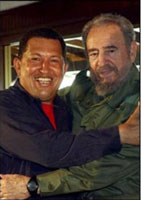 The president of oil-rich Venezuela is campaigning against President Bush’s plan to increase ethanol use in the United States, with the help of his close friend, Cuban President Fidel Castro.
 Meanwhile, Nicaraguan President Daniel Ortega is also criticizing the Bush ethanol “fantasy campaign.”
  The first batch of biodiesel is expected to be ready in one week. Plant manager Russ Read said the production time will be cut to 12 hours once the testing phase is done. “We’ll be going at a slow speed and making sure all the pumps and level sensors work.”