

 Congress’ financial watchdog, the Government Accountability Office, says the U.S. Department of Energy lacks a plan for how to match up increased biofuels production with infrastructure and vehicles to use the green fuels.
 This highlight report on the GAO web site says that America’s reliance on oil poses significant economic and environmental risks. But ethanol and biodiesel could replace oil for transportation fuels. However, the government doesn’t seem to be ready for the challenge:
DOE has not yet developed a comprehensive approach to coordinate its strategy for expanding biofuels production with the development of biofuel infrastructure and production of vehicles. Such an approach could assist in determining which blend of ethanol—E10, E85, or something in between— would most effectively and efficiently increase the use of the fuel and what infrastructure development or vehicle production is needed to support that blend level. In addition, DOE has not evaluated the performance of biofuel-related tax credits, the largest of which cost the Treasury $2.7billion in 2006. As a result, it is not known if these expenditures produced the desired outcomes or if similar benefits might have been achieved at a lower cost.
The report recommends that the Secretary of Energy collaborate with public and private sector stakeholders to develop a plan that coordinates expected biofuel production with gthe infrastructure to get it into the tanks of the vehicles that will need to be built, and coordinate with the Treasury Department to make sure biofuel tax credits and grants are doing what they afre supposed to do.
 Vice President for POET’s Research & Development division, Dr. Mark Stowers, has been tapped to the external advisory committee of the International Center for Advanced Renewable Energy and Sustainability… also known as I-CARES.
  I-CARES will foster institutional, regional and international research on the development and production of biofuels from plant and microbial systems and the exploration of sustainable alternative energy and environmental systems and practices. Funding for the project will include a $55 million investment from Washington University.
 While I was attending last week’s
  Number 17 Team Ethanol car driver Jeff Simmons was a lap leader for five laps at the
 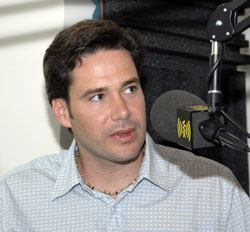 After Joe Jobe, CEO of the National Biodiesel Board did an XM Radio, Dave Nemo Show appearance I got a chance to interview him here at the CMA Music Festival.
 When I traveled to Jay Leno’s Garage recently the EcoJet was still being worked on and we couldn’t take pictures of it. Now it’s out on tour and the latest stop is the CMA Music Festival at the New Holland tent. Jay has a
  The wind generation industry in America breathed a collective sigh of relief when a U.S. Congressman from a coal-producing state pulled a measure that would have effectively killed wind power generation as an alternative to coal-powered plants.
 As his committee began final crafting of the energy package Wednesday, Rahall relented and agreed to support, instead, a less-sweeping measure offered by Rep. Edward Markey, D-Mass. It calls on the Interior Department to develop “guidelines” for protection of wildlife from wind turbines, not regulations.
 Singer Jenny Owen Youngs, known for her music on the Showtime series Weeds, is incorporating some green (different kind of green in this case) in the van she’s using to tour the country.
  Starting next month, all diesel sold in Portland, Oregon will have to have at least a five percent biodiesel content.
 The latest was a station the Quick Sav Food Store in Swartz Creek. That station got about $8,400 to put in the new pumps… one of six stations in Michigan that received about $43,400 in grants to help put in the infrastructure that will get ethanol and biodiesel into the hands (or more accurately, into the tanks) of drivers – check out