

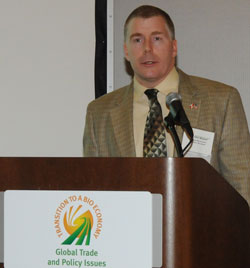
 Biofuels production in Canada will impact meat trading patterns according to research by Al Mussell, George Morris Centre, University of Guelph. He says that the increase in biofuels production will turn the country into an importer of grains instead of an exporter. Al was one of the speakers at the Transition To A Bio Economy Conference.
He says that as you develop an ethanol production system built on feed grains it will seriously impact feeding livestock. That will mean serious adjustments over time. He says that these trends take a while to work themselves out. But in the long run he says we should like the taste of Brazilian beef and pork.
You can listen to my interview with Al here: [audio:http://www.zimmcomm.biz/farm-foundation/ff-global-09-mussell.mp3]
You can download the interview with this link (mp3).
You can find photos from the conference here:
Transition To A Bio Economy Conference: Global & Trade Issues Photo Album
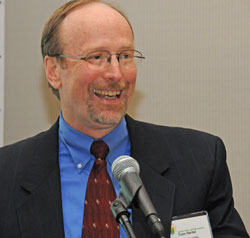 A very interesting presentation at our Farm Foundation Global Trade and Policy Issues conference had to do with the impact on poverty. Tom Hertel, Purdue University, was our presenter.
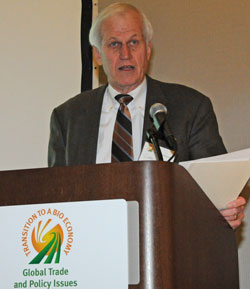 Former Texas Congressman Charles Stenholm was the moderator for our second session here at the Farm Foundation Global Trade & Policy Issues conference. I don’t think you’ll find anyone more knowledgeable about the policy side of this discussion.
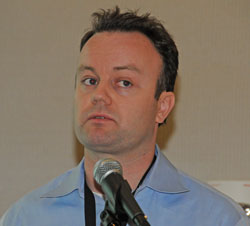 Providing us with a “Technical Global Biofuels Analysis” here at the Farm Foundation Global Trade & Policy Issues conference was Thomas Alfstad, Brookhaven National Laboratory.
 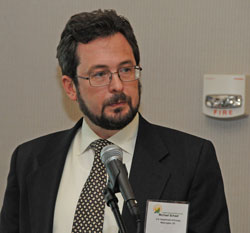 Michael Schaal is with the Energy Information Administration which is part of the U. S. Dept. of Energy. He spoke early on the program at the Farm Foundation conference about the global outlook for energy.
  Both Chrysler and General Motors (GM) reportedly did not meet the terms of their Federal loans but they will be given a second chance to restructure and survive. This news is admist General Motors Chief Executive Rick Wagoner, who led the company for nine years, stepping down at the request of the Obama administration and Chief Operating Officer Fritz Henderson taking over.
 “Let me say this as plainly as I can. If you buy a car from Chrysler or General Motors, you will be able to get your car serviced and repaired just like always,” Obama said in a speech today. “Your warranty will be safe. In fact, it will be safer than it has ever been. Because starting today, the United States will stand behind your warranty.”
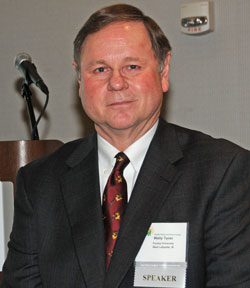 Today and tomorrow I’ll be covering the Farm Foundation,
 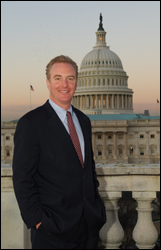 A proposed federally-owned “green bank” could finance many renewable energy projects, getting the credit markets for alternative energy moving again and spurring the burgeoning green economy.
 Keep our friends at